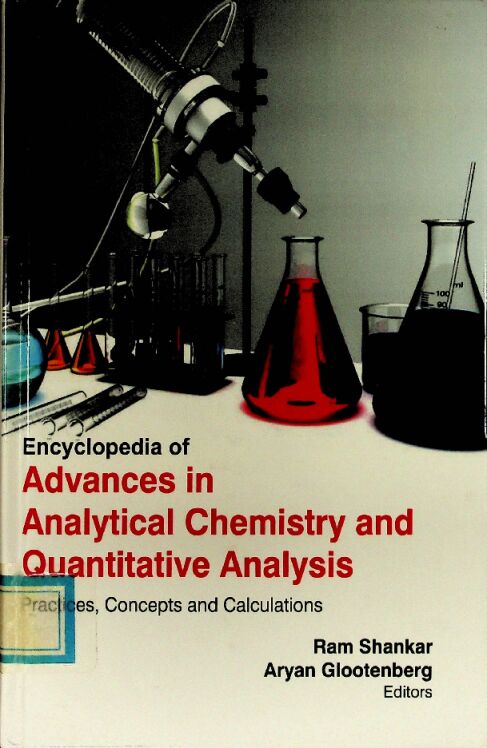
书名:Encyclopedia of advances in analytical chemistry and quantitative analysis
责任者:Ram Shankar | Aryan Glootenberg.
出版时间:2014
出版社:Auris Reference,
前言
Analytical chemistry spans nearly all areas of chemistry but involves the development of tools and methods to measure physical properties of substances and apply those techniques to the identification of their presence and quantify the amount present of species in a wide variety of set tings. If chemis try is the science of stuff, t hen analytical chemistry answers the question. Analytical methods can be separated into classical and instrumentai. Classical methods (also known as wet chemis try met hods) use separations such as precipitation, extraction, and distillation and qualitative analysis by colour, odour, or melting point. Quantitative analysis is achieved by measurement of weight or volume. Instrumentai methods use an apparatus to measure physical quantities of the analyte such as light absorption, fluorescence, or conductivity. The separation of materials is accomplished using chromatography, electrophoresis or Field Flow Fractionation methods. Analytical chemistry is also focused on improvements in experimental design, chemometries, and the creation of new measurement tools to provide bet ter chemical information. Analytical chemistry has applications in forensics, bioanalysis, clinical analysis, environmental analysis, and materials analysis.
Although modern analytical chemistry is dominated by sophisticated instrumentation, the roots of analytical chemistry and some of the principles used in modern instruments are from traditional techniques many of which are still used today. These techniques also tend to form the backbone of most undergraduate analytical chemistty educational labs. Analytical chemistry research is largely driven by performance (sensitivity, selectivity, robustness, linear range, accuracy, precision, and speed), and cost (purchase, operation, training, time, and space). Among the main branches of contemporary analytical atomic spectrometty, the most widespread and universal are optical and mass spectrometry. In the direct elementai analysis of solid samples, the new leaders are laser-induced breakdown and laser ablation mass spectrometry, and the related techniques with transfer of the laser ablation products into inductively coupled plasma. Advances in design of diode lasers and optical parametrie oscillators promote developments in fluorescence and ionization spectrometry and also in absorption techniques where uses of optical cavities for increased effective absorption pathlength are expected to expand. The use of plasma- and laser-based methods is increasing. An interest towards absolute analysis has revived, particularly in emission spectrometry. Analytical chemistry has played critical roles in the understanding of basic science to a variety of practical applications, such as biomedical applications, environmental monitoring, quality control of indu就rial manufacturing, forensic science and so on. The recent developments of computer automation and information technologies have extended analytical chemistry into a number of new biological fields. For example, automated DNA sequencing machines were the basis to complete human genome projects leading to the birth of genomics. Protein identification and peptide sequencing by mass spectrometry opened a new field of ptoteomics. Analytical chemistiy has been an indispensable area in the development of nano technology. Surface characterization instruments, electron microscopes and scanning probe microscopes enables scientists to visualize atomic structures with chemical characterizations.
This book provides updated information on various aspects of this subject. This book will be invaluable to students dealing with this topic.
查看更多
目录
Preface vii
1. Introduction • Inorgasnic Che Mistry • Key Concepts • Industrial Inorganic Chemistry • Transition Metal Carbonyl Clusters • Transition Metal Halide Clusters • Extended Metal Atom Chains • Bioinorganic Compounds • Solid State Compounds • Characterisation • Thermodynamics and Inorganic Chemistry • Coordination Complex • Cis-trans Isomerism and Facial-Meridional Isomerism • Paramagnetism 1
2. Characterisation and Application in Oxygen transfer Reactions • Oxidation of Styrene • Metal Complexes in the Blood for Oxygen Transport • Oxygen Transport via Metal Complexes • Conformational Changes Upon Binding of Oxygen • Spectroscopy and the Colour of Blood • The Effect of CO2 and H+ on O2 Binding • Structure of Coordination Compounds • Isomerism 40
3. Column Chromatography • High-Performance Liquid Chromatography • Types • Bioaffinity Chi'omatography • Parameters • Paper Chromatography • Rf Value • Retardation Factor 77
4. Thin Layer Chromatography • Plate Preparation • Unresolved Complex Mixture • Affinity Chromatography • Supercritical Fluid Chromatography 95
5. Gas Chromatography • Gas Chromatography-Mass Spectrometry • Variations • Environmental Monitoring and Cleanup • Prolate Trochoidal Mass Spectrometre • Ion-mobility Spectrometry-mass Spectrometry • Inverse Gas Chromatography • Surface Energy • Adhesion • Wetting • Real Smooth Surfaces and the Young Contact Angle • Wetting Transition 108
6. Spectrum Analysis •Spectral Power Distribution • Scattering Theory • Example Calculations • The Facts of Light • The Far Ultraviolet Wavelength Range • Atomic Emission Spectroscopy • Molecular Spectroscopy 152
7. Molecular Borromean Rings • Borromean Rings • Triquetra • Link Group • Celtic Knot • Knot Group • Endless Knot • Dynamic Covalent Chemistry • Template Reaction 171
8. Transition Metal • Classification • Characteristic Properties • Ligand Field Theory • Post-Transition Metal • Antiferromagnetism • Exchange Bias • Giant Magnetoresistance • Types of GMR • Magnetoresistance • Anisotropic Magnetoresistance (AMR) • olossal Magnetoresistance • Tunnel Magnetoresistance • Geometrical Frustration • Extension of Pauling's Model: General Frustration • Ising Model • Ferromagnetism 189
9. Photoelectric Flame Photomwtre • Qualitative Inorganic Analysis • Detecting Anions • Glowing Splint Test 235
10. Autocatalytic Reaction • Chemical Reactions • Equations • Elementary Reactions • Chemical Equilibrium • Reaction Types • Reaction Progress NMR • Reaction Calorimetry • Catalytic Kinetics and Catalyst Resting State • Saturation Kinetics • Determining Reaction Stoichiometry • Graphical Rate Laws • Reaction Stoichiometry and Mechanism • Factors Affecting Reaction Rate 243
11. Equilibrium Constant • Types of Equilibrium Constants • Competition Method • pH Considerations (Bronsted Constants) • Derivation from Gibbs Free Energy • Experimental Methods • Computational Methods 273
Bibliography 301
Index 303
查看PDF
查看更多
作者简介
Prof. Ram Shankar heads the Department of Chemistry at the Bangalore Open University. He is a renounced speaker for Chemistry and Quantitative Analysis at the University of Mysore. PA\Dr.Aryan Glootenberg is a PhD in Applied Chemistry and works at the University of Amsterdam as a Faculty of Chemistry. He has written a number of books on Chemistry for graduate and post-graduate students.
查看更多
馆藏单位
中科院文献情报中心