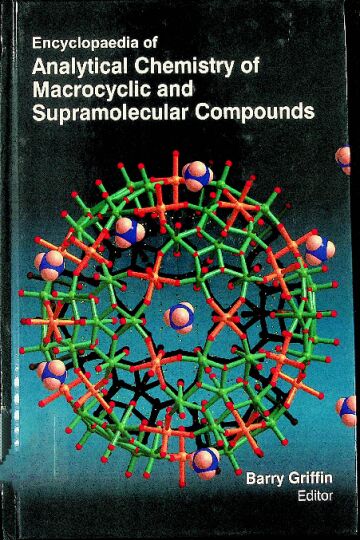
书名:Encyclopaedia of analytical chemistry of macrocyclic and supramolecular compounds. Volume 1, Characterisation and metal complexation chemistry
出版时间:2012
出版社:Auris Reference,
前言
Organic synthesis is usedin the constructionofbiologicalmolecules and drugs,and this department has excellent research links with other departments such as biochemistry, physiology and pharmacy. New methodology is also being developed for the enantioselective synthesis of chiral compounds. Thiosemicarbazones and their metal complexes present a wide range of applications that stretch from their use in analyticalchemistry, through pharmacology to nuclear medicine. The presence of amide,imine and thione groups makes them potential polydentate ligands and it is not surprising that numerous thiosemicarbazone complexes have been prepared and characterized. In addition, in the last few years there has been a growing attention towards thiosemicarbazones related to their range of biological properties,specifically as antifungal,antiviral,antibacterial and anticancer agents.In the present work,we have synthesized thiosemicarbazones ligand and its transition metal complexes, characterized and study their antimicrobial activity.
Chemicalinvestigations on metal complexes of naturally occurring ligand systems and their importance in biology and medicine constitute one of the most dynamic area of modern inorganic chemistry. Biochemicalactivity of many plantchemicals are known to be associated with their ability to form complexes with various inorganic species including metal ions.However,synthesis, characterisation and biological studies of metal complexes of synthetic analogues of many phytochemicals have not received as much attention as they deserve. Importance of 1,3-diketones and metal 1,3-diketonates have been brought out. Coumarin derivatives have found extensive applications in medicine and biology and they are also known for their tendency give coordination compounds with different metallic cations. The complexation behaviour of the transition cations in a different environment is always of interest to inorganic chemists. We have focused our attention in synthesising the coordinative compounds with ligands containing condensed aromatic rings.Such type of ligands are very important in obtaining complexes with an extend π- delocalised electron system wherea donor acceptor bond as the metal-ligand bond is,acts asa push-pull molecular device [3-7].We have coupled the monobasic and bidentate ligand,3-nitrozo-4-hydroxy- coumarine or oxiimidobenzotetronic acid (LH) with another monobasic and bidentate ligand,antranilic acid (LH) in order to obtaina giant planar molecule in a hybride inorganic-organic composition as a π delocalised system.The cations Ni(II),Pd(ID),Pt(II) and Cu(II) were chosen for these coordinative compounds because they easily give coordinative compounds four coordinated. These results are briefly discussed in an attempt to determine the stereochemistry around the cations and the nature of the bonds. The increased activity of the metal chelates can be explained on the basis of chelation theory. It is known thatchelation tends to make the ligand act as more powerful and potent bactericidal agents,thus killing more of the bacteria than the ligand. It is observed that, in a complex, the positive charge of the metal is partially shared with the donor atoms present in the ligands, and there may be π-electron delocalization over the whole chelating. These book are devised for such courses. Separate chapters are devoted for the various analytical techniques._-Editor
查看更多
目录
Preface uii
1. Introduction 1 Inorgasnic Chemistry·Key Concepts·Industrial Inorganic Chemistry·Transition Metal Carbonyl Clusters·Transition Metal Halide Clusters·Extended Metal Atom Chains·Bioinorganic Compounds·Solid State Compounds·Characterisation·Thermodynamics and Inorganic Chemistry·Coordination Complex·Cis-trans Isomerism and Facial- Meridional Isomerism · Paramagnetism
2. Organometallic Compounds 39 Coordination Compounds with Organic Ligands ·Chelation· Scientific Evaluation·National Childhood Vaccine Injury Act
3. Metal Carbonyl 70 Structure and Properties·ChemicalVapourDeposition·Types of Chemical Vapour Deposition·Substances Commonly Deposited forIes· Advantages and Limitations·Atomic Layer Epitaxy·Dual Polarization Interferometry·Ellipsometry·Basic Principles·Experimental Details·Advanced Experimental Approaches·Polarimetry·Hydrogenography·Coating·High-k Dielectric·Low-k Dielectric·Silicon- Germanium·Siliconon Insulator·ElectrostaticSpray Assisted Vapour Deposition ·Ion Plating ·Bubbler Cylinder· Metalorganic Vapour Phase Epitaxy·MolecularBeam Epitaxy· Hydrogen Purifier·Metalorganics
4. Characterisation and Application in Oxygentransfer Reactions 129 OxidationofStyrene·Metal Complexes in the Blood forOxygen Transport ·Oxygen Transport via Metal Complexes·Conformational Changes Upon Binding of Oxygen·Spectroscopy and the Colour of Blood·The Effect of CO,and H+ on O。Binding ·Structure of Coordination Compounds · Isomerism · Typical Ligands
5.Crystal Field Thec 167 The Basics of Coordination Complexes·Structure and Bonding in Transition Metal Complexes·Paramagnetism ofCoordination Complexes ·Hemoglobin·Different Complexes·The Spectrochemical Series·The Enthalpies of Hydration of d- metal Complexes·Charge Transfer Spectra·Ligand Field Spectra·Tetrahedral Coordination Compounds·The Jahn- Teller Effect
6.Metal Complexes of Macrocyclic Ligands 206 New Tetra-Azamacrocyclic Ligands·Macrocycle·Molecular Tethers ·Intermolecular Force·Coomber's Relationship· Polymerization · Non-Chelation Model
Bibliography 259
Index 263
查看PDF
查看更多
馆藏单位
中科院文献情报中心