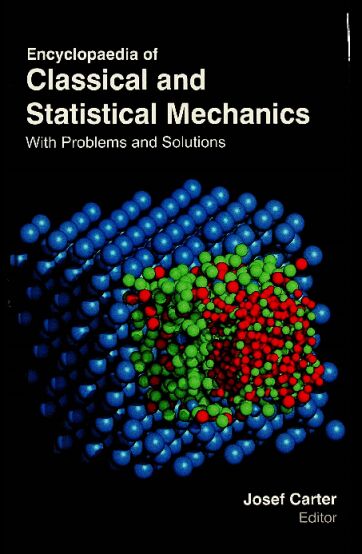
书名:Encyclopaedia of classical and statistical mechanics
出版时间:2012
出版社:Auris Reference,
前言
Quantum numbers describe values of conserved numbers in thedynamics of the quantum syatem.They often describe specifically theenergies of electrons in atoms, but other possibilities include angularmomentum,spin ete.Since any quantum system can have one or morequantum numbers,it is a futile job to list all possible quantumnumbers.The question of how many quantum numbers are needed todescribe any given system has no universal answer,although for eachsystem one must find the answer for a full analysis of the system.The dynamics of any quantum system are described by a quantumHamiltonian,H. There is one quantum number of the systemcorresponding to the energy,i.e.,the eigenvalue of the Hamiltonian.There is also one quantum number for each operator O that commuteswith the Hamiltonian.These are all the quantum numbers that thesystem can have. Note that the operators O defining the quantumnumbers should be independent of each other. Often there is morethan one way to choose a set of independent operators.Consequently.in different situations different sets of quantum numbers may be usedfor the description of the same system.
At the end of the 19th century,physics was considered nearlycomplete. The wave behaviour of electromagnetic radiation was thoughtto be well understood in terms of the theory of James Clerk Maxwell.and a picture of the particulate atom was slowly emerging.Only afew persistent but small problems remained to be cleared up.Thesehave rather esoteric names:the problem of black body radiation:thephotoelectric phenomenon;and the discrete emission and absorptionspectra of atoms.Physicists thought these problems would ultimatelybe solved within the so-called classical framework.Ultimately.however.this proved impossible.Only by introducing the very strange andcompletely unfamiliar idea of quantized energy were they able toprovide explanations for these rogue experiments.In doing so,theychanged forever not only the way that we think about the behaviourof matter at the atomic scale,but the way we think about measurementIn this text,it will not be appropriate for us to discuss the details ofthe explanations of the black body problem and the photoelectrieeffect.Suffice it to say that the idea of quantized energy was firstintroduced by Max Planck in 1900 in his explanation of the black bodyproblem;and the idea of light bundles that we call photons wasproposed by Einstein in 1905 to explain the photoelectric effect.This book presents the basics of classic and statistical mechanicsto the beginner,and at the same time develops the subject with well-chosen examples and worked-out problems right up to the point wherethe student can take up an advanced course with confidence.
查看更多
目录
Preface vii
1.Quantized Atom 1
The Dawn of Quantum Theory·Atomic Spectra·Bohr's Theory of the Hydrogen Atom · Wave Particle Duality-Modern Quantum Theory·The Heisenberg Uncertainty Principle·Periodic Properties Electron Configurations from the Periodic Table
2. Quantum Number 37
Single Electron in an Atom·Elementary Particles ·Quantum Nature of Light and Matter ·Black Body Radiation ·Rayleigh-Jeans-Law ·Wien's Law ·Planck's Law ·Thermal Photon Statistics ·Mode Counting ·Photo-electric Effect ·Spontaneous and Induced Emission
3. Nuclear Fuel Cycle 55
D-T Fuel Cycle·Pinch Devices·Safety and the Environment·Effluents during Normal Operation·Theoretical Power Plant Designs ·Reaction Stoichiometry ·Electron Transfer Reactions· Additional Aspects of Reaction Stoichiometry · Reactions Involving Gases ·Solutions and Concentration·Stoichiometry of Incomplete Reactions ·Oxidation States from Lewis Structures
4. Quantizing Radiation 96
Scattering Theory ·The Time-Independent Description ·The Born Approximation · The Lippmann-Schwinger Equation·The Transition Matrix·The Optical Theorem·The Born Cross-Section from Time-Dependent Theory ·Electrons Scattering from Atoms ·The Form Factor
5.Statistical Thermodynamics 120
Thermal Interaction betwee Macrosystems·Temperature ·Entropy·Entropy and Quantum Mechanics
6. Light as a Wave 148
General Theorems on Rays·Rays of Light ·Polarized Laght·Theories of MacCullagh·Optical Properties of Ponderable Bodies·Wave-surface·Cosmie Rays ·Cosmic Ray Sourees·Composition of Cosmio Rays·Modulation·Detection·Unusual Comic Ray·History of Comic Rays·Effectof Cosmic Rays·Coamic Rays and Fiction·Particles in Cosmic Rays · Coamic Ray Spallation
7.Photophysical Radiationless Transitions 191
Photophysical Radiationless Transitions as a Form of Electronic Relaxation ·A Classical Interpretation of RET as the Motion of a Representative · Wave Mechanical Interpretation of
Radiationless Transitions between States ·Radiationless Transitions and the Breakdown of the Born-Oppenheimer·Crucial Geometries Along the Excited State Reaction Coordinate ·Visualization of Radiationless Transitions Promoted by Vibrational Motion;Vibronic Mixing·Visualization of Radiationless Transitions Promoted by Spin-Orbit Coupling · The Relationship of Rates and Efficiencies of Radiationless Transitions to Molecular Structure·Radiationless Transitions between "Matching" or Adiabatic Surfaces ·Factors that Influence the Rate of Vibrational Relaxation·The Relationship of Internal Conversion to Excited State Structure of *R
8. Effects of Ionizing Radiation 218
Natural versus Induced Radioactivity · Nuclear Fission and Nuclear Fusion · Nucloar Synthesis and Nuclear Medicine·Radiation Therapy + Mechaniam of Action·Side Effects ·Acute Side Effects ·Medium and Long-term Side Effects ·Cumulative Side Effects·Dose·Fractionation·Types of Radiation Therapy ·Conventional External Beam Radiotherapy ·Virtual Simulation,3-dimensional Conformal Radiotherapy and Intensity-modulated Radiotherapy
9. Interaction of Light and Matter 246
The Quantized Atom·The Absorption of Light by Atoms and Molecules ·Molecular Motions and Energy ·Nuclear Magnetis Resonance-Eapin ·Spin-spin Splitting-A Closer Look·Infrared Spectroscopy--Evibration·Etranalation.Erotation Evibration ·Punctional Group Analysis and Fingerprinting· Electron Motion in Molecules--Eelectrons · Pauli Exclusion Principle ·Dirae wave Equation · Quantum Entanglement :Interpretations · Relativity and Quantum Mechanics Attempts at a Unified Theory ·Quantum Mechanies and Classical Physics ·Mathematical Formulation ·Interaction with Other Scientifie Theories
Bibliography 283
Index 287
查看更多
馆藏单位
中科院文献情报中心