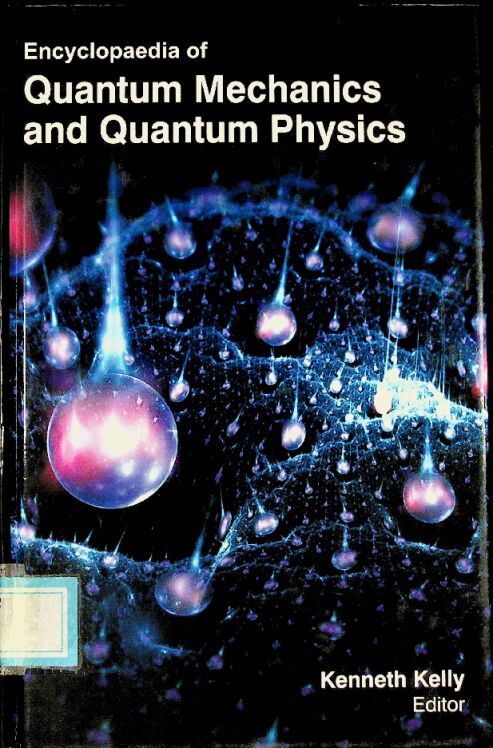
书名:Encyclopaedia of quantum mechanics and quantum physics. Volume 3, Elements in quantum physics
出版时间:2012
出版社:Auris Reference,
前言
Quantum physics or quantum theory, is a branch of physics dealing with physical phenomena where the action is of the order of Planck constant; quantum mechanics departs from classical mechanics primarily at the atomic and subatomic scales, the so-called quantum realm. It provides a mathematical description of much of the dual particle-like and wave-like behaviour and int eractions of energy and mat ter. In advanced topics of quantum mechanics, some of these behaviors are macroscopic and only emerge at very low or very high energies or temperatures. The name "quantum mechanics” derives from the observation that some physical quantities can change only by discrete amounts, or quanta in Latin. For example, the angular momentum of an elec tron bound to an atom or molecule is quantized. In the cont ext of quantum mechanics, the wave—particle duality of energy and matter and the uncertainty principleprovide a unified view of the behaviour of photons, electrons and other atomic-scale objects.
The mathematical formulations of quantum mechanics are abstract. A mathematical function called the wavefunction provides information about the probability amplitude of position, momentum, and other physical properties of a particle. Mathematical manipulations of the wavefunction usually involve the bra-ket notation, which requires an understanding of complex numbers and linear functionals. The wavefunction treats the object as a quantum harmonic oscillator and the mat hematics is akin to that of acoustic resonance.
The early quantum theory was significantly reformula ted in the mid-1920s by Werner Heisenberg, Max Born, Wolfgang Pauliand their associates, and the Copenhagen interpretation of Niels Bohr became widely accepted. By 1930, quantum mechanics had been further uniRed and formalized by the work of Paul Dirac and John von Neumann, with a greater emphasis placed on measurement in quantum mechanics, the statistical nature of our knowledge of reality and philosophical speculation about the role of the observer. Quantum mechanics has since branched out into almost every aspect of 20th century physics and other disciplines such as quantum chemistry, quantum electronics, quantum optics and quantum information science. Much 19th century physics has been re- evaluated as the classical limit of quantum mechanics, and its more advanced developments in terms of quantum field theory, string theory, and speculative quantum gravity theories. The history of quantum mechanics dates back to the 1838 discovery of cathode rays by Michael Faraday. This was followed by the 1859 statement of the black body radiation problem by Gustav Kirchhoff, the 1877 suggestion by Ludwig Boltzmann that the energy states of a physical system can be discrete, and the 1900 quantum hypothesis of Max Planck. Planck's hyp ot he sis that energy is radiated and absorbed in discrete “quanta”,or “energy elements", precisely matched the observed patterns of black body radiation. The foundations of quantum mechanics were established during the first half of the twentieth century by Niels Bohr, Werner Heisenberg, Max Planck, Louis de Broglie, Albert Einstein, Erwin Schrodinger, Max Born, John von Neumann, Paul Dirac, Wolfgang Pauli, David Hilbert, and others. In the mid-1920s, developments in quantum mechanics led to its becoming the standard formulation for atomic physics. In the summer of 1925, Bohr and Heisenberg published results that closed the nOld Quantum Theory”. Out of deference to their dual state as particles, light quanta came to be called photons (1926). From Einsteins simple postulation was born a flurry of debating, theorizing and testing. Thus the entire field of quantum physics emerged, leading to its wider acceptance at the Fifth Solvay Conference in 1927. While quantum mechanics traditionally described the world of the very small, it is also needed to explain certain recently investigated macroscopic systems such as superconductots and superfluids. Some fundamental aspects of the theory are still actively studied. Quantum mechanics is essential to understand the behaviour of systems at atomic length scales and smaller. For example, if classical mechanics governed the workings of an atom, electrons would rapidly t ravel to wards and collide with the nucleus, making stable atoms impossible. However, in the natural world the electrons normally remain in an uncertain, non- deterministic "smeared” (wave—particle wave function) orbital path around or through the nucleus, defying classical electiomagnetism.
The book presents a comprehensive introductoiy treatment, ideally suited students of physics and engineering courses. The book covers basic principles and applications of quantum mechanics.
查看更多
目录
Preface vii
1. Observation with Classical Physics Balmer Series • Wheeler—Feynman Absorber Theory • The Problem of Self-Interaction and Damping • Wigner's Classification • Photoelectric Effect • The Gold-Leaf Electroscope • Photoelectron Spectroscopy 1
2. Interpretations of Quantum Mechanics Historical Background • The Nature of Interpretation • Problematic Status of Interpretations • Instrumentalist Interpretation • The Copenhagen Interpretation • Relational Quantum Mechanics • Coherence • Philosophical Problems of Quantum Measurements • Experimental Observations • Heisenberg's Entryway to Matrix Mechanics • Consequences • Heisenberg Picture • Mat hematical Details • Commutator Relations • Interaction Picture • Many-worlds Interpretation • Measurement Problem • Quantum Zeno Effect • Molecular Orbital • Bonding in Molecular Orbitals • Heteronuclear Diatomics 22
3. Mathematical Formulation of Quantum Mechanics Old Quantum Theoiy and the Need for New Mathematics • The New Quantum Theoi-y • Mathematical Structure of Quantum Mechanics • The Relative St ate Interpreta tion • P-adic Quantum Mechanics • The Research • Path Integrals • Veneziano Amplitude • Representation Theoiy • Quantum Cosmology • Philosophy of Information • Computing and Philosophy • Philosophy of Physics • Philosophy of Space and Time • Einstein on the Importance of the Philosophy of Physics • Probability Amplitude • Quantum Chaos 95
4. Semiclassical Methods Periodic Orbit Theory • Excited State • Orthonormal Basis • Existence • Stationary State • W State • Field Electron Emission • Practical Applications: Past and Present • Field Electron Spectroscopy (Electron Energy Analysis) • Field Electron Emitters as Elec tron-gun Sources • Large-Are a Field Emission Sources: Vacuum Nanoelectronics • Fowler-Nordheim Tunnelling 136
5. Motive EnergyEscape Probability • Decay Width • Equations for Cold Field Electron Emission (CFE) • Zero-Temperature Form • Physically Complete Fowler-Nordheim-Type Equation • CFE Theoretical Equations (i-V Forms) • Fowler-Nordheim Plots and Millikan- Lauritsen Plots • Further Theoretical Information • Field Emission Microscopy • Field Emitter Array 161
6. Virtual ParticleProperties • Manifestations • Virtual Particles in Feynman Diagi-ams • Cyclotron • Mathematics of the Cyclotron • Gyr ot ron• Klystron • Travelling-Wave Tube • Travelling-wave-tube Amplifier • Crossed-Field Amplifier • Backward Wave Oscillator• Free-Electron Laser • Maser • Laser 189
7. Laser PhysicsContinuous and Pulsed Modes of Operation • Continuous Wave Operation • Pulsed Operation • Q・Switching • Beamline• Cyclotron Radiation • Synchrotron Light Source• Experimentai Techniques and Usage • Electron Cyclotron Resonance • Gyroradius • Particle Accelerator 235
Bibliography 281
Index 285
查看PDF
查看更多
馆藏单位
中科院文献情报中心