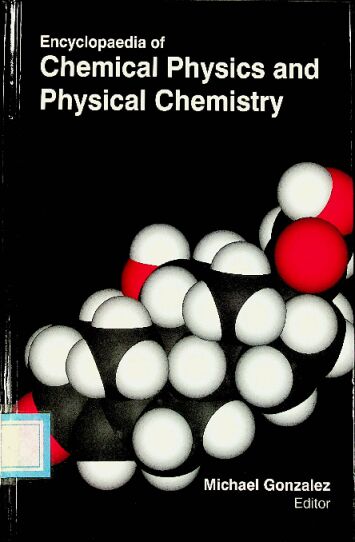
书名:Encyclopaedia of chemical physics and physical chemistry. Volume 1, Introduction to quantum mechanics
出版时间:2012
出版社:Auris Reference,
前言
Having decided on our topic to model, the first stage is to recap on the principles that surround the mechanics that will govern the behaviour of our experiments. The fundamental "quantity of motion" of an object is the product of its mass and velocity. This quantity of motion is called momentum. Newtons experimental evidence showed that for two particular colliding particles, the separation speed was always the same fraction of the approach speed. This implies that separation speed = e x approach speed. The value of e affects the elasticity of the collision.
The average velocity during that time interval is defined as Average velocity=change in position divided by the time. Note that, as with the position, the velocity is a vector: it has a magnitude and a direction associated with it. For example, if someone travels from Toronto to Vancouver by airplane in three hours, their average velocity for that trip is 3000 km divided by 3 hours, or 1000 km/hr, due east. Sometimes only the magnitude of the velocity is of interest. It is called the speed. The average speed for the above trip from Toronto to Vancouver is 1000 km/hr. No direction need be specified. Note that objects moving with a large speed change their position quickly over time, whereas those moving with a small speed take longer to cover the same distance. The average velocity only depends on the initial and final points of the travel-it knows nothing of the details of the motion between these points. For this reason one introduces the concept of instantaneous velocity, which applies to a single point, or time of the motion. The instantaneous velocity is defined as follows. Suppose one wants to define the instantaneous velocity at a certain point, say A along the journey.
We have traversed the realms of physical research as rapid travelers. Since we failed to take along the heavy weapons of mathematics, we have been limited, so to speak, to the role of a civilian war correspondent in the land of physical research who must be content to draw some mood pictures of the events there without seriously pursuing the strategical and technical problems.
We passed by rich departments of knowledge, varied and beautiful in their content. To omit consideration of the thought structures in which modern physical thought triumphs over the apparently hopeless paradoxes and difficulties which were evidenced in quantum physical experiments would require still greater decision. It is not possible to relate and explain here the heavy weight of experimental quantitative proof of the content and mathematical laws of modern quantum theory; a clarification of the philosophical-logical character of this theory by intimation must suffice. But even for that the author, who wants to make it more easily accessible to the reader, must request special attention.
The book seeks to serve as a practical guide to enable students to grasp the latest in chemical physics and physical chemistry.
查看更多
目录
Preface vii
1. Quantum Theory 1
Wave Mechanics • Objectivity • Complementarity
2. Quantum Gravity 17
Orbits Work • Theory of General Relativity • The Flow of Spacetime • The Einstein Field Equations • Quantu m Equilibrium ·Free Body Diagram • Gravity and Gravitational Force
3. Atomic Bonding and Quantum Dynamics 39
Ma tter and Atoms • Liq uid s • Speculative Atomism • Rutherford’s Model • Bohr’s Model • Multielectronic Atoms • Decay • Reaction of Division • Radioactivity
4. Dynamics of Mechanics 112
Principles of Mecha nics • Motion • Trajectory • Force ·Equilibrium • Inertia ·Mass • Rigid Body • Newton’s Laws of Motion • Principle of Work and Energy • Principle of Conservation of Energy • Parallelogram Laws • Newton’s Law of Gravitation
5. Equations and Reactions 152
Chemica l Changes • Chemical Symbols • Chemical Formulas • Chemical Equations • Chemical Energetics • Chemical Rates and Mechanisms • Chemical Equilibrium • Chemical Synthesis • General τ'ypes • Insrtion • Isomerization • Examples of Chemical Changes • Balancing Equations • Balancing Ionic Equations ·Balancing Equations • Balancing Bmning Reactions • Balancing by Overview • Types of Common Ionic Reaction • Double Replacement Reactions
6. Molecular Substance 185
Alcohol and Drug • Anthropological Work on Alcohol • Mind altering Plants in Societies • Emerging Directions for The Futm·e ·Lewis Structm·es of Molecules
7. Photoreactions 229
IR Spectroscopy • Acyclic aliphatic carbonyl groups
8. Photophysical Radiationless 266
Electronic Relaxation [mh]
Bibliography 291
Index 295
查看更多
馆藏单位
中科院文献情报中心