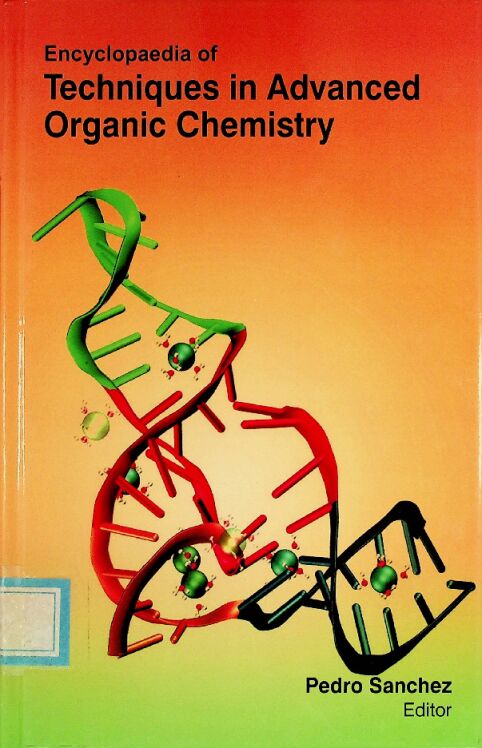
书名:Encyclopaedia of techniques in advanced organic chemistry. Volume 3, Reactions and mechanism in organic chemistry
出版时间:2012
出版社:Auris Reference,
前言
Organic chemistry has a strong tradition of naming a specific reaction to its inventor or in ven tors and a long list of so-called named reactions exists, conservatively estimated at 1000. A very old named reaction is the Claisen rearrangement (1912) and a recent named reaction is the Bingel reaction (1993). When the named reaction is difficult to pronounce or very long as in the Corey・House・Posner- Whitesides reaction it helps to use the abbreviation as in the CBS reduction. The number of reactions hinting at the actual process taking place is much smaller, for example the ene reaction oraldol reaction. Another approach to organic reactions is by type of organic reagent, many of them inorganic, required in a specific transformation. The major types are oxidizing agents such as osmium tetroxide, reducing agents such as Lithium aluminium hydride, bases such as lithium diisopropylamide and acids such as sulfuric acid. Factors governing organic reactions are essentially the same as that of any chemical reaction. Factors specific to organic reactions are those that determine the stability of reactants and products such as conjugation, hyperconjugation and aromaticity and the presence and stability of reactive intermediates such as free radicals, carbocations and carbanions.
An organic compound may consist of many isomers. Selectivity in terms of regioselectivity, diastereoselectivity and enantioselectivity is therefore an important criterion for many organic reactions. The stereochemistry of pericyclic reactions is governed by the Woodward- Hoffmann rules and that of many elimination reactions by the Zaitsev's rule. Organic reactions are important in the production of pharmaceuticals. In a 2006 review it was estimated that 20% of chemical conversions involved alkylations on nitrogen and oxygen atoms, another 20% involved placement and removal of protective groups, 11% involved formation of new carbon-carbon bond and 10% involved functional group interconversions. There is no limit to the number of possible organic reactions and mechanisms. However, certain general patterns are observed that can be used to describe many common or useful reactions. Each reaction has a stepwise reaction mechanism that explains how it happens, although this detailed description of steps is not always clear from a list of reactants alone. Organic reactions can be organized into several basic types. Some reactions fit into more than one category. For example, some substitution reactions follow an addition-elimination pathway. This overview isnt intended to include every single organic reaction. Rat her, it is intended to cover the basic reactions. Organic reactions can be categorized based on the type of functional group involved in the reaction as a reactant and the functional group that is formed as a result of this reaction. For example in the Fries rearrangement the reactant is an ester and the reaction product an alcohol.
The book provides authoritative and critical assessments of the many aspects of organic chemistry. This text is especially written with these students in mind. The language is simple explanations clear and presentation very systematic. These will prove essential reading for organic chemistry students at the upper undergraduate level.
查看更多
目录
Preface vii
1. Covalent Bonding Valence • Polar Covalent Bonds • Functional Groups • The Shape of Molecules • Isomers • Distinguishing Carbon Atoms • Formula Analysis • Resonance • Orbitals 1
2. Additional Hydroxyl Substitution Methods Methods for Hydroxyl Substitution Reactions of Alcohols • Ether Protective Groups • Silyl Ethers • Aldehydes and Ketones • Nomenclature of Aldehydes and Ketones • Occurrence of Aldehydes and Ketones • Synthetic Preparation of Aldehydes and Ketones • Properties of Aldehydes and Ketones 23
3. Reactions of Aldehydes and Ketones Reversible Addition Reactions • Enamine Formation • Other Carbonyl Group Reactions • Carboxylic Acids • Physical Properties and Acidity • Preparation of Carboxylic Acids 34
4. Reactions of Carboxylic Acids Reduction amd Oxidation Reactions • Derivatives of Carboxylic Acids • Reactions of Carboxylic Acid Derivatives • Addition to Carbon 一 Hetero Double Bonds • Carbonyls 54
5. The Reaction of Aldehydes and Ketones with Hydrogen Cyanide The Facts • Hemiacetals, Hemiketals, and Hydrates • Acetals and Ketals • N-glycosidic Bonds • Dependence of Ionization on pH • pOH • Some Typical pH Values • Calculations of pH 70
6. The Halogenation of Benzene Halogenation of Organic Compounds • Fluorination • Chlorination • Chloramination • Water Fluoridation • Sodium Hypochlorite • Packaging and Sale • Reactions 104
7. Mechanism of Disinfectant Action Safety • Trichloroisocyanuric Acid • Dichloroisocyanuric Acid • Haloalkane • Haloalkane Nomenclature • Free-Radical Halogenation • Aryl Halide • Haloketone • Haloketone Reactions • Halomethane • Hydrofluoro Compounds (HFC) • Chemical Building Blocks • The Electrophilic Substitution Reaction between Benzene and Chlorine or Bromine 134
8. The Sulphonation of Benzene The Electrophilic Substit ution Reac tion bet ween Benzene and Sulphuric Acid • Electrophilic Substitution into Already Substituted Benzene Rings • The Nitration of Methylbenzene • Electrophilic Substitution in Nitrobenzene • The Benzene Ring • The Halogenation of Benzene • Substitution Reactions • Substitution into the Ring • The Electrophilic Substitution Reaction between Benzene and Chlorine • Electrophilic Fluorination • The Need for a Catalyst 167
9. Factors Influencing Reaction Rate Catalysts • Bond Type • Concentration of Reactants • Concentration of Reactants • Pressure • Catalyst • Nature of Reactants • Orientation of Reacting Species • Surface Area • I ntensity of Light • Nature of Solvents • Operational Definition of Bases • Conceptual Definition of Acids and Bases • Bronsted- Lowery Theory • Behaviour of Species in Aqueous Solution • Electrolytes • Hodgkin-Huxley Model • Basic Components • Ionic Current Characterisation • Counterion 197
Bibliography 241
Index 245
查看PDF
查看更多
作者简介
Pedro Sanchez did his Ph.D.in2002 and Postdoctoral Fellow in 2002-2004.He is chief researcher in American Research Center. His research program is focused on the synthesis and characterization of novel polymeric and composite materials, with an emphasis on the control of nanoscale structure.Recent developments in polymer and colloid chemistry offer the synthetic chemist a wide range of tools to prepare well-defined, highly functional building blocks.
查看更多
馆藏单位
中科院文献情报中心