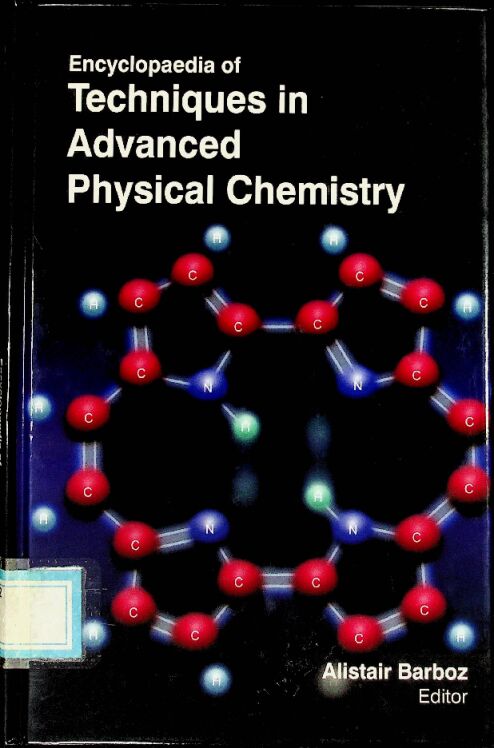
书名:Encyclopaedia of techniques in advanced physical chemistry. Volume 2, Applied physical chemistry
ISBN\ISSN:9781781540527,1781540527
出版时间:2012
出版社:Auris Reference,
前言
Absorption, reflection, scattering, polarization and dispersion of ligh t by a mat erial medium can all be explained in terms of the atoms, molecules and lattice structures which make up the medium. This section will concentrate on the mechanisms by which electromagnetic radiation is absorbed by mat ter.Absorption of radiation by mat ter always involves the loss of energy by the radiation and a gain in energy by the atoms or molecules of the medium. The energy of an assembly of atoms consists partly of thermal energy and partly of internal energy associated with the binding of the extra-nuclear electrons to the nucleus and with the binding of the particles within the nucleus itself. Molecules have, in addition, energy associated with the oscillations of the atoms within the molecule with respect to one another, and solids have energy associated with intermolecular bonds. The energy absorbed from radiation appears as increased internal energy or as increased vibrational energy of interatomic or intermolecular bonds.
In classical electromagnetic theory, atoms and molecules are considered to contain electrical charges which are regarded as oscillating about positions of equilibrium, each with its appropriate natural frequency, o, When placed in a radiation field of frequency ,each oscillator in the atom or molecule is set into forced vibration with the same frequency as that of the radiation. If « o or » o , the amplitude of the forced vibration is small, but as approaches the amplitude of the forced vibration increases rapidly. To account for the absorption of energy from the radiation field, it is necessary to assume that the oscillator in the atom or molecule must overcome some frictional force proportional to its velocity during its forced motion. For small amplitudes of forced oscillation, when is very different from o, the frictional force, and therefore the absorption of energy, is negligible. Near resonance, the amplitude of oscillation becomes large, with a correspondingly large absorption of energy to overcome the frictional force. Therefore, the radiation of frequencies near the natural frequency of the oscillator corresponds to an absorption band.
Identification of astronomical dust is usually achieved by comparing the observed spectral data with a catalogue of laboratory spectra of materials considered to be similar to those found in the astronomical dust. A computer programme can be used to make correlations bet ween the reference spectra and the observed spectra, however there are limitations to this technique. In order to compare the laboratory and observed spectra they need to be of similar type, i.e. t ransmission spectra of very fine particulate mat erials. Many of the available spectra are obtained from samples for which no attempt has been made to simulate the possible conditions in the observed astronomical dust. One of the reasons for this is that the laboratories want to optimize the surface conditions of the sample to yield the maximum amount of spectral information. Also, the applications to which infrared spectra are put are diverse and therefore the collection of such spectra uses many different techniques, producing different types of spectra, according to the application. A complete understanding of the transmission and reflection properties of both particulate and bulk media is imperative for the correct interpretation of the spectral data.
The book integrates theoretical chemistry teachings with industrial and laboratory practice, providing a realistic grounding for future practising chemists and engineers.
查看更多
目录
Preface vii
1. Chemistry of Continental Solids The Structure of Silicate Minerals • Weathering Processes • Clay Minerals • Soil Formation • Ion Exchange • Soil pH • Soil Structure • Spodosol • Contaminated Land 1
2. Electron Transfer Chemical Reactivity • Physical Properties of Acids and Bases • The Bronsted Concept • Strengths of Acids and Bases • Simple Calculations Involving Acid and ase Equilibria • Net Ionic Equations • Recognition of Species • Distribution Diagrams • pH Titration • Range of Acid Strengths in Water • Buffer Solutions • The Lewis Concept • Applications of the HSAB Principle 34
3. Stoichiometry Reaction Stoichiometry • Electron Transfer Reactions • Aspects of Reaction Stoichiometry • Solutions and Concentration • Stoichiometry of Incomplete Reactions • Oxidation States 99
4. Solids Physical Optics • Electrical Properties of Matter • Refractive Indices of Material • Scattering • Mie Theory • Determination of Optical Constants • Laboratory Spectrum • Thin Film vs. KBr- dispersion Spectra 123
5. Structure of Solids Amorphous Solids • Minerals • The Lattice • Bravais Lattices • Electrons in Metals • Unit Cell • Symmetry • Classification of Crystals by Symmetry • Crystal Systems • Crystallography and Crystal Defects • X Ray Crystallography • Braggs Law • Crystals and X-rays • Generation of X-Rays • Electromagnetic Spectrum • X-Ray DifiEraction • Scanning Tunneling Microscope (STM) • Challenges for STM • Uses and Capabilities of STM • Single-crystai X-ray Diffraction • Ci*ystallization • Theory of DifEraction • X-ray Powder Diffraction • Monochromatic X Ray 141
6. Metals Alkaline Earth Metals • Carbon Silicon Group • Pnictogens • Chalcogens • Noble Gases • Transition Metals • Nomenclature • History • Group 1 (Alkali Metals)・ Reactions of the Group 1 Elements with Water • Reactions with Air or Oxygen • Rubidium and caesium • The Hydroxides • Electrolysis • Flame Tests • Group 2 (Alkaline earth metals) • Electronegativity • Calcium, Strontium and Barium • The Reactions with Oxygen • Solubility 191
7. Heat Transfer Energy • Heat and Work • Enthalpy • Energy Ideas to Chemical Reactions • Processes • Energy and Chemical Bonds 235
Bibliography 265
Index 269
查看PDF
查看更多
作者简介
Alistair Barboz has recently joined as Junior Professor in Chemistry Research Institute(CRI), Sydney.His research areas have centred around Electro-organic synthesis throughout his career. Fluorine electrochemistry,especially electrochemical fluorination has been the major area of current interest to him. He has published 36 original and review papers in the areas of chemistry.
查看更多
馆藏单位
中科院文献情报中心