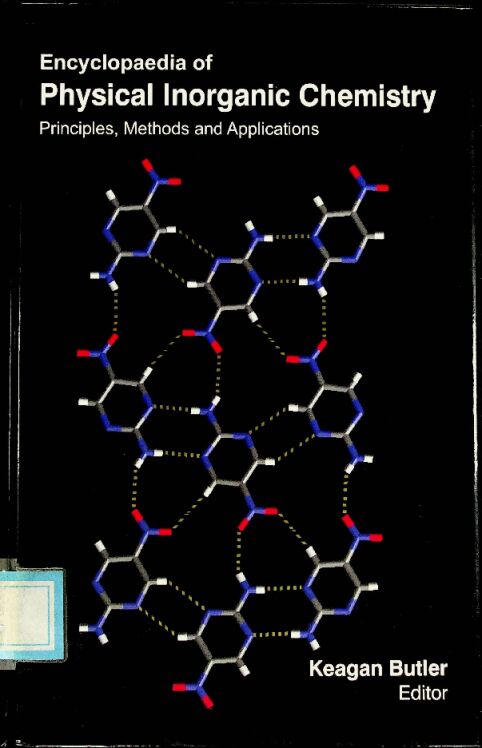
书名:Encyclopaedia of physical inorganic chemistry
出版时间:2012
出版社:Auris Reference,
前言
Inorganic chemistry is a highly practical area of science. Traditionally, the scale of a nation's economy could be evaluated by their productivity of sulfuric acid. The top 20 inorganic chemicals manufactured in Canada, China, Europe, India, Japan, and the US (2005 data): aluminium sulfate, ammonia, ammonium nit rate, ammonium sulfate, carbon black, chlorine, hydrochloric acid, hydrogen, hydrogen peroxide, nitric acid, nitrogen, oxygen, phosphoric acid, sodium carbonate, sodium chlorate, sodium hydroxide, sodium silicate, sodium sulfate, sulfuric acid, and titanium dioxide. The manufacturing of fertilizers is another practical application of industrial inorganic chemistry. Many inorganic compounds are ionic compounds, consisting of cations and anions joined by ionic bonding. Examples of salts (which are ionic compounds) are magnesium chloride MgCl.” which consists of magnesiumcations Mg2+ and chloride anions Cl; or sodium oxide Na.,O, which consists of sodium cations Na+ and oxideanions O2. In any salt, the proportions of the ions are such that the elec trie charges cancel out, so that the bulk compound is electrically neutral. The ions are described by their oxidation st ate and their ease of formation can be inferred from the ionization potential (for cations) or from the electron affinity (anions) of the parent elements.
Important classes of inorganic salts are the oxides, the carbonates, the sulfates and the halides. Many inorganic compounds are characterized by high melting points. Inorganic salts typically are poor conductors in the solid state. Another important featute is their solubility in water e.g., and ease of crystallization. Where some salts (e.g. NaCl) are very soluble in water, others (e.g. SiOJ are not. The simplest inorganic reaction is double displacement when in mixing of two salts the ions are swapped without a change in oxidation state. In redox reactions one reactant, the oxidanty lowers its oxidation state and anot her reactant, the reductant, has its oxidation st ate increased. The net result is an exchange of electrons. Electron exchange can occur indirectly as well, e.g. in batteries, a key concept in electrochemistry. When one reactant contains hydrogen atoms, a reaction can take place by exchanging protons in acid-base chemistry.In a more general definition, an acid can be any chemical species capable of binding to electron pairs is called a Lewis acid; conversely any molecule that tends to donate an electron pair is referred to as a Lewis base. As a refinement of acid-base interactions, the HSAB theory takes into account polarizability and size of ions. Inorganic compounds are found in nature as minerals. Soil may contain iron sulfide as pyrite or calcium sulfate as gypsum. Inorganic compounds are also found multitasking as biomolecules: as electrolytes (sodium chloride), in energy storage (ATP) or in construction (the polyphosphate backbone in DNA). The first important man-made inorganic compound was ammonium nitrate for soil fertilization through the Haber process. Inorganic compounds are synthesized for use as catalysts such as vanadium(V) oxide and titanium(III) chloride, or as reagents in organic chemistry such as lithium aluminium hydride. Subdivisions of inorganic chemistry are organometallic chemistry, clustei chemistry and bioinorganic chemistty. These fields are active areas of research in inorganic chemistry, aimed toward new catalysts, superconductors, and therapies.
This book offers only an elementary approach to certain theoretical concepts. The choice of materials has resulted from a process of elimination.
查看更多
目录
Preface vii
1. Osmo tic Pressure Thermodynamic Explanation • Distillation • Idealised Distillation Model • Laboratory Scale Distillation • Breaking an Azeotrope with Unidirectional Pressure Manipulation • Distillation in Food Processing • Conjugate Variables (Thermodynamics) • Fugacity: Definitions, Concepts, and Geology • Temperature Dependence of the Henry Constant • Comparison to Raoulfs Law • Activity (Chemistry) • Standard States 1
2. Solvation Distinction Bet ween Solva tion, Dissolution and Solub ility • Reaction Examples • Implicit Solvation • Accessible Surface Area • Met hods of Calculating ASA • Poisson-Boltzmann Equation 42
3. The Hammett Equation Hammet Substituent Constants • Chemical Equilibrium • Minimisation of Free Energy • Equilibrium Constant • Types of Equilibrium Constants • Conditional Constants • Derivation from Gibbs Free Energy 60
4. Chemical Reactivity Debye—Hückel Theory • Debye—Hückel Equation • The Potential Energy of an Arbitrary Ion Solution • The Additional Electric Term to the Thermodynamic Potential • Experimental Verification of the Theory • Photosynthesis • Water Photolysis 101
5. Light-independent Reactions Carbon Concentrating Mechanisms • Cyanobacteria and the Evolution of Photosynthesis • Electrochemical Cell • Electrode, Galvanic Cell, Electrolysis Cell • Electrolyte Concentration Cells • The Electrochemical Potential Scale • The Measurement of pH • The Electrode Reaction Potential • Chemical Kinetics • Factors Affecting Reaction Rate • Rate Equation • Parallel or Competitive Reactions 127
6. Principles of Chemical DynamicsElementary Processes and Reaction Mechanism • Temperature Dependence of Rate • Complex Reactions • Enzymes as Ca talysts • Mechanisms of Subst辻ution Reactions 171
7. Numerical Analysis of Auto-ignition of EthanolIntroduction • Numerical Model • Results and Discussion • Stella and Chemical Reactions • SN1 Reaction • Lindemann Mechanism • Thermodynamics and Kinetics of Reactions • Slow Exchange, Longer than a Few Minutes • Temperature Jump 243
8. Law of Mass ActionLe Chatelier's Principle • Reaction Rate • Factors Influencing Rate of Reaction • Autocatalytic Reaction • Creation of Order • Det ailed Balance • Dissipa tion in Systems with Det ailed Balance • Abundance (Chemistry) 263
9. Acid CatalysisActivated Complex • Activation • Autochem • Biochemical Cascade • Bronsted Catalysis Equation • Catalycity • Chain Reaction • Avalanche Breakdown in Semiconductors • Chemical Clock 293
Bibliography 307
Index 311
查看PDF
查看更多
馆藏单位
中科院文献情报中心