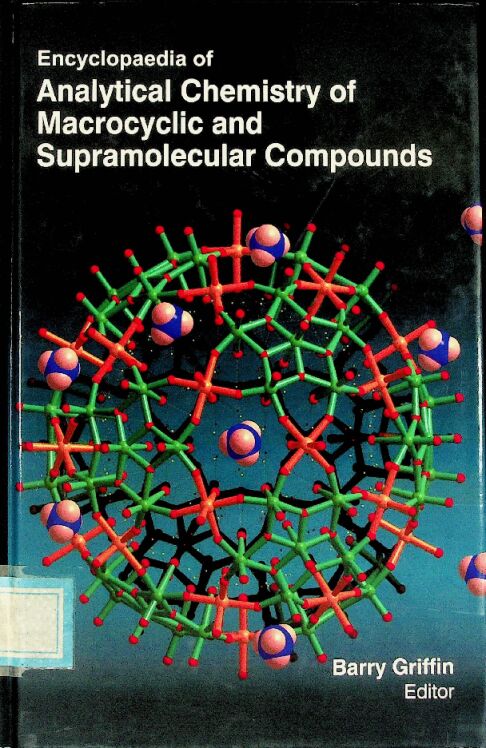
书名:Encyclopaedia of analytical chemistry of macrocyclic and supramolecular compounds. Volume 3, Elements in spectroscopy
出版时间:2012
出版社:Auris Reference,
前言
Spectroscopy pertains to the dispersion of an objecfs light into its component colors (i.e. energies). By performing this dissection and analysis of an objecfs light, astronomers can infer the physical properties of that object (such as temperature, mass, luminosity and composition). But before we hurtle headlong into the wild and woolly field of spectroscopy, we need to try to answer some seemingly simple questions, such as what is light? And how does it behaved These questions may seem simple to you, but they have presented some of the most difficult conceptual challenges in the long history of physics. It has only been in this century, with the creation of quantum mechanics that we have gained a quantitative understanding of how light and atoms work. You see, the questions we pose are not always easy, but to understand and solve them will unlock a new way of looking at our Universe.
Typically one can observe two distinctive classes of spectra: continous and discrete. For a continuous spectrum, the light is composed of a wide, continuous range of colors (energies). With discrete spectra, one sees only bright or dark lines at very distinct and sharply-defined colors (energies). As we'll discover shortly, discrete spectra with bright lines are called eirtission spectra, those with dark lines are termed absorption spectra. Continuous spectra arise from dense gases or solid objects which radiate their heat away through the production of light. Such objects emit light over a broad range of wavelengths, thus the apparent spectrum seems smooth and continuous. Stars emit light in a predominantly (but not completely!) continuous spectrum. Other examples of such objects are incandescent light bulbs, electric cooking stove burners, flames, cooling fire embers and...you. Yes, you, right this minute, are emitting a continuous spectrum — but the light waves you're emitting are not visible — they lie at infrared wavelengths (i.e. lower energies, and longer wavelengths than even red light). Unlike a continuous spectrum source, which can have any energy it wants (all you have to do is change the temperature), the electron clouds surrounding the nuclei of atoms can have only very specific
查看更多
目录
Preface vii
1. Spectroscopy Continuous Spectra • Classification of Methods • Astronomical Spectroscopy • Applied Spectroscopy • Spectroscopic Notation • Reflection Through a Plane Containing the Internuclear Axis 1
2. Spectrum Analysis Spectral Power Distribution • Scattering Theory • Element Identification and Emission Spectra • Example Calculations • The Facts of Light • The Far Ultraviolet Wavelength Range • Atomic Emission Spectroscopy • Molecular Spectroscopy 24
3. Rotational Spectroscopy Understanding the Rotational Spectrum • Structure of Rotational Spectra • Experimental Determination of the Spectrum • Mechanical Properties of Rotation 49
4. Vibrational Spectra Molecular Vibration • Vibrational Coordinates • Near-Infrared Spectroscopy • GF Method • Fermi Resonance • Lennard-Jones Potential • Transition Dipole Moment • Potential and Field of an Electric Dipole • Dipole Moment Density and Polarization Density • Dipole Moments of Fundamental Particles 62
5. Resonance Raman Spectroscopy X-Ray Raman Scattering • Theory of Raman Scattering • Coherent Anti-Stokes Raman Spectroscopy • Comparison to Raman Spectroscopy 104
6. Infrared Spectroscopy Number of Vibrational Modes • Two-Dimensional IR 117
7. Electronic Spectroscopy Electronic Spectra of Molecules • Vibrational and Electronic Energy Levels of Polyatomic Transient Molecules • Types of Measurement • Electronic Spectra • Excited Electronic States • Ground・ and Excited-State Vibrations • Molecular Electronic Transition • Atomic Electron Transition 127
8. Proton Magnetic Resonance Proton NMR • Carbon Satellites and Spinning Sidebands • Ion Traps • Common Mass Spectrometre Configurations and Techniques • Liquid Chromatography • Mass Spectrometry • Pharmacokinetics • Data Analysis • Protein and Peptide Fractionation Coupled with Mass Spectrometry • Practical Applications • Nuclear Magnetic Resonance Spectroscopy • Nuclear Spin Interactions in the Solid Phase • Modern Solid- State NMR Spectroscopy • Biomolecular NMR Spectroscopy • Homonuclear Nuclear Magnetic Resonance 166
9. Photochemistry Principles • Mechanistic Organic Photochemistry • Parallel Studies on Multiplic辻y; the Role of Triplets • The Electromagnetic Spectrum 232
Bibliography 251
Index 255
查看PDF
查看更多
作者简介
Barry Griffin is professor of analytical chemistry. He earned his B.S.in 1970 and Ph.D.in 1974.His research interest include Analytical,Energy Science,Materials and Polymer Chemistry,Surfaces and Solid State.His notable publications are: Selective Interlayers and Contacts in Organic Photovoltaic Cells,Photoemission spectroscopy of tethered CdSe nanocrystals: Shifts in ionization potential and local vacuum level as a function of nanocrystal capping ligand etc.
查看更多
馆藏单位
中科院文献情报中心