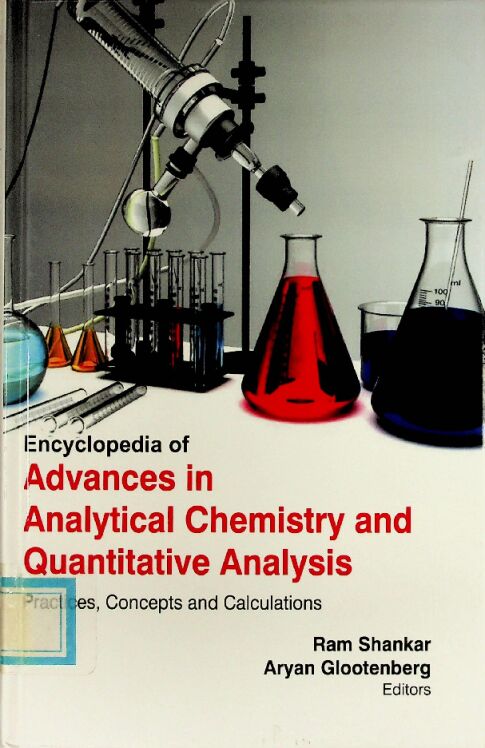
书名:Encyclopedia of advances in analytical chemistry and quantitative analysis
责任者:Ram Shankar | Aryan Glootenberg.
出版时间:2014
出版社:Auris Reference,
前言
Analytical chemistty is the science of making quantitative measurements. In practice, quantifying analytes in a complex sample becomes an exercise in problem solving. Analytical Chemistry is concerned with providing qualitative and quantitative information about the chemical and structural composition of a sample of matter. A huge variety of samples, from high concentrations of elements in alloy steels to part-per-billion levels of drugs in biological tissue, are handled by the analyst. The field is founded on the conversion of a measured physical property of the species being examined to a usable signal. It is generally divided into two categories, classical and instrumental, on the basis of its historical development. The overall strategy is to prepare a sample correctly, choose a particular method of analysis, and report the results in a meaningful format, which may include a statistical evaluation. Analytical chemists use a diverse range of methods to investigate the chemical nature of substances. The aim of such work is to identify and understand the substance and how it behaves in different conditions. In the pharmaceutical industry, for example, analytical chemists are involved throughout the drug development process; they study the physical or chemical properties of drug substances and formulations, with a view to determining the quality and stability of drug products.
In analytical chemistry, sample preparation refers to the ways in which a sample is treated prior to its analysis. Preparation is a very important step in most analytical techniques, because the techniques are often not responsive to the analyte in its in-situ form, or the results are distorted by interfering species. Sample preparation may involve dissolution, reaction with some chemical species, pulverizing, t re a tment with a chelating agent (e.g. EDTA), masking, filtering, dilution, sub-sampling or many other techniques. Just as for any other analytical technique, good sample preparation is essential for performing high・quality chemical analysis using X-ray fluorescence (XRF). Whichever samples are being assessed — loose or pressed powders, fused beads, solid samples or liquids 一 finding the right approach to sample preparation is the first, and one of the most important, steps in achieving accurate and reproducible results. Unlike other analytical techniques, XRF analysis does not require extensive sample preparation work, and the required methods are normally inexpensive, straightforward and easy to learn. Even taking the need for sample preparation into account, XRF spectrometry is still easier and quicker than most other chemical analysis techniques.
The book covers theoretical and objects analyzed applied aspects of analytical chemistry; it informs the reader of new achievements in analytical methods, and analysts; new instruments; and reagents. It is intended for scientists and specialists at research institutes, universities, and other educational establishments; for students at institutions of higher education; and for analysts working in industry, agi'icultute, medicine, and environmental services. Devoted entirely to teaching and reinforcing these necessary pretreatment steps, Sample Preparation Techniques in Analytical Chemistry addresses diverse aspects of this important measurement step.
查看更多
目录
Preface vii
1. Good Laboratory Practice · GLP and the OECD · GLP and the USFDA · GLP and the European Union · GLP and Non-OECD Member-countries · Criticism ofGLP · GLP and Automated Systems · Verification and Validation · Izaak Kolthoff · List of Materials Analysis Methods · Metrology 1
2. MeasurementUncertainty · Random Uncertainties and Systematic Errors · GUM Approach · Measurement Model · Fluorescence · Infrared Spectroscopy 40
3. Electron Paramagnetic Resonance · Theory · Spectral Parameters · Pulsed EPR · Applications · High-field High-frequency Measurements · Fourier Transform Spectroscopy 68
4. Forensic Chemistry · Methods · Examples · Microscopy · Digital Microscope 86
5. Electrophysiology · Definition and Scope · Optical Electrophysiological Techniques · Extracellular Recording · Other Methods · X-ray Crystallography.Lead(II) Nitrate 110
6. Scanning Electron Microscope · History · Scanning Process and Image Formation · Magnification · Sample Preparation · Biological Samples · Atomic Force Microscopy 155
7. Synthetic Ion Channels · History · Characterisation and Mechanisms · Macrocycles-based · Rigid Rods. Gating · Antimicrobial Peptides · Peripheral Membrane Protein 178
8. Molecular Sensor · Boronic Acid·Boronic Acids in Supramolecular Chemistry · Line Group · Point Group · One-dimensional Symmetry Group · Frieze Group .Ken Raymond · Scorpionate Ligand 205
9. Chemical Database · Chemical Structures.Chemical Structure Representation · Search · Conformation · Ferrocene · Reactions · PubChem 248
10. Accuracy and Precision in Sample Techniques · Accuracy Versus Precision:The Target Analogy · Quantifying Accuracy and Precision · Accuracy and Precision in Binary Classification · Accuracy and Precision in Logic Simulation · Accuracy and Precision in Information Systems · Test Method · Data Analysis · NCSL International 285
Bibliography 285
Index 287
查看PDF
查看更多
馆藏单位
中科院文献情报中心