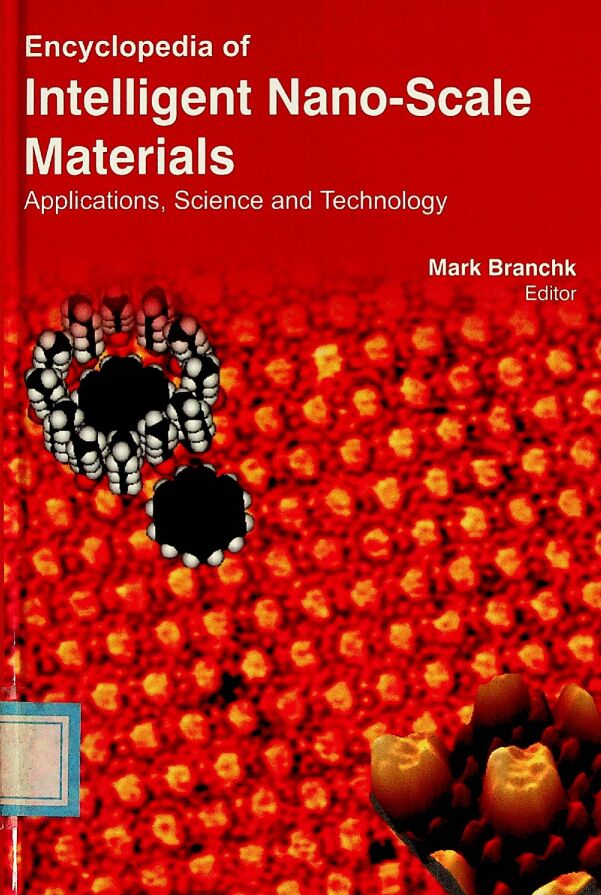
书名:Encyclopedia of intelligent nano-scale materials
出版时间:2014
出版社:Auris Reference,
前言
Nanomaterials are chemical substances or materials that are manufactured and used at a very small scale. Nanomaterials are developed to exhibit novel characteristics compared to the same material without nanoscale features. Hundreds of products containing nanomaterials are already in use. Examples are batteries, coatings, anti-bacterial clothing etc. Nano innovation will be seen in many sectors including public health, employment and occupational safety and health, information society, industry, innovation, environment, energy, transport, security and space. Over the past decade, nanomaterials have been the subject of enormous interest. These materials, notable for their extremely small feature size, have the potential for wide-ranging industrial, biomedical, and electronic applications. As a result of recent improvement in technologies to see and manipulate these materials, the nanomaterials field has seen a huge increase in funding from private enterprises and government, and academic researchers within the field have formed many partnerships. Nanomaterials can be metals, ceramics, polymeric materials, or composite materials. Their defining characteristic is a very small feature size in the range of 1-100 nanometers(nm). The unit of nanometer derives its prefix nano from a Greek word meaning dwarf or extremely small. One nanometer spans 3-5 atoms lined up in a row. By comparison, the diameter of a human hair is about 5 orders of magnitude larger than a nanoscale particle. Nanomaterials are not simply another step in miniaturization, but a different arena entirely; the nanoworld lies midway between the scale of atomic and quantum phenomena, and the scale of bulk materials. At the nanomaterial level, some material properties are affected by the laws of atomic physics, rather than behaving as traditional bulk materials do. Although widespread interest in nanomaterials is recent, the concept was raised over 40 years ago. Physicist Richard Feynman delivered a talk in 1959 entitled “There's Plenty of Room at the Bottom”, in which he commented that there were no fundamental physical reasons that materials could not be fabricated by maneuvering individual atoms. Nanomaterials have actually been produced and used by humans for hundreds of years-the beautiful ruby red colour of some glass is due to gold nanoparticles trapped in the glass matrix. The decorative glaze known as luster, found on some medieval pottery, contains metallic spherical nanoparticles dispersed in a complex way in the glaze, which give rise to its special optical properties. The techniques used to produce these materials were considered trade secrets at the time, and are not wholly understood even now. Development of nanotechnology has been spurred by refinement of tools to see the nanoworld, such as more sophisticated electron microscopy and scanning tunnelling microscopy. By 1990, scientists at IBM had managed to position individual xenon atoms on a nickel surface to spell out the company logo, using scanning tunnelling microscopy probes, as a demonstration of the extraordinary new technology being developed. In the mid-1980s a new class of material - hollow carbon spheres-was discovered. These spheres were called buckyballs or fullerenes, in honour of architect and futurist Buckminster Fuller, who designed a geodesic dome with geometry similar to that found on the molecular level in fullerenes.
The variety of nanomaterials is great, and their range of properties and possible applications appear to be enormous, from extraordinarily tiny electronic devices, including miniature batteries, to biomedical uses, and as packaging films, superabsorbants, components of armour, and parts of automobiles. General Motors claims to have the first vehicle to use the materials for exterior automotive applications, in running boards on its mid-size vans. Editors of the journal Science profiled work that resulted in molecular-sized electronic circuits as the most important scientific development in 2001. It is clear that researchers are merely on the threshold of understanding and development, and that a great deal of fundamental work remains to be done. What makes these nanomaterials so different and so intriguing? Their extremely small feature size is of the same scale as the critical size for physical phenomena-for example, the radius of the tip of a crack in a material may be in the range 1-100 nm. The way a crack grows in a larger-scale, bulk material is likely to be different from crack propagation in a nanomaterial where crack and particle size are comparable. Fundamental electronic, magnetic, optical, chemical, and biological processes are also different at this level. Where proteins are 10-1000 nm in size, and cell walls 1-100 nm thick, their behaviour on encountering a nanomaterial may be quite different from that seen in relation to larger-scale materials. Nanocapsules and nanodevices may present new possibilities for drug delivery, gene therapy, and medical diagnostics.
This book contains the latest research and developments in the processing, properties, and applications of intelligent nanomaterials.
-Editor
查看更多
目录
Preface vii
1. Introduction 1
Fullerenes·Nanoparticles·Inorganic Materials·Synthesis, Characterization, and Self-assembly of Colloidal Quantum Dots·Bound Exciton Energy·Colloidal Synthesis·Viral Assembly·Photovoltaic Devices·Molecular Oxides·Metal Oxides
2. Vapor-Liquid-Solid Mechanism 30
Epitaxy·Gas-Liquid Phase Epitaxy·Gas Detector·Electrochemical Gas Sensor·SnO NWs Based Gas Sensors
3. Nanowire 52
Molecular Wire·Nanorod·Aggregated Diamond Nanorod
4. Plasma 68
Non-Neutral Plasma·Plasma Display Panel·Nanophosphors for Plasma Display Panel·Applications
5. Amorphous Porous Mixed Oxides: A New and Highly Versatile Class of Materials 105
Porous Medium·Nanoporous· Mesoporous Materials ·Macroporous Materials·Nuclear Magnetic Resonance in Porous Media·Reticulated Foam·Sol-Gel Method for the Production of Porous Oxides
6. Zinc Oxide Nanostructures and their Applications 129
Nanobiotechnology·Cancer and the Role of Nanobiotechnology
7. Smart Nanomaterials for Space and Energy Applications 151
Transparent Conducting Film·Cadmium Telluride Solar Cell·Gallium Arsenide Substrate·Germanium Substrate·Indium Phoshide Substrate·Quantum Well Solar Cells·Nanomaterials for Hydrogen Storage·Carbon Nanotubes·Optical Properties·Experimental Capacity
8. Boron Nitride Nanotubes 222
Hydride Materials·Metal-Organic Framework·Nanomaterials in Batteries·Nanomaterials for Energy Storage in Supercapacitors·Thermochromic Thin Films and Nanocomposites for Smart Glazing·Challenges for VO2 Use in Architectural Glazing
9. Organic Materials 249
Heterogeneous Polymerization·Polymer Adsorption on Nanoparticles·Applications·Self-Assembly of Micelles ·Surface Plasmon Resonance Spectroscopy(SPR) ·FTIR Spectroscopic Method for the Determination of the LCST ·Temperature-Responsive Polymer·Conjugates of Nanomaterials with Phthalocyanines
10. Nanoparticles 291
Advancement in Cellulose Based Bio-Plastics for Biomedicals·Tissue Engineering·PART III Composite Materials ·Biomaterials and Devices·Nano-Sized Carrier Systems as New Materials for Nuclear Medicine·Biomimetic Materials Toward Application of Nano bio devices
Bibliography 333
Index 335
查看更多
馆藏单位
中科院文献情报中心