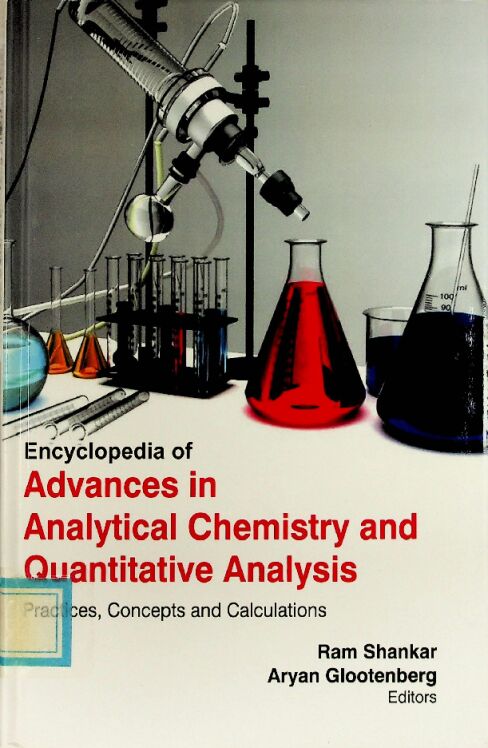
书名:Encyclopedia of advances in analytical chemistry and quantitative analysis
责任者:Ram Shankar | Aryan Glootenberg.
出版时间:2014
出版社:Auris Reference,
前言
The vast discipline of analytical chemistry has implications in all experimental sciences. Its study requires knowledge of many different areas. As a multidisciplinary science, also sometimes referred to as transferable, analytical chemistry calls upon many phenomena, certain of which quite distant from chemistry in the usual sense of the term, in order to provide results. Thus, modern chemical analysis is based on physico-chemical measurements obtained through the use of a variety of instruments, which have greatly benefited from the appearance of microcomputers. Gradually a tremendous arsenal of processes has been developed, allowing the analyst to respond to an increasing number of various demands. Furthermore, the study of modern chemical analysis techniques is far removed from traditional descriptive chemistry. Many analyses are conducted in non-specialized environments, either on site or at simple workbenches. The determination of compounds is currently quite remote from the use of chemical reactions, which are often avoided for many reasons.
Former wet chemistry methods, at the origin of the term analytical chemistry, have become less important because they are labour intensive, require large samples due to their lack of sensitivity, are lengthy and their precision can too easily be altered by the use of insufficien tly pure reagen ts. None theless, wet chemistry met hods are still interesting to study. One way of determining the importance of a technique is to examine the economic statistics related to the sale of corresponding instruments. The diffusion of a technique increases the probability that an analyst will encountet it during his professional career. For example, chromatographic techniques alone represent more than half of the sales of instruments for molecular analysis, as opposed to elemental analysis which is half of this. However, the latter domain is far from static, other emerging sectors of analysis or novel, alternative methods are being developed and will no doubt come to the prominence. Elsewhere, economic indicators are not the only factor taken into account when assigning the importance of a met hod. For certain analyses, even a rarely used met hod can be the most important if it represents the only available means of solving a problem. Chemical analysis is the proof of many innovations: the evolution of technologies has led to the development of high- performance instruments bringing newer and broader possibilities, notably hyphenated met hods and non-destructive met hods. Non�destructive tests can be conducted on very small samples that do not necessitate extensive sample preparation prior to the measurement. Users can finally acquire instruments that meet the quality and precision requirements necessary for attaining certification. This latter requirement an important step in the official recognition of the quality of the laboratory. Certification procedures are enforced by a number of test compounds all over the world.
The book classifies methods of analysis according to three categories: separation techniques, spectroscopy techniques and other methods. It was written for undergraduate students in chemistry but with the view that it may be of interest for students in other disciplines. Thus, it provides sufficient information to understand the techniques and their application and allows students to find additional information in more advanced works that discuss specialised instrumentai techniques in more detail. Written and presented as comprehensively as possible, the text addresses a broad spectrum of techniques relevant to a wide range of subjects in chemistry, physics and applied biology and will prove appropriate for students of pre-university, undergraduate and postgraduate levels.
查看更多
目录
Preface (vii)
1. Digital Pathology · Digital Pathology Environment · Infrared Spectroscopy Correlation Table · Rotational Spectroscopy · Structure of Rotational Spectra · Experimental Determination of the Spectrum·Applications · Molecular Vibration · Near-infrared Spectroscopy 1
2. Gas Chromatography-mass Spectrometry · History · Instrumentation · Purge and Trap GC-MS · Refractive Index · Relations to Other Quantities · Refractive Index Measurement · X-ray Fluorescence · Emission Spectrum · Atomic Spectral Line 21
3. Nuclear Magnetic Resonance · Rabi,Bloch, and Purcell Noticed That Magnetic Nuclei, Like · Theory of Nuclear Magnetic Resonance · Spin Behavior in a Magnetic Field.Magnetic Resonance by Nuclei.NMR Spectroscopy · Continuous Wave (CW) Spectroscopy · Fourier Transform Spectroscopy · Multidimensional NMR Spectroscopy · Solid-state NMR Spectroscopy · Applications.Raman Spectroscopy · Biochemistry · Biomolecules 68
4. X-ray Computed Tomography · Entymology · Types of CT Machine · Diagnostic Use · Advantages · Adverse Effects · Artifacts · Prevalence · Process · Three-dimensional Reconstruction · Industrial Use · History · Cyclic Voltammetry · Differential Scanning Calorimetry 110
5. Resonance Raman Spectroscopy · X-Ray Raman Scattering · History · Theory of Raman Scattering · Resonance Raman Spectroscopy · Instrumentation · Raman Scattering · Nonlinear Optics · Example Uses of Nonlinear Optics.Optical Phase Conjugation·Parametric Process (Optics) · Eckart Conditions · Separation of External and Internal Coordinates · GF Method 138
6. Molecular Modelling · Molecular Mechanics.Variables · Applications · Cheminformatics · Computational Chemistry · Force Field (Chemistry) · Nanotechnology·Current Research 184
7. Supramolecular Chemistry · History.Control of Supramolecular Chemistry · Concepts in Supramolecular Chemistry.Structural Units · Applications · Organic Chemistry · Classification of Organic Compounds 228
8. Photochemistry · Principles.Spectral Regions · Applications · Excitation · Organic Photochemistry · Dendrimer · Nanoparticle · Fullerene·Cell Membrane
9. Dynamical System · Basic Definitions.Linear DynamicalSystems · Local Dynamics · Bifurcation Theory · Ergodic Systems · Chemical Thermodynamics · Thermodynamic Databases for Pure Substances 295
Bibliography 317
Index 319
查看PDF
查看更多
馆藏单位
中科院文献情报中心