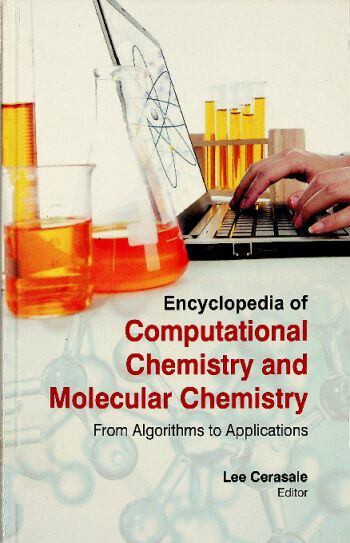
书名:Encyclopedia of computational chemistry and molecular chemistry
责任者:Lee Cerasale. | Cerasale, Lee.
ISBN\ISSN:9781781542712,1781542716
出版时间:2014
出版社:Auris Reference,
前言
Computational chemistry is a branch of chemistry that uses principles of computer science to assist in solving chemical problems. It uses the results of theoretical chemistry,incorporated into efficient computer programs, to calculate the structures and properties of molecules and solids.One of the first mentions of the term"computational chemistry"can be found in the 1970 book Computers and Their Role in the Physical Sciences by Sidney Fernbach and Abraham Haskell Taub, where they state "It seems, therefore,that'computational chemistry'can finally be more and more of a reality." During the 1970s, widely different methods began to be seen as part of a new emerging discipline of computational chemistry.The necessity of computational chemistry arises from the well- known fact that apart from relatively recent results concerning the hydrogen molecular ion(see references therein for more details), the
many-body problem cannot be solved analytically,much less in closed form.While its results normally complement the information obtained by chemical experiments,it can in some cases predict hitherto unobserved chemical phenomena.It is widely used in the design of new drugs and materials. Computational and molecular chemistry has a wide range of applications in various disciplines of engineering sciences,such as materials science,chemical engineering, biomedical engineering,etc.andis used for the modelling and simulationof small chemical and biological systems in order to understand and predict their behaviour at the molecular level. Knowledge of computational chemistry is essential to understand the behaviour of nanosystems; it is probably the easiest route or gateway to the fast-growing discipline of nanosciences and nanotechnology,which covers many areas of research dealing with objects that are measured in nanometers and which is expected to revolutionize the industrial sector in the coming decades.
Computational chemistry uses the results of theoreticalchemistry, incorporated into efficient computer programs, to calculate the structures and properties of molecules and solids. Computational Chemistry uses the results of theoretical chemistry,incorporated into efficient computer programs,to calculate the structures and properties of molecules and solids.It can deal with system of a single molecule, a group of molecules, a liquid or solid. It calculates properties such as properties are structure, relative energies, charge distributions, dipoles and multipole moments,vibrationalfrequencies reactivity and other spectroscopic vibrational frequencies,reactivity and other spectroscopic quantities, etc. The term computational chemistry is usually usedwhen a mathematical methodis sufficiently well developed that it can be automated for implementation on a computer. Computational chemistry is the application ofchemical, mathematical and computing skills to the solution of interesting chemical problems. It uses computers to generate information such as properties of molecules or simulated experimental results. Very few aspects of chemistry can be computed exactly,but almost every aspect of chemistry has been described in a qualitative or approximate quantitative computational scheme.
The book provides in one comprehensive volume the in-depth theoretical background for molecular modelling and detailed descriptions of the applications in chemistry and related fields like drug design, molecular sciences, biomedical, polymer and materials engineering. The book provides an overview of the field, explains the basic underlying theory at a meaningful level that is not beyond beginners, and it gives numerous comparisons of different methods with one another and with experiment. It extensively deals with a comprehensive account of the fundamental principles under-lying different methods,ranging from classicaltothe sophisticated.Although comprehensive in its coverage, this textbook focuses on calculating molecular structures and molecular properties and dynamical aspects.Suitable for students and researchers entering the field of computational chemistry,it is also an essentialreference for procedures commonly cited in computational chemistry literature.---Editor
查看更多
目录
Preface (vii)
1. Molecular Substance 1· Alcohol and Drug · Sociocultural Context of Alcohol Use· Acculturation and Culture Change Studies·Disease Concept of Alcoholism·Anthropological Work on Alcohol·Mind-altering Plants in Societies· The"Firewater Myth"· Biocultural Synthesis of Alcoholism Etiology · Increasing Anthropology's Impact·Lewis Structures of Molecules·Lewis Structures for Molecules·Exceeding the Octet · A Formal Charge Refinement—Optimizing the Lewis Structure· Three-Dimensional Structures of Molecules: VSEPR·Bond Angle Refinements· Charge Distribution in Molecules Electronegativity·Bond Dipoles and Dipole Moment
2. Revolution in Biological Information 38·What is Bioinformatics?·Aims and scope·Cell Culture·Concepts in Mammalian Cell Culture·Culture of Non-mammalian Cells·Cell Disruption · Laboratory-scale Methods
3. Challenges of Chemical Genomics 62· Chemical Biology or Genetics · Development of Target-Specific Chemical Ligands·Chemical Ligands and Systematic Study of gene and Protein Functions
4. Developmental Biology and Evolutionary Genetics 76·Developmental Biology·Studied Phenomena·Evolutionary Genetics· Heritability of IQ
5. Important Bioactive Compounds and their Applications 94· Molluscan Derived Compounds· Vertebrate-Derived Compounds· Cnidarian Derived Compounds· Ascidian Derived Compounds·Bryozoans Derived Compounds·Helminth Derived Compounds·Microbe Derived Compounds·Protein Folding·Circular Dichroism· Circular Polarization ·Left/Right Handedness Conventions·In Electrical Engineering· Dual Polarization Interferometry
6. Immunogenicity of Biopharmaceuticals 121·The Classical Immune Response·Possible Mechanisms of Epoetin Immunogenicity· Neo-antigens· Other Factors· Formulation Changed in 1998·Motion Planning for Proteins: Biophysics and Applications· Structural Biochemistry/Proteins/Protein Folding Problem · Enzyme·Transition State Theory ·Enzyme/Zymogen· Procarboxypeptidase · Angiotensin
7. Column Chromatography 154·Stationary Phase·Column Chromatogram Resolution Calculation· High-Performance Liquid Chromatography· Types·Bioaffinity Chromatography·Parameters·PaperChromatography·Retardation Factor
8. Reversed-phase Chromatography 177·Stationary Phases·Simulated Moving Bed·Fast Protein Liqud Chromatography·Countercurrent Chromatography·Xanthanolide Purification·Aqueous Normal-phase Chromatography·Multicolumn Countercurrent Solvent Gradient Purification ·Purnell Equation
9. Chromatography in Blood Processing 194·Van Deemter Equation·Rodrigues Equation·Binding Selectivity·Solvent Extraction·Receptor (Biochemistry)· Types·Liquid- liquid Extraction·Measures of Effectiveness·Techniques·Signal Transduction
10. Clinical Significance 230·VEGF in Disease·Peripheral Membrane Protein·Transporters ofSmallHydrophobicMolecules·Proteases inAngiogenesis·Proteases Involved in the Recruitment of Bone Marrow Derived Cells During Angiogenesis· Steroid Hormone· Cell Surface Receptor· Neuromodulation
11.Industrial Aspects of Amylase Enzymes267·History of Enzymes·Early Developments in Japan·Enzymes for Textile·Enzymes for Leather·Enzymes for Baking·Enzymes for Alcohol·Enzymes for Brewing·Enzymes for Detergent·Enzymes for Starch·Enzymes for Animal Feed·How are Enzymes Made?·Symbiotic Nitrogen Fixation in Stem Nodulating Sesbania Rostrata·Biological Nitrogen Fixation·Mechanism of Biological Nitrogen Fixation·Factors Limiting Biological Nitrogen Fixation·Inoculation of Legumes·Defoliation,Crop Competition,and Pests·Estimation of Nitrogen Fixation·How to Increase BNF and N2 Fixing Ability
Bibliography 301
Index 303
查看PDF
查看更多
馆藏单位
中科院文献情报中心