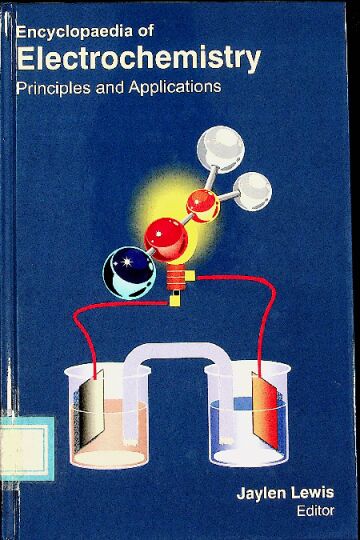
书名:Encyclopaedia of electrochemistry
ISBN\ISSN:9781781540121,1781540128
出版时间:2012
出版社:Auris Reference,
前言
Electrochemistry is the study of interchange of chemical and electrical energy. Oxidation/Reduction involves the exchange of electrons from one chemical species to another. Normally, this is done when the two chemicals contact each other in the activated complex (when two species bump into each other in solution for example). We are interested in separating the chemical species such that the electrons transfer via an external circuit. That way, we can measure the electrochemical effects. To properly understand the connection between the redox reaction and the electricity, we should balance the overall redox reaction using a half-reaction method such as the one described in the previous section of these notes. We can set up the physical reaction vessel such that the chemicals from one half reaction are separated from those of the second half reaction. For reaction to occur, we still need to connect the solutions to complete the circuit. This is done by attaching wires between electrodes in the two half cells and by connecting the solutions of the two half cells via a salt bridge or by some other device such as a semi-permeable membrane. Understanding of electrical matters began in the sixteenth century. During this century the English scientist William Gilbert spent 17 years experimenting with magnetism and, to a lesser extent, electricity. For his work on magnets, Gilbert became known as the "Father of Magnetism." He discovered various methods for producing and strengthening magnets.
In 1663 the German physicist Otto von Guericke created the first electric generator, which produced static electricity by applying friction in the machine. The generator was made of a large sulphur ball cast inside a glass globe, mounted on a shaft. The ball was rotated by means of a crank and a static electric sparkwas produced when a pad was rubbed against the ball as it rotated. The globe could be removed and used as source for experiments with electricity. By the mid-18th century the French chemist Charles Franc;ois de Cisternay du Fay had discovered two types of static electricity, and that like charges repel each other whilst unlike charges attract. Du Fay announced that electricity consisted of two fluids: "uitreons" (from the Latin for ''glass'), or positive, electricity; and "resinoits," or negative, electricity. This was the two-fluid theory of electricity, which was to be opposed by Benjamin Franklin's one-fluid theorylater in the century. CharlesAugustin de Coulomb developed the law of electrostatic attraction in 1785 as an outgrowth of his attempt to investigate the law of electrical repulsions as stated by Joseph Priestley in England. In the late 18th century the Italian physician and anatomist Luigi Galvani marked the birth of electrochemistry by establishing a bridge between chemical reactions and electricity on his essay ''De Viribus Electricitatis in Motu Musculari Co,nmentarius"in 1791 where he proposed a "nerueoelectrical substance" on biological life forms. In his essay Galvani concluded that animal tissue contained a here-to-fore neglected innate, vital force, which he termed "animal electricity," which activated nerves and muscles spanned by metal probes. He believed that this new force was a form of electricity in addition to the "natural" form produced by lightning or by the electric eel andtorpedo ray as well as the "artificial" form produced by friction.
Galvani's scientific colleagues generally accepted his views, but Alessandro Volta rejected the idea of an "animal electric fluid," replying that the frog's legs responded to differences in metal temper, composition, and bulk. Galvani refuted this by obtaining muscular action with two pieces of the same material. In 1800, William Nicholson and Johann Wilhelm Ritter succeeded in decomposing water into hydrogen and oxygen byelectrolysis. Soon thereafter Ritter discovered the process of electroplating. He also observed that the amount of metal deposited and the amount of oxygen produced during an electrolytic process depended on the distance between theelectrodes. By 1801 Ritter observed thermoelectric currents and anticipated the discovery of thermoelectricity by Thomas Johann Seebeck. By the 1810s William Hyde Wollaston made improvements to the galvanic cell. Sir Humphry Davy's work with electrolysis led to the conclusion that the production of electricity in simple electrolytic cells resulted from chemical action and that chemical combination occurred between substances of opposite charge. This work led directly to the isolation of sodium and potassium from their compounds and of the alkaline earth metals from theirs in 1808.
This book will be found useful by those who wish to make a more detailed study of the topics discussed.
查看更多
目录
Preface vii
1. Introduction 1
History of Electrochemistry • Rise of Electrochemistry as Branch of Chemistry • Redox ·Oxidising and Reducing Agents • Redox Reactions in Industry • Redox Reactions in Geology
2. Chemical Equation 27
Bala ncing Chemical Equations • Electroche mical Cells • Standard Electrode Potential • Spontaneous Process • Nernst Equation • Using Entropy and Gibbs Energy • Concentration Cell
3. Battery (Electricity) 44
History of the Battery • The Baghdad Battery of Antiquity
• List of Battery Types • Alkaline Battery ·Recharging of Alkaline Batteries • Aluminium-air Batte
4. Atomic Battery 67
Direct Charging Generators ·Reciprocating Electromechanical Atomic Batteries • Optoelectric Nuclear Battery • Nuclear Micro· batte • Bunsen Cell • Chromic Acid Cell • Clark Cell • Daniell Cell • Porous Pot Cell
5. Earth Battery 80
Frog Batte • Galvanic Cell • Grove Cell • Leclanche Cell
• Lemon Battery • Lithium Battery • Lithium Batteries and Methamphetamine Labs • Lithium-air Battery • Mercury Battery • Electrical Characteristics
6. Molten Salt Battery 112
Vehicles Powered by ZEBRA Batteries • Nickel Oxyhydroxide Battery • Paper Battery • Pulvermacher's Chain • Reserve Battery • Silver-oxide Battery • Penny Battery • Trough Battery
7. Solid-state Battery 132
Voltaic Pile ·Weston Cell • Zinc-air Battery ·Zinc-Carbon Battery • Flow Battery · Vanadium Redox Battery • Zin bromine Battery • Fuel Cell • Proton Exchange Membrane Fuel Cells • High Temperature Fuel Cells • Theoretical Maximum Efficiency • Fuel Cell Electric Vehicles (FCEVs) ·Lead-acid Battery • Measuring the Charge Level • Deep Cycle Battery
• VRLA Battery • Comparison with Flooded Lead-acid Cells
8. Lithium-ion Battery 194
Modern Batteries • Battery Charging Procedure • Beltway Battery ·Lithium-ion Polymer Battery • Prolonging Life 山 Multiple Cells Through Cell Balancing • Lithium Iron Phosphate Battery • Lithium-sulfur Battery • Lithium-Titanate Battery • Nickel-Cadmium Battery • Battery Characteristics • Memory and Lazy Battery Effects • Nickel-Cadmium Battery (Tented Cell Type) • Nickel-Hycu:ogen Battery • Nickel-iron Battery • Nickel-Metal Hydride Battery ·DT Temperature Charging Method ·Comparison with Other Battery Types • Low Self- discharge Battery • Nickel-zinc Battery
9. Organic Radical Battery 251
Poly mer- based Ba ttery • Polysu lfide Brom ide Battery • Potassium- ion Battery • Rechargeable Alkaline Battery • Silicon-air Battery ·Sodium-ion Battery • Sodium-sulfur Battery • Super Iron Battery • Baghdad Battery • Battery (Vacuum Tube) ·Battery Pack • Battery Room ·Submarines and Ocean Going Vessels • Bioba ttery • Button Cell • Properties of Different Types • Electrochemical System
Bibliography 281
Index 285
查看更多
馆藏单位
中科院文献情报中心