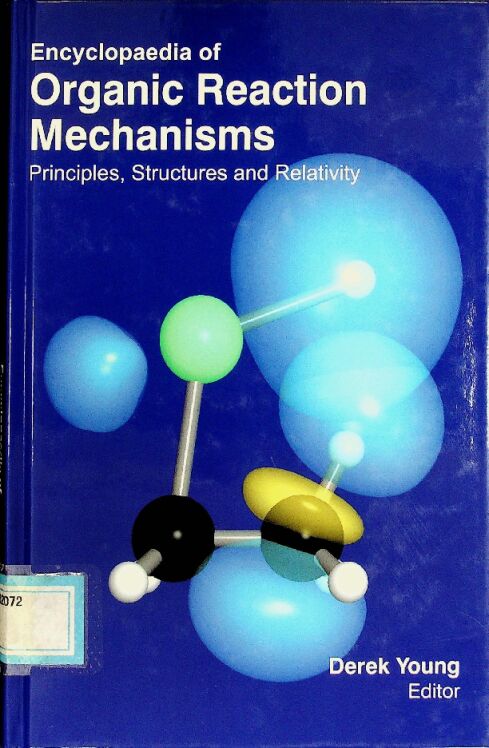
书名:Encyclopaedia of organic reaction mechanisms
ISBN\ISSN:9781781540138,1781540136
出版时间:2012
出版社:Auris Reference,
前言
In chemistry, a reaction mechanism is the step by step sequence of elementaty reactions by which overall chemical change occurs. Although only the net chemical change is directly observable for most chemical reactions, experiments can often be designed that suggest the possible sequence of steps in a reaction mechanism. Recently, electrospray ionization mass spectrometry has been used to corroborate the mechanism of several organic reaction proposals. In a substitution reaction, a functional group in a particular chemical compound is replaced by another group. In organic chemistry, the electrophilic and nucleophilic substitution reactions are of prime importance.
Organic substitution reactions are classified in several main organic reaction types depending on whether the reagent that brings about the substitution is considered an electrophile or a nucleophile, whether a reactive intermediate involved in the reaction is a carbocation, a carbanion or a free radical or whether the substrate is aliphatic or aromatic. Detailed understanding of a reaction type helps to predict the product outcome in a reaction. It also is helpful for optimizing a reaction with regard to variables such as temperatuxe and choice of solvent.
Nucleophilic substitution happens when the reagent is a nucleophile, which means, an atom or molecule with free electrons. A nucleophile reacts with an aliphatic substrate in a nucleophilic aliphatic substitution reaction. These substitutions can be produced by two different mechanisms: unimolecular nucleophilic substitution (SN]) and bimolecular nucleophilic substitution (SNJ. The SNX mechanism has two steps. In the first st ep, the leaving group departs, forming a carbocation. In the second step, the nucleophilic reagent attacks the carbocation and forms a sigma bond. This mechanism can result in either inversion or retention of configuration. An SN2 reaction has jus t one st ep. The attack of the reagent and the expulsion of the leaving group happen simultaneously. This mechanism always results in inversion of configuration. When the substrate is an aromatic compound the reaction type is nucleophilic aromatic substitution. Carboxylic acid derivatives react with nucleophiles in nucleophilic acyl substitution. This kind of reaction can be useful in preparing compounds. Coupling reactions are a class of metal-catalysed reactions involving an organometallic compound RM and an organic halide R'X that together react to a compound of the type R-R' with formation of a new carbon-carbon bond.
This book is not a physical organic chemistry text. The sole purpose of this book is to teach students how to come up with reasonable mechanisms for reactions that they have never seen before. As most chemists know, it is usually possible to draw more than one reasonable mechanism for any given reaction.
查看更多
目录
Preface vii
1. Reaction Mechanism Nucleophilic Substitution • Electrophilic Substitution • Electrophilic Aromatic Substitution • Description • Organic Reaction • Chemical Bonds to Carbon • Nucleophilic Acyl Substitution • Finkelstein Reaction • Electrochemical Reaction Mechanism • Arrow Pushing • Electrophilic Aromatic Substitution • Mechanism of Nucleophilic Substitution • Substitution Reaction Mechanisms 1
2. Alcohols and Alkyl Halides Radical Substitution • Radical Substitution Mechanism • Selectivity • R-H • Nucleophilic Substitution Reactions • The SN2 Reaction • Mechanism • Factors Which Influence the Reaction Pathway • SN1 • Introduction to Halogenoalkane Reactivity • The Nucleophilic Substitution of Halogenoalkane by Cyanide Ion • The Elimination of Hydrogen Bromide from a Bromoalkane • Nucleophilic Substitutions at Saturated Carbon Centres • Electrophilic Substitution at Unsaturated Carbon Centres • Organic Chemistry/Alkenes • Restricted Rotation • Reactions • Addition Reactions • Substitution and Elimination Reaction Mechanisms • El vs E2 44
3. Pericyclic Reaction Chemistry Cycloaddition • FMO Theory • Thermal and Photochemical Reactivity • Electrocyclic Reactions • Sigma tropic Rearrangemen ts
4. Reactions of Amines Reaction of Amines with Nitrous Acid • Aryl Amines • 2°-Aiyl Amines • 3°-Aryl Amines • Reactions of Aiyl Diazonium Salts • Bonding to Nitrogen • Substitution and Elimination Reactions of Amines • Hofmann Elimination • Oxidation S tates of Nitrogen • Amine Oxides • Nitroxide Radicals • Practice Problems 126
5. Electrophilic Aromatic Substitution Reactions The bromination of Benzene • The Nitration of Benzene • The Sulfonation of Benzene • Substituent Effects: Orientation • Consider the Possibilities • Some Representative Enzymatic Electrophilic Ai-omatic Substitution Reactions • Electrophilic Aromatic Substitution Reactions • Aromatic Substitution Reac tions • Organic Chemistry/Aromatics • Redox • Electrophilic Aromatic Substitution • Electrophilic Aromatic Sulfonation • Restrictions • Benzene Health Effects • Resonance Effects • Polysubstituted Benzenes • Nucleophilic Aroma tic Substitution 139
6. Nucleophilic Substitution Nucleophile • Ritchie Equation • Mayr-Patz Equation • Types of Nucleopliiles • Nucleophilic Substitution at Saturated Carbon Centres • Nucleophilic Substitution at Carbon • SN1 Reaction • Mechanism • Scope of the Reaction • Stereochemistry • SN2 Reaction • SNi • Electroph订e • Electi'ophiles in Organic Chemistry • Lewis Acids and Bases • Lewis Bases • HSAB Theory • Chemical Hardness • Oxophilicity 192
7. Electrophilic Substitution Electrophilic Aromatic Substitution • Electrophilic Substitution Reactions Involving Positive Ions • The General Mechanism •Electrophilic Substitution Reactions not Involving Positive Ions • Comparing the Nitration of Benzene, Nitrobenzene and Phenol 230
8. The Nitration of Benzene Aromatic Nitration • Ipso Nitration • Stage One • Stage Two • Nitration of Benzene and Methylbenzene • Explaining the Niti'ation of Benzene • The Electrophilic Substitution Mechanism • The Friedel-Crafts Acylation of Benzene • An Industrial Alkylation of Benzene • Benzidine Rearrangement 241
Bibliography 258
Index 262
查看PDF
查看更多
作者简介
Derek Young is Professor ofPharmacology and Toxicology. He completed his B.S.in 1989 and Ph.D.in 1992.His research interests are:Organic Chemistry,Chemical Biology and Synthesis/Synthetic Methods Development. Dr. Young has over 100 publications, including twenty book chapters, one book and eight patents.
查看更多
馆藏单位
中科院文献情报中心