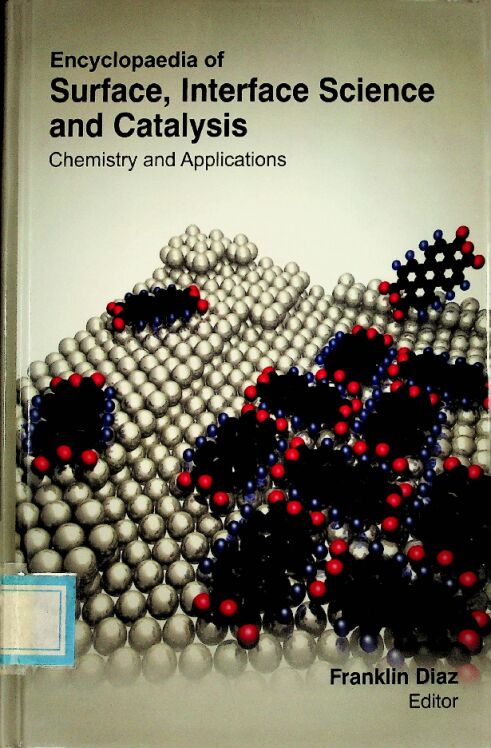
书名:Encyclopaedia of surface, interface science and catalysis
ISBN\ISSN:9781781540169,1781540160
出版时间:2012
出版社:Auris Reference,
前言
Chemical processes that occur at the phase boundary between gas-liquid, liquid-liquid, liquid—solid, or gas-solid interfaces. The chemistry and physics at surfaces and interfaces govern a wide variety of technologically significant processes. Chemical reactions for the production of low-molecular-weight hydrocarbons for gasoline by the cracking and reforming of the high・molecula「wei呂ht hydrocarbons in oil are catalysed at acidic oxide materials. Surface and interfacial chemistry are also relevant to adhesion, corrosion control, tribology (friction and wear), microelectronics, and biocompatible materials.
Interactions with the substrate may alter the electronic structure of an adsorbate. Those interactions that lower the activation energy of a chemical reaction result in a catalytic process. Adsorption of reactants on a surface also confines the reaction to two dimensions as opposed to the three dimensions available for a homogeneous process. The two-dimensional confinement of reactants in a bimolecular event seems to drive biochemical processes with higher reaction efficiencies at proteins and lipid membranes. The field of surface chemistry started with heterogeneous catalysis pioneered by Paul Sabatier on hydrogenation and Fritz Haber on the Haber process. Irving Langmuir was also one of the founders of this field, and the scientific journal on surface science, Langmuir, bears his name. The Langmuir adsorption equation is used to model monolayer adsorption where all surface adsorption sites have the same affinity for the adsorbing species. Gerhard Ertl in 1974 described for the first time the adsorption of hydrogen on a palladium surface using a novel technique called LEED. Similar studies with platinum, nickel, and iron followed. Most recent developments in surface sciences include the 2007 Nobel Prize of Chemistry winner Gerhard ErtFs advancements in surface chemistry, specifically his investigation of the interaction bet ween carbon monoxide molecules and platinum surfaces. Surface chemistry can be roughly defined as the study of chemical reactions at interfaces. It is closely related to surface engineering, which aims at modifying the chemical composition of a surface by incorporation of selected elements or functional groups that produce various desired effects or improvements in the properties of the surface or interface. Surface chemistry also overlaps with electrochemistry. Surface science is of particular importance to the field of heterogeneous catalysis. The adhesion of gas or liquid molecules to the surface is known as adsorption. This can be due to either chemisorption or by physisorption. These too are included in surface chemistry. The behaviour of a solution based interface is affected by the surface charge, dipoles, energies, and their distribution within the electrical double layer.
An interface is a surface forming a common boundary among two different phases, such as an insoluble solid and a liquid, two immiscible liquids or a liquid and an insoluble gas. The importance of the interface depends on which type of system is being treated: the bigger the quotient area/volume, the more effect the surface phenomena will have. Therefore interfaces will be considered in systems with big area/ volume ratios, such as colloids. Interfaces can be spherical or flat, so they can be considered to be always spherical with finite or infinite radius. For example oil droplets in a salad dressing are spherical but the interface between water and air in a glass of water is mostly flat. Surface tension is the function which rules interface processes. Interfaces may cause various optical phenomena, such as refraction. Optical lenses serve as an example of a practical application of the interface bet ween glass and air. One important interface is the gas liquid interface between aerosols and other atmospheric molecules.
This book contains a brief review of absorption and catalysis, for practical purposes. This also presents some important information on adsorbents and catalysts.
查看更多
目录
Preface vii
1. The Constitution of Liquids and Surface Tension Phenomena Forces Near the Surfaces of Molecules • Repulsive Forces between Molecules • Attractive Forces between Molecules • Ions • Polar Molecules • Principle of Independent Surface Action 1
2. Analytical Chemistry Volumetric Analysis • Gas Analysis • Organic Analysis • Orga notins Disrupt the 11 [b]-Hydroxy steroid Dehydrogenase Type 2-Dependent Local Inactivation • Chemicals and Reagents • Cell and Organism • Cell Culture • Inhibition of 11[b]-HSD2 in Endogenous Cell Lines 20
3. DNA-Expressed Sulphotransferase and Polychlorobiphenylols Kinetics of Inhibition • Sulphonation of 3-OH-BaP by HL Cytosol and Expressed Human SULT Isoforms • Neuroinflammation • Immune Cells in the Brain • Trauma tic Brain Injury and Development of PD • Systems Genetics • Alcoholism Genetics • Epis tasis Or Gene-Gene Interaction • Met hods for Detecting St atistical Epistasis • Toward a Systems Gene tics Approach • Ecology and Environmentai Exposure 71
4. Oxidative Stress and Mitochondrial Damage Ambient Particle Collection • Particle Chemical Analysis • C- type Cytochrome Assembly in Saccharomyces Cerevisiae • Re- emerges in Dupont • Commitment to Fundamental Research • A Robust Strategy 115
5. Complexity Theory Undefined but Complex Theory • Nonlinear • Computer Models • The Dichloroacetate Dilemma: Therapeutic Goldmine 154
6. Multiple Local Sequence Alignment and Gibbs Sampling Strategies Varia tions and Commonalities Among Functionally • Multinomial Models • Alignment When the Number of Elements Is Given • The Rank Test Of Significance • Organisation ofMatter • Change of form of Motion and Energy • Science, Materialism, and Religion • The Strategic Implications • Emerging Technologies • The Strategic Management of Technology • Illustrative Case Studies in R&D Strategy and Organisation 182
7. Ascorbate Depletion: Step in Nickel Carcinogenesis Extracellular Matrix, Ascorbate, and Tumour Promoters • Ascorbic Acid Interactions with Transition Metals • Cleaner Supply Chain: the Case of Green Chemistry • Green Chemistry: Sustainability through the Supply Chain • Policy Strategies to Advance Innovation for Sustainable Development • Greening the Defence Industry 243
Bibliography 275
Index 279
查看PDF
查看更多
作者简介
Franklin Diaz is BE in Chemical Engineering and PhD in PhysicalChemistry.At present he is associate professor of Chemical Engineering. His main study focus on Methodical focus on model predictive control, robust control and nonlinear control; control engineering applications in the field of automotive engineering,railway engineering,medical engineering and industry automation.
查看更多
馆藏单位
中科院文献情报中心