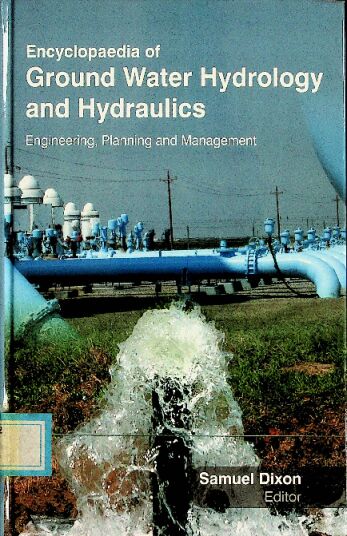
书名:Encyclopaedia of ground water hydrology and hydraulics
出版时间:2012
出版社:Auris Reference,
前言
The first water was most probably not from the sea,but in the clouds.For simplicity,however,let us begin with the sea,that vast reservoir holding all but a tiny fraction of our water.For man,to whom the withholding of a mere two quarts of the liquid a day can mean death, the quantity of water in the oceans is all but incomprehensible.To number the quarts in the sea would result in astronomical figures.Even the number of cubic miles contained is fantastic to those of us not used to dealing in such figures. There are some 327,672,000 cubic miles of water in the oceans. Expressed in a way that is easier to visualise,there is sufficient water in the world that all the dry land could be covered with a column of water five miles high.Of this total,98.33 percent is sea water.Herein lies the big problem of man dependent on fresh water to drink.
Leonardo da Vinci was a pioneer in pinpointing the true nature of the hydrologic cycle.Among his many careers was that of commissioner of canals for the Milan area,and he learned enough about water to write,"we may conclude that the water goes from the rivers to the, sea and from the sea to the rivers,thus constantly circulating and returning,and that all the sea and rivers have passed through the mouth of the Nile an infinite number of times.”Egyptians would have been inclined to agree with this,adding perhaps that it seemed that all the water passed through the Nile several times during flood season.Da Vinci goes on:"The conclusion is that the saltness of the sea must proceed from the many springs of water which,as they penetrate the earth,find mines of salt,and these they dissolve in part and carry with them to the ocean and the other seas. whence the clouds,the begetters of rivers,never carry it up.'
Da Vinci erred very slightly at this point,for there is some salt carried into the atmosphere.In fact,some scientists believe that salt forms nuclei for raindrops,as do ice crystals and dust particles.There is salt in rainwater,but since it is there in a concentration of only about a few parts per million,Da Vinci was essentially correct.The clouds,indeed,are the begetters of rivers.Each year about 80,000 cubic miles of water evaporates from the oceans of the world.Another 15,000 cubic miles evaporates from water on the continents.In due course,this huge amount of water must fall as some sort of precipitation. Because they represent only about one-quarter of the surface of the earth, the lands receive "only"about 24,000 cubic miles of precipitation a year. We can thank the sun for operating this vast global distillery of fresh water for us.Aiding in circulating the vapour content of the atmosphere are the winds generated by the rotation of earth and by the uneven heating of land and water surfaces.The result is a great mixing that guarantees world tours for individual water molecules.
The reader of the book will find comprehensive knowledge with suitable examples to this subject.
查看更多
目录
Preface vii
1. The Hydrologic Cycle 1
Floods and Drought ·Controlling and Restoring the Waters 32
·Water in Motion·Storing Floodwaters·Restoring and Conserving Water·Designing to Conserve and Restore Water and to Prevent Floods·A Plan for Every City
2. The Global Challenge 32
In the Year 2025 · In the Year 2080 ·The Economic Paradigm ·Case Study:An Irrigation Cycle in Southern India·Water Resource Planning at the Regional Scale ·Irrigation Water Efficiencies ·Case Study:Water Allocation on the Palestinian West Bank ·The Rural and Urban uses of Water·Policy Alternatives
3. Water Quality Management Systems 89
The Basin-Wide Firm Again - Regional System with Flow Regulation ·Effluent Charges and Collective Measures ·Unmeasured Values as Constraints on the Objective·Some "Short-Run"Aspects of System Operation and Cost Assessment
4.Industrial Topography and Groundwater 105
Transportation Systems and Water ·Drawing on Geology and Hydrology ·Engineering Industrial Sites ·The Engineer's Geography·The Engineer's Way ·An Introductory Hydrogeology Course·Project Scenario ·Project Requirements ·Model and Simulations ·Evaluation
5.Groundwater Site Characterisation 135
Characterisation of Groundwater Systems ·An Environmental Engineering Design ·Interactive Site Investigation Software Sedimentary Geology,Sediment Cycling and
6.the Earth System 156
Sediment and Palaeoenvironments ·Sedimentation.Erosion and Active Tectonic Structures ·The Lateral growth of Surface Faults ·Catchment or Regional Scale ·Empirical Geo-abiotic Relationships ·Sediment Burial or Sequestration Rates ·Sedimentary and Stratigraphie Process Models·Cybertectonic Earth and Gaia's Weak Hand ·Continental Dispositions: Climate,Ocean Circulation and Tectonic Cycling ·Soil Development and Management ·The Special Effects of Clay Parent Materials ·Soils of the Humid Tropics · Soils of Arid Lands ·The Role of Hydrology in Soil Management ·Rapid Mass Movement Processes -Surface Water Erosion ·Subsurface-water Erosion
7. The Groundwater Resource 205
Groundwater Movement ·Occurrence and Natural Quality of Groundwater ·Use of Groundwater ·Movement of Contaminants ·Changes in the Composition of Groundwater Due to Natural Processes -Contamination Due to Waste- Disposal Practices·Land Disposal of Solid Wastes·Collection Treatment,and Disposal of Municipal Wastewater·Deep-Well
Disposal of Liquid Wastes·Other Sources of Contamination Accidental Leaks and Spills
8. Hydrology and Hydrologic Function 259
Precipitation Patterns ·Soil Characteristics ·Runoff Processes and Streamflow ·Erosion and Sediment Transport ·Channel Dynamics and Morphology ·Large Woody Materials · Water Quality
Bibliography 273
Index 277
查看更多
馆藏单位
中科院文献情报中心