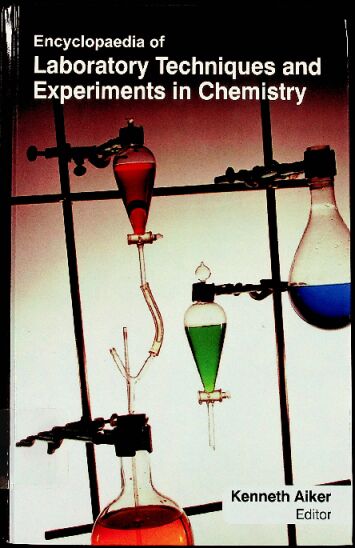
书名:Encyclopaedia of laboratory techniques and experiments in chemistry. Volume 1
ISBN\ISSN:9781781540503,1781540500
出版时间:2012
出版社:Auris Reference,
前言
Chemistry is a practical science. Practical activities are notjust motivational and fun: they also enable students to apply and extend their knowledge and understanding ofchemistry in novelinvestigative situations, which can aid learning and memory and stimulate interest. Good quality,appropriate chemistry experiments and investigations are the key to enhanced learning, and clarification and consolidation of theory.Traditional chemistry starts with the study of elementary particles,atoms,molecules,substances, metals, crystals and other aggregates of matter in solid, liquid, and gas states, whether in isolation or combination. The interactions,reactions and transformations that are studied inchemistry are a result of interaction either between different chemical substances or between matter and energy. Such behaviours are studied in a chemistry laboratory using various forms of laboratory glassware. A chemical reaction is a transformation of some substances into one or more other substances. It can be symbolically depicted through a chemical equation. The number of atoms on the left and the right in the equation for a chemical transformation is most often equal. The nature of chemical reactions a substance may undergo and the energy changes that may accompany it are constrained by certain basicrules,known aschemical laws.
Energy and entropy considerations are invariably important in almost all chemical studies. Chemical substances are classified in terms of their structure, phase as well as theirchemical compositions. They can be analysed using the tools of chemical analysis,e.g. spectroscopy and chromatography. Scientists engaged in chemical research are known as chemists. Most chemists specialize in one or more sub-disciplines. When a chemical substance is transformed as a result of its interaction with another or energy,a chemical reaction is said to have occurred. Chemical reaction is therefore a concept related to the 'reaction'of a substance when it comes in close contact with another, whether as a mixture or a solution; exposure to some form of energy,or both.It results in some energy exchange between the constituents of the reaction as well with the system environment
查看更多
目录
Preface xi
VOLUME 1
1. Barometre 1 Barometre ·Types· Compensations ·Etymology· Soda Siphons · Social Popularity,Decline,and Renaissance·Historical Development and Importance·An Experimental Enquiry Concerning the Source of the Heat which is Excited by Friction·Mechanical Equivalent of Heat·Conservation of Energy·Mechanical Equivalent of Heat·The First Law of Thermodynamics·Chlorophyll·Chemical Structure·Earth's Early Atmosphere
2. Geiger-Marsden Experiment 39 Experimental Procedure and Results·Titration·Types of Titrations·Complexometric Titration·Endpoint and Equivalence Point·Neutralisation (Chemistry)· Precipitation(Chemistry)·Representation Using Chemical Equations· Redox· Redox Reactions in Biology
3. Mass Spectrometry 62 Inductively Coupled Plasma·Sector Instruments·Ion Traps·Tandem Mass Spectrometry·Ion Mobility·Data Analysis·Trace Gas Analysis·Respired Gas Monitor·Biochemistry·Structure Determination·CellSignalling and Ligand Binding·Structure Prediction and Simulation·Distillation·Idealized Distillation Model·Steam Distillation·Air-sensitive Vacuum Distillation·Pressure-swing Distillation·Distillation in Food Processing · Absorption (Electromagnetic Radiation)·Fluorescence·Analytical Chemistry·Organic Liquids·Resistivity of Various Materials
4. Chromatography 133 Chromatography Terms· Techniques by Chromatographic Bed Shape·Techniques by Physical State of Mobile Phase·Techniques by Separation Mechanism·Special Techniques·Simulated Moving-bed Chromatography·Chemometrics·Classification,Pattern Recognition,Clustering·Forensic Science· Bioanalysis ·Clinical Chemistry
5. Elemental Analysis 163 Laboratory Techniques·Air Sensitivity·Cannula Transfer Methods·Handling Pyrophoric Material·Glovebox·Schlenk Flask· Straus Flask
6.Electrophoresis 181 Affinity Electrophoresis·Gel Electrophoresis·Capillary Electrophoresis·Modes of Separation ·Colour Marker·Commercially Available Kits and Reagents·DNA Separation by Silica Adsorption ·Electrical Mobility·Electrophoresis(Journal)
7. Electrophoretogram 217 Gel Electrophoresis of Nucleic Acids·HPCE-based Viral Titer Assay ·Iontocaine·Iontophoresis ·Isoelectric Focusing in Laboratory·Microchip Based Isotachophoresis · Kinetic Capillary Electrophoresis· Gel Electrophoresis of Proteins·Denaturing Gel Methods·Protomap (Proteomics)·Pulsed Field Gel Electrophoresis·QPNC-PAGE·SDS-PAGE·Chemical Ingredients and their Roles·Chemicals for Processing and Visualisation·Prealbumin·Temperature Gradient Gel Electrophoresis·Denaturing Gradient Gel Electrophoresis ·Terminal Restriction Fragment Length Polymorphism· Two-dimensional Gel Electrophoresis
VOLUME 2
8. Laboratory Techniques 265 Acid-base Extraction·Affinity Magnetic Separation·Air-free Technique· Allele-specific Oligonucleotide·Ames Test· Ammonium Sulfate Precipitation·Animal Testing·Care anduse ofAnimals·Research Classification·Cosmetics Testing· Annexin A5 Affinity Assay
9. Anterograde Tracing 305 Assay·Baby Gender Mentor·Accuracy of the Test Disputed·Blot ·Cannula Transfer· Cannula Transfer Methods·Handling Pyrophoric Material·Carnoy's Solution·Cell Counting · Cell Disruption by Nitrogen Decompression
10. Cell Fractionation 329 Centrifugation · Centrifugation in Biological Research·Centrifugation Analysis·Chemotaxis Assay·Micro-video- recordingTechnology·Clearing Factor·COLD-PCR·Column Chromatography·Automated Systems· Conditioned Place Preference · Cooling Bath
11. Cot Analysis 353 Cot Filtration·Crystallisation·Artificial Methods·Typical Equipments ·Main Crystallisation Processes · Cooling Crystallisation· Cycling Probe Technology·Decantation·Degasification ·Differential Centrifugation
12. Digital Holographic Microscopy 377 Working Principle·DigitalPolymerase Chain Reaction·Direct Fluorescent Antibody·Dispersion Stability
13. DNA Extraction 389 DNA Footprinting·DNALaddering·DNase FootprintingAssay· Electric Cell-substrate Impedance Sensing
4. Electrochromatography 396 Electropherogram· Electrophoresis (Disambiguation)·Ethanol Precipitation·Ethidium Homodimer Assay·Far-Eastern Blotting·Field Flow Fractionation·Filtration·Achieving Flow Through the Filter·FLAG-tag·Flow Cytometry·Hybridisation·Variations on Probes and Analysis·Förster Resonance Energy Transfer· Experimental Confirmation of the Fgrster Resonance EnergyTransferTheory·Plasma Protein Fractionation
15. Gas Chromatography 433 Carrier Gas Selection and Flow Rates·Sample Size andInjection Technique ·Data Reduction and Analysis ·Gas Chromatography-mass Spectrometry·Types of Mass Spectrometre Detector·Gel Extraction ·Gene Gun·Gene Knockin·Gene Knockout·Helicase-dependent Amplification·Hofmeister Series ·Homogenization·Homogenization(Chemistry)·Host-Cell Reactivation ·Hot Plate Test· Hydrophilic Interaction Chromatography
16. Immunocytochemistry 468 Immunocytochemistryvs.Immunohistochemistry·Immunoelectrophoresis·Immunohistochemistry·Sample Labelling · Target Antigen Detection Methods·Immunomagnetic Separation ·Immunoperoxidase·Impalefection·In Situ Hybridisation·Inverse Polymerase Chain Reaction·Ion-mobility Spectrometry-mass Spectrometry·Analysis ofNano ParticlesIsotopic Dilution·IsotopicLabelling·Isotopic Tracer ·K-Casein ·K-factor(Centrifugation)·Kodecyte·Kodevirion·Kugelrohr·Laboratory Automation·Laboratory Centrifuge·Laboratory Diagnosis of Viral Infections·Lamm Equation·Liquid Gas·Liquefied Petroleum Gas·Liquid-liquid Extraction·Measures of Effectiveness·Multistage Countercurrent Continuous Processes·Industrial Process Design ·List of Purification Methods in Chemistry ·Low Copy Number
VOLUME 3
17. Experiments in Molecules 521 Acetic Acid ·Methanol Carbonylation·Ethylene Oxidation·Reduction to Alcohols·Formic Acid·Hymenoptera· Chemical Formula·Common Types of Structural Formula·Atom·Atomic Theory·Atomic Nucleus·Shell Models and otherQuantum Models·Electron·Proton·Neutron·Neutron Interactions · Molecule
18. Molecular Spectroscopy 578 Chemical Bond· The Covalent Bond· Coordinate Covalent Bond ·Hydrogen Bond in Proteins and DNA · Isomer· Structural Isomers·Stereoisomers·Hydrogen Peroxide· Crystal· Crystalline Materials·Classification of Crystals by Symmetry·Crystal Symmetry and Physical Properties· Polymer ·Physical Properties of Polymers
19.Acid-base Reaction 630 Common Acid-base Theories·Other Acid-base Theories·Ion·Carbon·Notable Characteristics·Carbon Exchange Involving Biological Processes · Oxygen
20. Covalent Bond 657 History and TheoreticalDevelopment·Bond Order·Coordinate Covalent Bonds· Electronegativity·Electronegativity Trends·Carbide·Carbon Monoxide·Principal Chemical Reactions·Organic and Main Group Chemistry·Internal Combustion Engine·DieselEngine Ignition Process·Engine Configuration·Fuel·Pressure·RelativePressure orGauge Pressure·Steam Engine·External Combustion Engine·Rotary Steam Engines·Mechanical Work·Conservation of Mechanical Energy·Carbon Dioxide·Carbon Cycle·Carbon Exchange with the Atmosphere, Biosphere, and Oceans
21. Biogeochemical Cycle741 Nitrogen Cycle·Phosphorous Cycle·Sulfur Cycle·Water Cycle·Hydrogen Cycle·LacticAcid·LacticAcidasa Polymer Precursor·CitricAcid·Ethanol·Acid-base Chemistry·Types of Ethanol·Chemicals Derived from Ethanol·Alcohol·Some Simple Alcohols and their Sources·Preparation of Alcohols·Reactions of Alcohols
Bibliography 783
Index 787
查看PDF
查看更多
馆藏单位
中科院文献情报中心