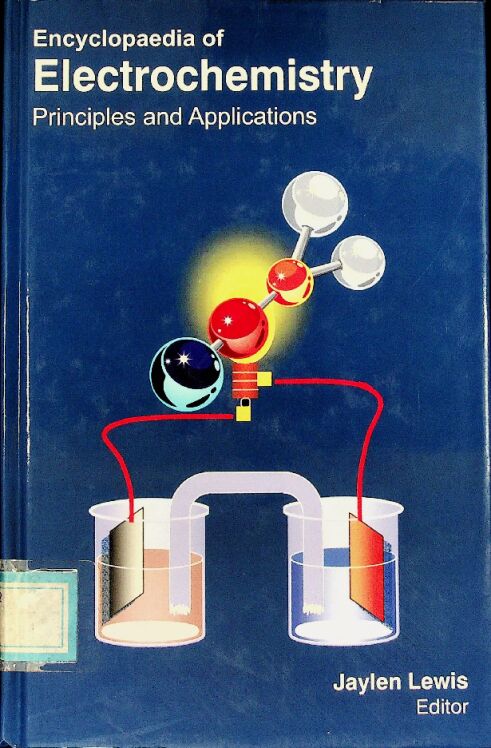
书名:Encyclopaedia of electrochemistry
ISBN\ISSN:9781781540121,1781540128
出版时间:2012
出版社:Auris Reference,
前言
Electroanalytical methods are a class of techniques in analytical chemistty which study an analyte by measuring the potential (volts) and/or current (amperes) in an electrochemical cell containing the analyte. These methods can be broken down into several categories depending on which aspects of the cell are controlled and which are measured. The three main categories arepotentiometry (the difference in electrode potentials is measured), coulometry (the celFs current is measured over time), and voltammetry (the cell's current is measured while actively altering the celFs potential). Potentiometry passively measures the potential of a solution between two electrodes, affecting the solution very little in the process. The potential is then related to the concentration of one or more analytes. The cell structure used is often referred to as an electrode even though it actually contains tuuo electrodes: an indicator electrode and a reference electrode (distinct from the reference electrode used in the three electrode system). Potentiometry usually uses electrodes made selectively sensitive to the ion of interest, such as a fluoride-selective electrode. The most common potentiometric elec tiode is the glass-membrane electrode used in a pH meter.
Coulometry uses applied current or potential to completely convert an analyte from one oxidation state to another. In these experiments, the total current passed is measured directly or indirectly to determine the number of electrons passed. Knowing the number of electrons passed can indicate the concentration of the analyte or, when the concentration is known, the number of electrons transferred in the redox reaction. Common forms of coulometry include bulk electrolysis, also known as Potentiostatic coulometry or controlled potential coulometry, as well as a variety of coulometiic titrations. Voltammetry applies a constant and/or varying potential at an electrode's surface and measures the resulting current with a three electrode system. This met hod can reveal the reduction pot ential of an analyte and its elec trochemical reacti vity. This met hod in practical terms is nondestructive since only a very small amount of the analyte is consumed at the two-dimensional surface of the working andauxiliary electrodes. In practice the analyte solutions is usually disposed of since it is difficult to separate the analyte from the bulk electrolyte and the experiment requires a small amount of analyte. A normal experiment may involve 1—10 mL solution with an analyte concentration bet ween 1 and 10 mmol/L.
Polarometry is a subclass of voltammetry that uses a dropping mercury electrode as the working electrode. The auxiliary electrode is often the resulting mercury pool. Concern over the toxicity of mercury has caused the use of mercury electrodes to decrease greatly. Alternate electrode materials, such as the noble metals and glassy carbon, are aHordable, inert, and easily cleaned. Most of Amperometry is now a subclass of voltammetry in which the electrode is held at constant potentials for various lengths of time. The distinction between amperometry and voltammetry is mostly historic. There was a time when it was difficult to switch between “holding” and “scanning” a potential. This function is trivial for modern potentiostats, and today there is little distinction between the techniques which either “hold”,"scan”,or do both during a single experiment. Yet the terminology still results in confusion, for example, differential pulse voltammetry is also referred to ^differential pulse amperometry. This experiment can be seen as the combination of linear sweep voltammetry and chronoamperometry thus the confusion in which category it should be named. One advantage that distinguishes amperometry from other forms of voltammetry is that in amperometry, the current readings are averaged (or summed) over time. In most of voltammetry, current readings must be considered independently at individual time intervals. The averaging used in amperometry gives these methods greater precision than the many individual readings of (other) voltammetric techniques. Not all of the experiments which were historically amperometry now fall under the domain of voltammetry. In an amperometric titration, the current is measured, but this would not be considered voltammetry since the entire solution is transformed during the experiment. Amperometrie titrations are instead a form of coulometry.
This book will be found useful by those who wish to make a more det ailed study of the t opics discussed.
查看更多
目录
Preface vii
1. Triboelectric Effect Risks and Counter-Measures • Nanowire • Physics of Nanowires • Electrical Conductor • Perfect Electric Conductor • Polariser • Beam-Splitting Polarisers • Malus' Law and Other Properties • Creating Circularly Polarised Light • Absorbing and Passing Circularly Polarised Light • Homogenous Circular Polariser • Circular Polarisation • Circularly Polarised Luminescence 1
2. Electromagnetism History of Electromagnetic Theory • Middle Ages and the Renaissance • Second Indus trial Revolution • Elec trodynamic Tethers • Classical Electromagnetism • Electroma呂netic Waves • Photoelectric Effect • Electromotive Force • Notation and Units of Measurement • Formal Definitions of Electromotive Force • Electromotive Force in Thermodynamics • Electromotive Force and Voltage Difference • Electromotive Force Generation • Electromotive Force of Cells • Raoulfs Law • Michaelis-Menten Kinetics • Equilibrium Approximation 40
3. Reaction Progress Kinetic Analysis Monitoring Reaction Progress • Data Manipulation and Presentation • Catalytic Kinetics and Catalyst Resting State • Determining Catalyst Turn-Over Frequency • Determining Reaction Stoichiome try • Steady St ate (Chemis try) • Chemical Equilibrium • Addition of Reactants or Products • Types of Equilibrium • Oxidative Addition • Oxidative Phosphorylation • Overview of Energy Transfer by Chemiosmosis 117
4. Partial Oxidation Dissociation Constant • Acid Dissociation Constant • Equilibrium Constant • Experimentai Determination • Values for Common Substances 175
5. Potential Energy Gravitational Potential Energy • Calculation of Elastic Potential Energy • Electrostatic Potential Energy • Relation between Potential Energy, Potential and Force • Stray Voltage • Origins of Stray Voltages • Liquid Junction Potential • Elimination of Liquid Junction Potential • EMF Measurements • Direct Methanol Fuel Cell • Direct-ethanol Fuel Cell 200
6. Bromley Equation Eutler-Volmer Equation • Cottrell Equation • Davies Equation • Levich Equation • Nernst—Planck Equation 234
7. Pitzer Equations Compilation of Pitzer Parameters • Randles-Sevcik Equation • Tafel Equation • Carbon Paste Electrode • Cellulose Electrode 242
8. Electrode Anode and Cathode in Electrochemical Cells • Alternating Current Electrodes • Anode • Battery or Galvanic Cell Anode • Chemically Modified Electrode • Applications of Chemically Modified Electrodes • Approaches to Chemically Modify Electrodes • Clark Electrode 251
9. Dynamic Hydrogen Electrode Fluoride Selective Electrode • Palladium-Hydrogen Electrode • Mixed Metal Oxide Electrode • Liquid Metal Electrode • Lightning Rod • Electric Power System Lightning Protection • Dissipation & Charge Transfer Theories • Strong Electrolyte 264
Bibliography 283
Index 287
查看PDF
查看更多
作者简介
Jaylen Lewis is a principal investigator at the Department of Ceramics and Glass Engineering, University of Melbourne.Having received his doctoral degree in physical chemistry from the Belarus State University in1993,Dr. Lewis has published over 280 scientific papers in international SCI journals, including 10 reviews,and coauthored over 40 papers in other refereed journals and volumes, 3 books and 2 patents.
查看更多
馆藏单位
中科院文献情报中心