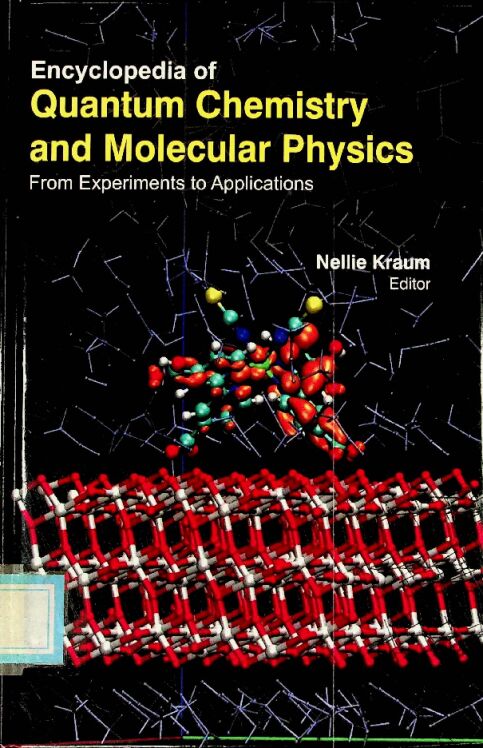
书名:Encyclopedia of quantum chemistry and molecular physics
ISBN\ISSN:9781781542958,1781542945
出版时间:2014
出版社:Auris Reference,
前言
The manner in which the negative charge of an atom or a molecule is arranged in three-dimensional space is determined by the electronic charge density distribution. Thus, it determines directly the sizes and shapes of molecules, their electrical moments and, indeed, all of their chemical and physical proper ties. Since the charge density describes the distribution of negative charge in real space, it is a physically measurable quantity. Consequently, when used as a basis for the discussion of chemistry, the charge density allows for a direct physical picture and interpretation. In particular, the forces exerted on a nucleus in a molecule by the other nuclei and by the electronic charge density may be rigorously calculated and interpreted in terms of classical electrostatics. Thus, given the molecular charge distribution, the stability of a chemical bond may be discussed in terms of the electrostatic requirement of achieving a zero force on the nuclei in the molecule. A chemical bond is the result of the accumulation of negative charge density in the region between any pair of nuclei to an extent sufficient to balance the forces of repulsion. This is true of any chemical bond, ionic or covalent, and even of the shallow minimum in the potential curves arising from van der Waals* forces. In this treatment, the classifications of bonding, ionic or covalent, are retained, but they are given physical definitions in terms of the actual distribution of charge within the molecule. In covalent bonding the valence charge density is distributed over the whole molecule and the attractive forces responsible for binding the nuclei are exerted by the charge density equally shared between them in the internuclear region. In ionic bonding, the valence charge density is localized in the region of a single nucleus and in this extreme of binding the charge density localized on a single nucleus exerts the attractive force which binds both nuclei.
This book begins with a discussion of the need for a new mechanics to describe the events at the atomic level. This is illustrated through a discussion of experiments with electrons and light, which are found to be inexplicable in terms of the mechanics of New ton. The basic concepts of the quantum description of a bound electron, such as quantization, degeneracy and its probabilistic aspect, are introduced by contrasting the quantum and classical results for similar one・ dimensional systems. The atomic orbital description of the many�electron atom and the Pauli exclusion principle are considered in some detail, and the experimental consequences of their predictions regarding the energy, angular momentum and magnetic properties of atoms are illu就rated. The alternative interpretation of the probability distribution (for a stationary state of an atom) as a representation of a static distribution of electronic charge in real space is stressed, in preparation for the discussion of the chemical bond. Chemical binding is discussed in terms of the molecular charge distribution and the forces which it exerts on the nuclei, an approach which may be rigorously presented using electrostatic concepts. The discussion is enhanced through the extensive use of diagrams to illustrate both the molecular charge distributions and the changes in the atomic charge distributions accompanying the formation of a chemical bond.
The primary aim of this book is to present a succinct account of the essential features of this subject. It is being prepared by keeping in view the requirements of the students and academic professionals.
查看更多
目录
Preface (vii)
1.Introduction · Molecule · History of Molecular Theory · Molecular Size · Molecular Formula · Born-Oppenheimer Approximation · Dihydrogen Cation · Hydrogen · Properties · Hydrogen Atom · Protons and Acids · History 1
2.Homonuclear Molecule · Diatomic Molecule · Hund's Cases · Period 1 Element · Period 2 Element · Oxidation State · Oxidation State and Formal Charge · Fractional Oxidation States · Spectroscopic Oxidation States vs. Formal Oxidation Numbers · Unusual Formal Oxidation States · History of the Oxidation Number Concept · Oxygen · Reflection Symmetry.VSEPR Theory · Multi-Configurational Self-Consistent Field · Diatomic Carbon 42
3. Spectroscopic Notation · Ionization States·Molecular Term Symbol · Triatomic Molecule · Vibronic Spectroscopy · Rotational Spectroscopy · Structure of Rotational Spectra · Wave Function · Information about Quantum Systems ·Definition(Other Cases) · One Spin-0 Particle in Three Spatial Dimensions 100
4. Density Matrix · Pure and Mixed States · Entropy · Tensor Operator · Rotations of Tensorial Operators · Angular Momentum and Spherical Harmonics · Rotation · MatrixExponential · Applications · Logarithm of a Matrix 153
5.Standard Model · Overview · Theoretical Aspects · Hartree-Fock Method · Mathematical Formulation · Perturbation Theory · Perturbation Orders · Perturbation Theory of Degenerate States · Perturbation Theory in Chemistry · Electronic Correlation · Basis Set(Chemistry) · Basis Set Superposition Error 193
6. Gaussian Orbital · Rationale · Gaussian Beam · Power and Intensity · Koopmans' Theorem · Configuration Interaction · Coupled Cluster · Bond Length 232
7. Molecular Geometry · Molecular Geometry Determination · Types of Molecular Structure · Orbital Hybridization · Types of Hybridization · Clarifying Misconceptions · Electron Electric Dipole Moment · Conformational Isomerism · Bent Molecular Geometry · Capped Square AntiprismaticMolecular Geometry · LCP Theory 257
8. Tetrahedral Molecular Geometry · Main Group Chemistry · Inverted Tetrahedral Geometry · Orbital Overlap · Octahedral Molecular Geometry · Molecular Hamiltonian · Electron Configuration · Energy-Ground State and Excited States 276
Bibliography 301
Index 303
查看PDF
查看更多
作者简介
Dr. Nellie Kraum has more than 25 years of experience as a lecturer of Chemistry and Physics, including 15 years of chemical research project head. She has done PhD in chemistry degrees from theNHTV Breda University, Holland. She also has extensive teaching experience ranging from academics to hands-on workshops.
查看更多
馆藏单位
中科院文献情报中心