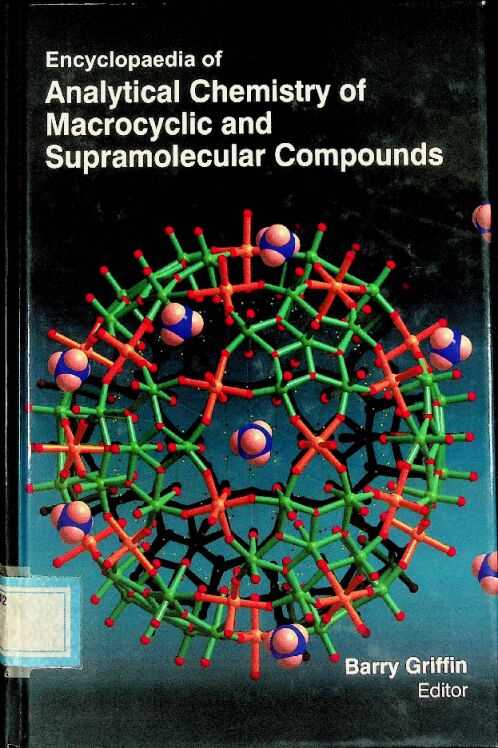
书名:Encyclopaedia of analytical chemistry of macrocyclic and supramolecular compounds. Volume 4, Rotaxane synthesis and applications chemistry
出版时间:2012
出版社:Auris Reference,
前言
Catenanes and rotaxanes are both examples of interlocked molecules. Unlike classical molecular structures, they consist of two or more separate components which are not connected by chemical (i.e. covalent) bonds. These structures are, however, true molecules (NOT supramolecular species!), as each component is intrinsically 11 nked to the other — resulting in a lnechanical bond which prevents dissociation without cleavage of one or more covalent bonds. Catenanes consist of two or more interlocked macrocyclic rings. The discovery of highly efficien t synt he tic stra tegies for making elec trochemically switchable, mechanically interlocked compounds will facilitate their continued development as components in molecular electronic devices (MEDs) and nanoelectromechanical systems (NEMS). Traditionally, such compounds, incorporating cyclobis(paraquat-p-phenylene) (CBPQT4+) as the 兀・accepting ring component, have been synthesized by "clipping' a partially formed CBPQT4+ ring around a dumbbell or ring containing 7r-electron・rich recognition sites. Although this synthetic strategy has found wide application, the moderate yield typical of the CBPQT4+ clipping reaction limits 辻s practical value to the preparation of rotaxanes and catenanes. Herein, we describe an alternative synthetic approach to donor-acceptor rotaxanessincluding previously inaccessible and rotaxanes. Their synthesis relies upon the efficient stopperin呂 of their pseudorotaxane precursors. Motivated by the use of click chemistry in the synthesis of a variety of functional materials, including an example in which the Cu catalyst templates rotaxane formation, we reasoned that donor-acceptor rotaxanes might be obtained by attaching alkyneterminated stoppers to CBPQT4+ pseudorotaxanes using the Cu- (I)-catalyzed Huisgen 1,3-dipolar cycloaddition.
The click reaction has been noted for its high regioselectivity, toletance of sensitive functional groups, mild reaction conditions, and excellent yields. The click reaction occurs at room temperature, requiring only the addition of catalytic amounts of CuSO t and ascorbic acid, all conditions which are ideal for strongbinding of CBPQT" to a wide variety of thread molecules containing 兀-donors. This threading- followed-by-stoppering approach is complementary to clipping and has a number of ad van ta 呂 es. Because t herecognition elements are fully formed from the outset of the reaction, templation utilizes the full thermodynamic binding of CBPQT,+ to the guest of interest. The click methodology is also much more convergent: relatively simple, modular rotaxane components are synthesized in parallel, and the mechanically interlocked structure is assembled in the final step of the reaction protocol. The general synthetic strategy (Scheme 1) involves the mixing of CBPQTP4PF6 in DMF at -10 °C, with a 1,5- dioxynaphthalene (DNP) derivative 1 carrying azide-terminated glycol chains. Under these conditions, the equilibrium lies predominantly in favour of the pseudorotaxane [1 CBPQT4+ ]P 4PF6. A propargyl ether- functionalizedstoppei is then added to the reaction mixture along with CuSO0p5H.,O and ascorbic acid. Following these mild reaction conditions, the rotaxane 3p4PF6 was isolated in 82% yield. Formation of the dumbbell was not observed by thin layer chromatography.
These book are devised for such courses. Separate chapters are devoted for the various analytical techniques.
查看更多
目录
Preface vii
1. Rotaxane Macrocycle Effect • Cyclotide Structure • Macrocycle • Cryptand • Clathrate Compound • Clathrochelate • Molecular Knot • Supramolecular Chemistry • Control of Supramolecular Chemistry • Concepts in Supramolecular Chemistry • Scanning Tunnelling Microscope 1
2. Catenane Properties and Applications • Elementary Proper ties of Superconductors • Superconducting Phase Transition • Crystal Structure of High-Temperature Ceramic Superconductors • Cyclobutane • Cyclobutadiene • 1,3-Butadiene • Butane • Polybutadiene • Metallocene Polybutadiene • Polymer Degradation • Chemical Degradation • Mechanically-Interlocked Molecular Architectures • Mechanisms of Action • Dimethyl Ether 34
3. Molecular Borromean Rings Borromean Rings • Triquetra • Link Group • Celtic Knot • Knot Group • Endless Knot • Dynamic Covalent Chemistry • Template Reaction 92
4. Knot Theory Quipu • Linking Number • Knot Polynomial • Dowker Notation • Conway Notation (Knot Theory) • Quantum Topology • Knots and Graphs 110
5. Transition Metal Classification • Characteristic Properties • Ligand Field Theory • Post-Transition Metal • Antiferromagnetism • Exchange Bias • Giant Magnetoresistance • Magnetoresistance • Anisottopic Magnetoresistance (AMR) • Colossal Magnetoresistance • Tunnel Magnetoresistance • Geometrical Frustration • Extension of Pauling's Model: General Frustration • Ising Model • Ferromagnetism 149
6. Co-ordination Polymers Coordination Polymerization • Organometallic Chemistry • Metal-Organic Framework • Coordination Polymers and Supramolecular Architectures 197
Bibliography 251
Index 255
查看PDF
查看更多
作者简介
Barry Griffin is professor of analytical chemistry. He earned his B.S.in 1970 and Ph.D.in 1974.His research interest include Analytical,Energy Science,Materials and Polymer Chemistry, Surfaces and Solid State.His notable publications are:Selective Interlayers and Contacts in Organic Photovoltaic Cells,Photoemission spectroscopy of tethered CdSe nanocrystals: Shifts in ionization potential and local vacuum level as a function of nanocrystal capping ligand etc.
查看更多
馆藏单位
中科院文献情报中心