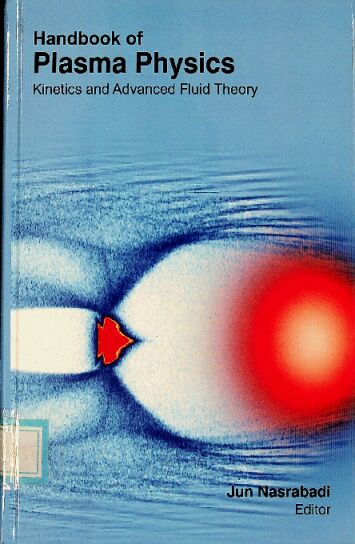
书名:Handbook of plasma physics
出版时间:2012
出版社:Auris Reference,
前言
A plasma is a gas in which an important fraction of the atoms is ionized, so that the electrons and ions are separately free. When does this ionization occur? When the temperatw·e is hot enough. Plasmas are by far the most common phase of matter in the universe, both by mass and by volume. All the stars are made of plasma, and even the space between the stars is filled with a plasma, a lbeit a very sparse one. In our solar system, the planet Jupiter accounts for most of the non-plasma, only about 0.1 % of the mass and 10-1r,% of the volume within the orbit of Pluto. Very small grains within a gaseous plasma will also pick up a net negative ch arge, so that they in twin may act like a very heavy negative ion component of the plasma. In physics and ch emistry, plasma is a state of matter similar to gas in which a certain portion of the particles are ionized. Heating a gas mayionize its molecules or atoms (reduce or increase the number of electrons in them), thus turning it into a plasma, which contains ch argedparticles: positive ions and negative electrons or ions. Ionization can be induced by other means, such as strong electromagnetic field applied with a laser or microwave generator, and is accompanied by the dissociation of molecular bonds, if present. The presence of a nonnegligible number of charge carriers makes the plasma electrically conductive so that it responds strongly toelectromagnetic fields. Plasma, therefore, has properties quite unlike t hose of solids, liquids, or gases and is considered a distinct state of matter. Like gas, plasma does not h ave a definite shape or a definite volume unless enclosed in a container; unlike gas, under the influence of a magnetic field, it may form structures such as filaments, beams and double layer. Some common plasmas a re found in stars and neon signs. In the universe, plasma is the most common state of matter for ordinary matter, most of which is in the rarefied intergalactic plasma (particularlyintraclu ter medium) and in stars.
Plasma temperature is commonly measured in kelvins or electronvolts and is, informally, a measure of the thermal kinetic energy per particle. Very high temperatures are usually needed to sustain ionization, which is a defining feature of a plasma. The degree of plasma ionization is determined by the "electron temperature" relative to the ionization energy, (and more weakly by the density), in a relationship called the Saha equation. At low temperatures, ions and electrons tend to recombine into bound states- atoms, and the plasma will eventually become a gas. In most cases th e electrons are close enough to thermal equilibrium that their temperature is relatively well-defined, even when there is a significant deviation from a Maxwellian energy distribution function, for example, due to UV radiation, energetic particles, or strong electric fields. Because of the large difference in mass, the electrons come to thermodynamic equilibrium amongst themselves much faster than they come into equilibrium with the ions or neutral atoms. For this reason, the "ion temperature" may be very different from (usually lower than) the "electron temperature". This is especially common in weakly ionized technological plasmas, where the ions are often near the ambient temperature.
Based on the relative temperatures of the electrons, ions and neutrals, plasmas are classified as "thermal" or 'non-thermal". Thermal plasmas have e lectrons and the heavy particles at the same temperature, i.e., they are in thermal equilibrium with each other. Non-thermal plasmas on the other h and have t he ions and neutrals at a much lower temperature (normally room temperature), whereas electrons are much "hotter". A plasma is sometimes referred to as being "hot" if it is nearly fully ionized, or "cold" if only a small fraction (for example 1 %) of the gas molecules are ionized, but other definitions of the terms "hot plasma" and "cold plasma" are common . Even in a "cold" plasma, the electron temperature is still typically several thousand degrees Celsius.
This Handbook will help in under st anding of plasmas has led to important advances in fields as diverse as computers, lighting, waste handling, space physics, switches and relays, and lasers.
查看更多
目录
Preface vii
1. Introduction 1
Plasma • Kinetics • Fluid Mechanics
2. Common Forms of Plasmas 25
Astrophysical Plasma • Interstellar Medium • Outer Space • Space versus Orbit • Exploration and Applications • Dusty Plasma
3. Plasma Display 50
General Characteristics • Plasma Display Advantages and Disadva nta ges • Na tive Plasma Television Resolutions • Enhanced-definition Plasma Television • High-definition Plasma Television • How Plasma Displays Work • Contrast Ratio ·Environmental Impact • History • Fluorescent Lamp Neon La mps • Commercialisation of Fluorescent La mps Principles of Operation • Electrica l Aspects of Operation • Cold Cathode La mps • Electronic Ballasts • Emission Mix • Ballast Electronics • Phosphors and the Spectrum of Emitted Light • Phosphor Composition • Ultraviolet Emission • Flicker Problem s • Disposal and Recycling • Other Fluorescent Lamps Science Demonstration s • Ion Thruster • Electrostatic Ion Thrusters • Field Emission Electric Propulsion • Electromagnetic Thrusters ·Neon Sign • Tube Bending ·Bombardment • Heat Processed Neon Tubes ·Electrical Wiring • Blocking out and Coating ·Heat Shield • Cold Plasma ·Fusion Power • Nuclear Proliferation • Electric Arc • Plasma Globe • Tesla Coil
4. Inductively Coupled Plasma 161
Operation • Lightning • Leader Formation and the Return Stroke • Types of Lighting • Sound • Lightning-Induced Magnetism • Lightning Detection ·Harvesting Lightning Energy • Ball Ligh tning • Ionosphere • Scientific Research on Ionospheric Propagation • Aurora
5. Kinetics 225
Classical Mechanjcs • Velocity and Speed • Acceleration ·Frames of R.efesrence • Forces; Newton’s Second Law ·Beyond Newton’s Laws • Lagrangian Mechanics • amiltonian Mechanics
6. Fundamental Concepts of Mechanics 272
Space • Time • Velocity • Speed • Mass • Acce leration • Gravitation • Force • Impulse • Torque
7. Fluid Theory 300
Fluid Dynamics • Fluid Statics • Liquids-fluids with Free Surfaces • Su1face Tension
Bibliography 329
Indes 333
查看更多
馆藏单位
中科院文献情报中心