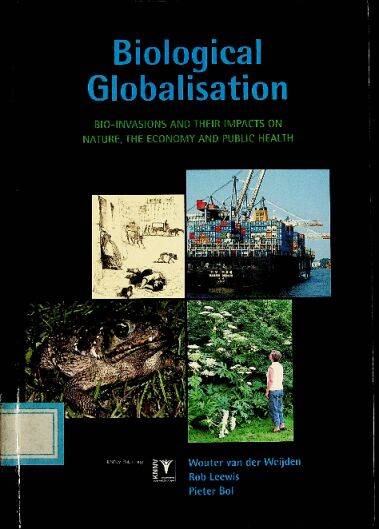
书名:Biological globalisation
责任者:Wouter van der Weijden | Rob Leewis | Pieter Bol.
ISBN\ISSN:9789050112437,9050112439
前言
The world is globalising, and nature is no exception.More and more plants, animals and microbes are crossingnatural barriers and settling in new areas. The sumtotal of these biological invasions can be termed 'biologicalglobalisation: Although this proliferation is anythingbut new, it is now accelerating as a result of climatechange, the globalisation of traffic and transportand the breakdown of distribution barriers. One of theimpacts of bio-globalisation is the decline in differencesbetween biotas: 'biotic homogenisation: Charles Elton's groundbreaking The Ecology ofInvasions by Plants and Animals was published in 1958.Since then several more books on the subject of bioinvasionshave seen the light of day, and yet there arestill very few books that describe not only the effects onnature and biodiversity, agriculture and other productivesectors, but also the consequences for publichealth. For the Netherlands there is no general overviewavailable at all. In 2003 it occurred to one of us, Wouter van derWeijden of the Centre for Agriculture and Environment,to write such a report He then approached Pieter Bol atDelft University of Technology and Rob Leewis, who atthat time worked at the Netherlands EnvironmentalAssessment Agency. This led to a unique and fruitfulcollaboration between three scientists from diverse disciplines:a biologist specialising in zoogeography, terrestrialecology and agriculture; an aquatic biologist;and a medical epidemiologist with a broad knowledgeof history. The Dutch Ministry of Agriculture, Natureand Food Quality, which was already developing a policypaper on invasive exotic species, was willing to paysome of the costs. The result was the report Biologische globolisering -omvong, oorzoken, gevolgen, hondelingsperspectieven(Biological globalisation - extent, causes, effects andoptions, 2005). The next logical step was this Englishlanguage book. KNNV Publishers agreed to publish thebook and the Ministry of Agriculture, Nature and FoodQuality made an additional financial contribution.This unique book integrates biological, agricultural, m~dicalhistorical and economic knowledge on b1olog1calglobalisation. It treats invading micro-organisms, plantsand animals alike in their multiple impacts on nature andbiodiversity, the economy and human health.
查看更多
目录
Preface 5
1 Introduction 7
2 The nature and scope of bio-globalisation 9
The role of geographical barriers in evolution 9
Islands and lakes 9
Effects of crossing geographical barriers 11
3 History, drivers, mechanisms and pathways of C2\bio-invasions 20
Early history 20
The Columbian Exchange 21
Drivers 21
Mechanisms and pathways 22
Success of invasions 23
4 Patterns of bio-invasions 39
How do bio-invasions proceed over time? 39
Changes following invasion 41
Which species are invasive? 43
Which species are vulnerable? 44
Which bioregions and ecosystems provide invasive species? 44
Which bioregions and ecosystems are susceptible to invasions? 46
Can we, and should we, control bio-invasions? 47
Prevention 49
Eradication 49
Containment and control 49
5 Impacts on nature, biodiversity and environmental quality 66
Biodiversity generally 66
Biodiversity on continents 66
Biodiversity on islands 67
Biodiversity in lakes 69
Mechanisms 69
Last-resort remedies 69
Effects on environmental quality 69
6 Impacts on the economy and public health 86
Agriculture and forestry 86
Livestock husbandry 89
Fishery and aquaculture 89
Commercial shipping 89
Waterways 90
Power stations and industry 90
Houses and other buildings 90
Public health 90
Environmental costs 91
Total costs 91
7 The Netherlands and bio-globalisation 116
The biogeographical position of the Netherlands 116
The Netherlands as a player in bio-globalisat1on 117
The Netherlands as an object of bio-globalisation 118
Economic costs from bio-invasions 127
8 Lessons learned and actions needed 161
Lessons learned 161
Actions needed 166
Notes 171
References 179
Illustration Credits 187
Appendix 1 Bio-invasions: definitions and their implications 188
Appendix 2 The economy of bio-invasions: dilemmas in calculating costs 191
Appendix 3 Economic effects of invasive animal diseases in the Netherlands 193
Appendix 4 Calculating productivity losses from human epidemics 200
Appendix 5 Pathways of species introductions 202
Appendix 6 100 of the World's Worst Invasive Alien Species 206
Appendix 7 Glossary of terms 209
Index 212
Acknowledgements 222
About the authors 223
Colophon 224
查看PDF
查看更多
作者简介
Rob Leewis (1947) studied biology, later specialising in marine biology and ecology. He wrote a PhD thesis on the phytoplanktonoff the Dutch coast (1985). He has worked as a project manager with Rijkswaterstaat, the National Water. Authority, on the environmental impacts of the Delta Works in the southwest of the Netherlands. He studied underwaterlife on dikes and shipwrecks, and co-founded the European Artificial Reef Research Network. He also participated inseveral underwater archaeological projects. Later he worked at the National Institute of Public Health and EnvironmentalProtection (RIVM), coordinating marine research to inform and advice the government on various environmental issues.Currently Rob is chairman of the Dutch Working Group on Exotic Species and a guest researcher for exotic species atthe National Museum of Natural History (Naturalis). He is a professional diver and underwater photographer, has producedseveral books and CD-ROMs on underwater life, and writes for a sport diver magazine.E-mail: r.leewis@cosema.nl
查看更多
馆藏单位
中科院文献情报中心