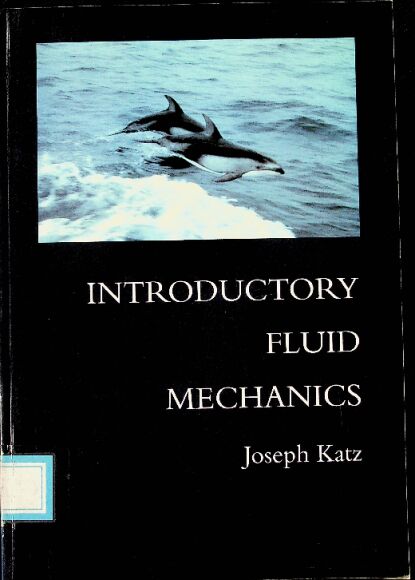
书名:Introductory fluid mechanics
出版时间:2013
出版社:Cambridge University Press
前言
Fluid mechanics is a fascinating but complex science and some problems cannot be solved by simple intuition. The reason behind this is the complex nonlinear differen�tial equations, which cannot be solved analytically. The approach that evolved over recent centuries is to develop simple models for specific flow regions so that engi�neering calculations and predictions become possible. Unfortunately, even these simple models rely on complex mathematics, which makes introductory courses on this subject extremely difficult and sometimes confusing to students.
On the other hand, numerical solutions have matured recently and generating a solution for a given geometry can be achieved by a simple "run" command. The approach of many users is to run a large number of cases and develop their own Teaming curve" of the problem, exactly as is done by experiments. The ease of generating attractive, colorful solutions creates the illusion (for many students) that further study of the subject is unnecessary.
The first objective of this introductory text is to familiarize students (and many will be exposed to only one course on fluids) with the basic elements of fluid mechan�ics. Therefore, if their future work relies on occasional numerical solutions, they will be familiar with the jargon of the discipline and with the expected results. At the same time, this book can serve as a long-term reference text, contrary to the over�simplified approach occasionally used for such introductory courses. The second objective is to provide a comprehensive foundation for more advanced courses in fluid mechanics (in areas such as mechanical or aerospace engineering disciplines). In order not to confuse the students, the governing equations are introduced early and the assumptions leading to the various models are clearly presented. This pro�vides a logical hierarchy for the material that follows and explains the intercon�nectivity between the various models. Subsequent topics are then logically devel�oped from the early chapter (Chapter 2) and the discussions are simple, brief, nonconfusing, and accompanied by useful examples (e.g., make it easy to under�stand to stimulate students' interest in the subject). Supporting examples demon�strate and explain the underlying principles and provide engineering analysis tools for various practical engineering calculations.
查看更多
目录
Preface page xi
A Word to the Instructor xiii
1 Basic Concepts and Fluid Properties 1
1.1 Introduction 1
1.2 A Brief History 1
1.3 Dimensions and Units 3
1.4 Fluid Dynamics and Fluid Properties 4
1.4.1 Continuum 4
1.4.2 Laminar and Turbulent Flows 5
1.4.3 Attached and Separated Flows 6
1.5 Properties of Fluids 7
1.5.1 Density 7
1.5.2 Pressure 8
1.5.3Temperature 8
1.5.4 Viscosity 9
1.5.5 Specific Heat 11
1.5.6 Heat Transfer Coefficient k 12
1.5.7 Surface Tension σ 13
1.5.8 Modulus of Elasticity E 16
1.5.9 Vapor Pressure 17
1.6 Advanced Topics: Fluid Properties and the Kinetic Theory of Gases 18
1.7 Summary and Concluding Remarks 21
2 The Fluid Dynamic Equation 32
2.1 Introduction 32
2.2 Description of Fluid Motion 33
2.3 Choice of Coordinate System 34
2.4 Pathlines, Streak Lines, and Streamlines 36
2.5 Forces in a Fluid 37
2.6 Integral Form of the Fluid Dynamic Equations 39
2.7 Differential Form of the Fluid Dynamic Equations 44
2.8 The Material Derivative 50
2.9 Alternative Derivation of the Fluid Dynamic Equations 52
2.10 Summary and Concluding Remarks 55
3 Fluid Statics 65
3.1 Introduction 65
3.2 Fluid Statics: The Governing Equations 65
3.3 Pressure Due to Gravity 66
3.4 Hydrostatic Pressure in a Compressible Fluid 70
3.5 "Solid-Body" Acceleration of Liquids 71
3.5.1 Linear Acceleration 72
3.5.2 Solid-Body Rotation of a Fluid 74
3.6 Hydrostatic Forces on Submerged Surfaces and Bodies 77
3.6.1 Hydrostatic Forces on Submerged Planar Surfaces 78
3.6.2 Hydrostatic Forces on Submerged Curved Surfaces 85
3.7 Buoyancy 87
3.8Stability of Floating Objects 91
3.9 Summary and Conclusions 93
4 Introduction to Fluid in Motion - One-Dimensional (Frictionless) Flow 111
4.1 Introduction 111
4.2 The Bernoulli Equation 112
4.3 Summary of the One-Dimensional Tools 113
4.4 Applications of the One-Dimensional Flow Model 114
4.4.1 Free Jets 114
4.4.2 Examples for Using the Bernoulli Equation 118
4.4.3 Simple Models for Time-Dependent Changes in a Control Volume 119
4.5 Flow Measurements (Based on Bernoulli's Equation) 122
4.5.1 The Pitot Tube 122
4.5.2 The Venturi Tube 123
4.5.3 The Orifice 125
4.5.4 The Sluice Gate 126
4.5.5 Nozzles and Injectors 127
4.6 Summary and Conclusions 127
5 Viscous Incompressible Flow: Exact Solutions 142
5.1 Introduction 142
5.2 The Viscous Incompressible Flow Equations (Steady State) 142
5.3 Laminar Flow between Two Infinite Parallel Plates - The Couette Flow 143
5.3.1 Flow with a Moving Upper Surface 144
5.3.2 Flow between Two Infinite Parallel Plates 一 The Results 145
5.3.3 Flow between Two Infinite Parallel Plates - The Poiseuille Flow 148
5.3.4 The Hydrodynamic Bearing (Reynolds Lubrication Theory) 151
5.4 Laminar Flow in Circular Pipes (The Hagen-Poiseuille Flow) 157
5.5 Fully Developed Laminar Flow between Two Concentric Circular Pipes 161
5.6 Flow in Pipes: Darcy's Formula 163
5.7 The Reynolds Dye Experiment, Laminar-Turbulent Flow in Pipes 164
5.8 Additional Losses in Pipe Flow 166
5.9 Summary of One-Dimensional Pipe Flow 167
5.9.1Simple Pump Model 170
5.9.2Flow in Pipes with Noncircular Cross Sections 170
5.9.3 Examples for One-Dimensional Pipe Flow 172
5.9.4 Network of Pipes 177
5.10 Open Channel Flows 179
5.10.1 Simple Models for Open Channel Flows 179
5.10.2 Uniform Open Channel Flows 182
5.10.3 Hydraulic Jump 188
5.10.4 Flow Discharge through Sharp-Crested Weirs 192
5.11 Advanced Topics: Exact Solutions; Two-Dimensional Inviscid Incompressible Vortex Flow 194
5.11.1Angular Velocity, Vorticity, and Circulation 197
5.12 Summary and Concluding Remarks 199
6 Dimensional Analysis and High-Reynolds-Number Flows 213
6.1 Introduction 213
6.2 Dimensional Analysis of the Fluid Dynamic Equations 213
6.3 The Process of Simplifying the Governing Equations 216
6.4 Similarity of Flows 217
6.5 Flow with High Reynolds Number 218
6.6 High-Reynolds-Number Flows and Turbulence 220
6.7 Summary and Conclusions 222
7 The (Laminar) Boundary Layer 227
7.1 Introduction 227
7.2 Two-Dimensional Laminar Boundary-Layer Flow over a Flat Plate - (The Integral Approach) 228
7.3 Solutions Based on the von Karman Integral Equation 231
7.4 Summary and Practical Conclusions 238
7.5 Effect of Pressure Gradient 241
7.6 Advanced Topics: The Two-Dimensional Laminar Boundary-Layer Equations 244
7.6.1Summary of the Blasius Exact Solution for the Laminar Boundary Layer 246
7.7 Concluding Remarks 248
8 High-Reynolds-Number Flow over Bodies (Incompressible) 254
8.1 Introduction 254
8.2 The Inviscid Irrotational Flow (and Some Math) 255
8.3 Advanced Topics: A More Detailed Evaluation of the Bernoulli Equation 258
8.4 The Potential Flow Model 259
8.4.1Methods for Solving the Potential Flow Equations 260
8.4.2 The Principle of Superposition 260
8.5 Two-Dimensional Elementary Solutions 261
8.5.1Polynomial Solutions 261
8.5.2 Two-Dimensional Source (or Sink) 263
8.5.3 Two-Dimensional Doublet 265
8.5.4 Two-Dimensional Vortex 268
8.5.5 Advanced Topics: Solutions Based on the Green's Identity 270
8.6 Superposition of a Doublet and a Free Stream: Flow over a Cylinder 273
8.7 Fluid Mechanic Drag 277
8.7.1 The Drag of Simple Shapes 278
8.7.2 The Drag of More Complex Shapes 283
8.8 Periodic Vortex Shedding 287
8.9 The Case for Lift 289
8.9.1 A Cylinder with Circulation in a Free Stream 289
8.9.2 Two-Dimensional Flat Plate at a Small Angle of Attack (in a Free Stream) 293
8.9.3 Note about the Center of Pressure 294
8.10 Lifting Surfaces: Wings and Airfoils 295
8.10.1 The Two-Dimensional Airfoil 296
8.10.2 An AirfoiFs Lift 298
8.10.3 An Airfoil's Drag 300
8.10.4 An Airfoil Stall 301
8.10.5 The Effect of Reynolds Number 301
8.10.6 Three-Dimensional Wings 303
8.11 Summary and Concluding Remarks 313
9 Introduction to Computational Fluid Dynamics 324
9.1 Introduction 324
9.2 The Finite-Difference Formulation 325
9.3 Discretization and Grid Generation 327
9.4 The Finite-Difference Equation 328
9.5 The Solution: Convergence and Stability 331
9.6 The Finite-Volume Method 332
9.7 Example: Viscous Flow over a Cylinder 334
9.8 Potential Flow Solvers: Panel Methods 337
9.9 Summary 340
10 Elements of Inviscid Compressible Flow 343
10.1 Introduction 343
10.2 Propagation of a Weak Compression Wave (the Speed of Sound) 344
10.3 One-Dimensional Isentropic Compressible Flow 347
10.3.1Critical Conditions 350
10.3.2 Practical Examples for One-Dimensional Compressible Flow 352
10.4 Normal Shock Waves 355
10.5 Some Applications of the One-Dimensional Model 360
10.5.1 Normal Shock Wave ahead of a Circular Inlet 360
10.5.2 The Converging-Diverging Nozzle (de Laval Nozzle) 361
10.5.3 The Supersonic Wind Tunnel 364
10.6 Effect of Compressibility on External Flows 367
10.7 Concluding Remarks 370
11 Fluid Machinery 377
11.1 Introduction 377
11.2 Work of a Continuous-Flow Machine 380
11.3 Axial Compressors and Pumps (The Mean-Radius Model) 382
11.3.1 Velocity Triangles 385
11.3.2 Power and Compression-Ratio Calculations 387
11.3.3 Radial Variations 390
11.3.4 Pressure-Rise Limitations 392
11.3.5 Performance Envelope of Compressors and Pumps 394
11.3.6 Degree of Reaction 399
11.4 The Centrifugal Compressor (or Pump) 402
11.4.1 Torque, Power, and Pressure Rise 403
11.4.2 Impeller Geometry 405
11.4.3 The Diffuser 408
11.4.4 Concluding Remarks: Axial versus Centrifugal Design 410
11.5 Axial Turbines 411
11.5.1 Torque, Power, and Pressure Drop 412
11.5.2 Axial Turbine Geometry and Velocity Triangles 414
11.5.3 Turbine Degree of Reaction 415
11.5.4 Remarks on Exposed Tip Rotors (Wind Turbines and Propellers) 423
11.6 Concluding Remarks 426
Appendix A: Conversion Factors 433
Appendix B: Properties of Compressible Isentropic Flow 435
Appendix C: Properties of Normal Shock Flow 437
Index 439
查看更多
馆藏单位
中科院文献情报中心