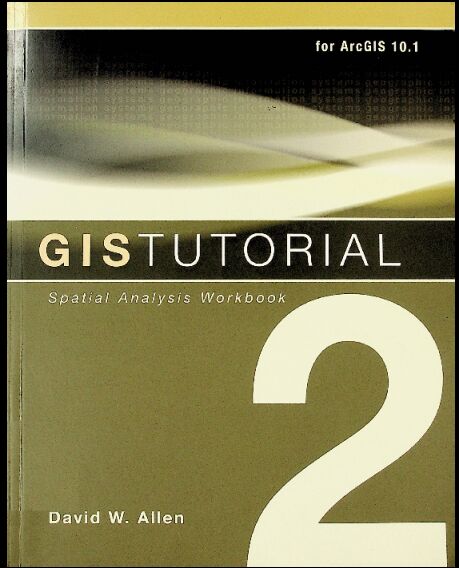
书名:GIS tutorial 2
ISBN\ISSN:9781589483378,1589483375
前言
GIS Tutorial 2: Spatial Analysis Workbook provides hands-on exercises for intermediate-level GIS users to build problem-solving and analysis skills. A companion to the concepts in The Esri® Guide to GIS Analysis book series, GIS Tutorial 2 gives experience with various spatial analysis methods, including location analysis; change over time, location, and value comparisons; geographic distribution; pattern analysis; and cluster identification. This edition has been updated for ArcGIS 10.3 for Desktop. Downloadable data is available on the Esri Press "Book Resources" web page, esripress.esri.comookresources. Additional resources are available for instructors.
查看更多
目录
Preface ix
Acknowledgments xi
Chapter 1: Mapping where things are 1
Tutorial 1-1 Working with categories 12
Exercise 1-1 12
Tutorial 1-2 Controlling which values are displayed 14
Exercise 1-2 19
Tutorial 1-3 Limiting values to display 21
Exercise 1-3 27
Chapter 2: Mapping the most and least 29
Tutorial 2-1 Mapping quantities 30
Exercise 2-1 41
Tutorial 2-2 Choosing classes 44
Exercise 2-2 56
Tutorial 2-3 Creating a map series 58
Exercise 2-3 66
Tutorial 2-4 Working with charts 68
Exercise 2-4 72
Chapter 3: Mapping density 75
Tutorial 3-1 Displaying density for analysis 76
Exercise 3-1 85
Tutorial 3-2 Creating dot density maps 87
Exercise 3-2 91
Tutorial 3-3 Creating a density surface 93
Exercise 3-3 98
Chapter 4: Finding what's inside 101
Tutorial 4-1 Overlaying datasets for analysis 102
Exercise 4-1 110
Tutorial 4-2 Finding what's partially inside 112
Exercise 4-2 120
Chapter 5: Finding what's nearby 123
Tutorial 5-1 Selecting what's nearby 124
Exercise 5-1129
Tutorial 5-2 Creating buffer features 131
Exercise 5-2 137
Tutorial 5-3 Clipping features 139
Exercise 5-3 146
Tutorial 5-4 Buffering values 148
Exercise 5-4 151
Tutorial 5-5 Using multiple buffer zones 153
Exercise 5-5 160
Tutorial 5-6 Quantifying nearness 162
Exercise 5-6 169
Tutorial 5-7 Creating distance surfaces 171
Exercise 5-7 177
Tutorial 5-8 Calculating cost along a network 179
Exercise 5-8 189
Tutorial 5-9 Calculating nearness along a net work 191
Exercise 5-9 195
Chapter 6: Mapping change 197
Tutorial 6-1 Mapping change in location 198
Exercise 6-1 205
Tutorial 6-2 Mapping change in location and magnitude 207
Exercise 6-2 212
Tutorial 6-3 Mapping percent change in value 214
Exercise 6-3 220
Chapter 7: Measuring geographic distribution 223
7-1 Calculating centers 224
Exercise 7-1 229
Tutorial 7-2 Adding weights to centers 231
Exercise 7-2 235
Tutorial 7-3 Calculating standard distance 237
Exercise 7-3 241
Tutorial 7-4 Calculating a standard deviational ellipse 243
Exercise 7-4 247
Tutorial 7-5 Calculating the linear directional mean 249
Exercise 7-5 253
Chapter 8: Analyzing patterns 255
Tutorial 8-1 Using average nearest neighbor 256
Exercise 8-1 264
Tutorial 8-2 Identifying the clustering of values 266
Exercise 8-2 272
Tutorial 8-3 Checking for multidistance clustering 274
Exercise 8-3 282
Tutorial 8-4 Measuring spatial autocorrelation 284
Exercise 8-4 289
Chapter 9: Identifying clusters 291
Tutorial 9-1 Performing cluster and outlier analysis 292
Exercise 9-1 299
Tutorial 9-2 Performing hot-spot analysis 301
Exercise 9-2304
Independent projects 307
Appendix A Task index 311
Appendix B Data source credits 315
Appendix C Data license agreement 321
Appendix D Installing the data and software 325
查看更多
作者简介
David W. Allen is the GIS manager for the City of Euless, Texas. He has taught at Tarrant County College since 1999, where he helped found one of the first GIS degree programs in Texas and establish a state standard for GIS degree programs. He is the author of GIS Tutorial for Python Scripting (Esri Press, 2014), Getting to Know ArcGIS® ModelBuilder™ (Esri Press, 2011) and the co-author of GIS Tutorial 3: Advanced Workbook (Esri Press, 2010 and Esri Press, forthcoming).
查看更多
馆藏单位
中科院文献情报中心