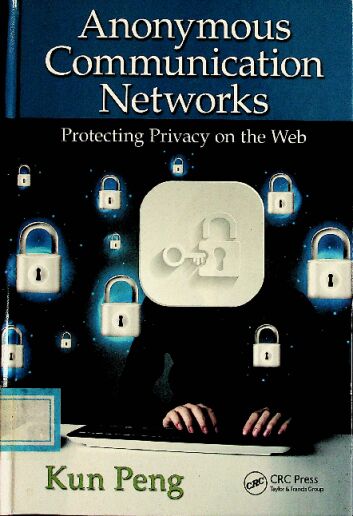
书名:Anonymous communication networks
责任者:Kun Peng. | Peng, Kun,
ISBN\ISSN:9781439881576,143988157X
出版时间:2014
出版社:CRC Press/Taylor & Francis Group
摘要
In today’s interactive network environment, where various types of organizations are eager to monitor and track Internet use, anonymity is one of the most powerful resources available to counterbalance the threat of unknown spectators and to ensure Internet privacy.
Addressing the demand for authoritative information on anonymous Internet usage, Anonymous Communication Networks: Protecting Privacy on the Web examines anonymous communication networks as a solution to Internet privacy concerns. It explains how anonymous communication networks make it possible for participants to communicate with each other without revealing their identities.
The book explores various anonymous communication networks as possible solutions to Internet privacy concerns―making it ideal for network researchers and anyone interested in protecting their privacy or the privacy of their users. Identifying specific scenarios where it is best to be anonymous, it details the two main approaches to anonymous communication networks: onion routing and mixed networks.
查看更多
目录
1 Anonymity in Network Communication 1
1.1 Right to Be Anonymous 2
1.2 When We Need to Be Anonymous 8
1.3 The Current Situation and Where We Start 10
2 Mix Networks 15
2.1 Definition of Mix Network 16
2.2 Classification of Mix Networks 17
2.2.1 Decryption Chain or Re-encryption 17
2.2.2 General or Separate Verification 19
2.2.3 Tag Attached to Input 21
2.2.4 Summary 22
2.3 Efficient and Secure GiVIN : a Simple and Efficient Solution 22
2.3.1 The GMN in [92] 24
2.3.2 Analysis and Summary 26
2.4 Efficient and Secure SlVIN : the Most Important Mix Network 27
2.4.1 SMN Employing Miultiplicative Homomorphic Encryption Algorithm 32
2.4.2 SMN Employing Add itive Homomorphic Encryption Algorithm 35
2.5 Grouped Shuffling: a Trade-off to Improve Efficiency of Mix Networks 3
2.5.1 Group Shuffling in [93] 39
2.5.2 Another Grouped Shu ffling Protocol to Support Efficient SMN 44
2.6 Survey and Analysis of SMN 49
2.6.1 The Assumptions Needed in the Mix Networks in [51] and [52] 50
2.6.2 Security Concerns in [90] and [102] 53
2.6.3 Failure in Functionality of the Mix Network by Wikstrom 55
2.7 Efficiency of SMN: Claim and Reality 57
2.7.1 Un fair Usage of Short Exponents 58
2.7.2 Other Unfair Factors in Efficiency Claim and Comparison 59
3 Application of Mix Network to E-Voting: a Case Study 63
3.1 Mix Network for E-Voting 63
3.1.1 The Rβcent Mix Network Schemes 64
3.1.2 The New Mix Network 66
3.1.3 Security and Efficiency Analysis 72
3.1.4 Extension and Application 76
3.2 Mix Network-Based E-Voting 7
3.3 Security Concerns and Suggested Solution in Practice 81
3.3.1 Various Relation Attacks and the Existing Countermeasures 83
3.3.2 Main Idea of the New Countermeasure 88
3.3.3 A Prototype and Its Drawbacks 91
3.3.4 Optimization and Security Analysis 93
3.4 Off-Line Pre-Computation in l\llix Networks 99
3.4.1 Security Model of Shuffles 102
3.4.2 The Basic Design 103
3.4.3 Off-Line Pre-Computation and Batch Verification 106
3.4.4 The Final Shuffling Protocol: Modi々ing Encryption and Further Improving Efficiency 108
3.4.5 Comparison and Conclusion 111
4 Onion Routing 115
4.1 The Basic Idea 115
4.2 Formal Definition of Secur ity 117
4.3 Second Generation: Tor 124
4.3.1 Design of Tor 127
4.3.2 Application of Symmetric Cipher and Diffie-Hellman Key Exchange in Tor: Efficiency Improvement 133
5 Optimisation and Practical Application of Onion Routing 137
5.1 Verifiable TOR: a Verifiable Application of Onion Routing 137
5.1.1 Preliminars 13
5.1.2 Advanced Tor with a Verification Mechanism 139
5.2 Efficiency Improvment Using Diffie-Hellman Chain 142
5.2.1 A Simple Optimisation of Tor and its Drawback: Simpler but Still Direct Application of Diffie-Hellman Key Exchange 143
5.2.2 A New and More Advanced Technique: Diffie-Hellman Chain 144
5.2.3 Analysis and Comparison 147
5.2.4 Further Optimisation : Small Compressed Onion Routing 148
5.3 A Practical Application: Paid and Anonymous Use of Cloud Softwares 151
5.3.1 How to Obtain Anonymou s Usage Permit of a Cloud Software: A nonymous Token 153
5.3.2 Two 认 ay Onion Routing to Support Anonymous Usage of Cloud Software 155
5.3.3 Efficiency Optimisation: Two-Way Onion Routing with Compact Diffie-Hellman Handshakes 158
5.3.4 Security Analysis 162
6 Practical Systems to Achieve Anonymity: How to Use Them 165
6.1 Installation and Usage of Tor 166
6.1.1 Download and Installation 166
6.1.2 Configuration 168
6.2 Installation and Usage of I2P 169
6.2.1 Download and Installation 169
6.2.2 Con figuration 173
6.3 Installation and Usage of JAP/ JonDo 174
6.3.1 Download and Installation 175
6.3.2 Configuration 176
6.4 Installation and Usage of QuickSilver 178
6.4.1 Download and Installation 178
6.4.2 Configuration 180
References 183
Index 191
查看更多
作者简介
Dr. Kun Peng received his bachelor’s degree in software and master’s degree in computer security from Huazhong University of Science and Technology, China. He graduated from the Information Security Institute, Queensland University of Technology, Australia, in 2004, obtaining his PhD degree in information security. His main research interest is in applied public key cryptology. His main research interests include applied cryptology, network security, secure e-commerce, and e-government.
查看更多
馆藏单位
中科院文献情报中心