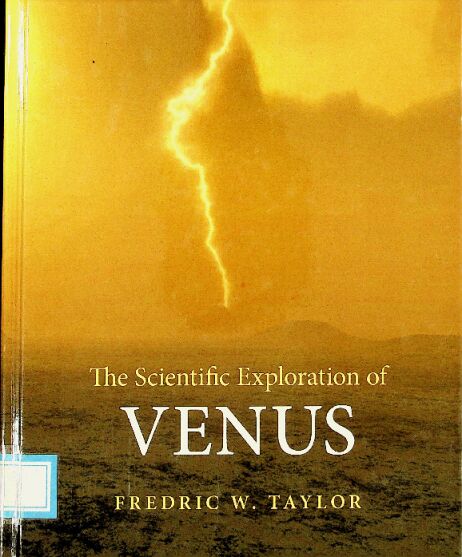
书名:The scientific exploration of Venus
责任者:Fredric W. Taylor | University of Oxford.
ISBN\ISSN:9781107023482,1107023483
出版时间:2014
出版社:Cambridge University Press
前言
Venus is the brightest 'star' in the night sky and it has been observed since ancient times. Often dubbed Earth's 'twin', it is the planet most similar to the Earth in size, mass and composition. There the similarity ends: Venus is shrouded by a dense carbon dioxide atmosphere, its surface is dominated by thousands of volcanoes and it lacks a protective magnetic field to shield it from energetic solar particles. So why isn't Venus more like Earth? In this book, a leading researcher of Venus addresses this question by explaining what we know through our investigations of the planet. Venus presents an intriguing case study for planetary astronomers and atmospheric scientists, especially in light of the current challenges of global warming, which supports, and potentially threatens, life on Earth. Scientifically rigorous, yet written in a friendly non-technical style, this is a broad introduction for students and astronomy and space enthusiasts.
查看更多
目录
Overview page xi
Prologue xiii
A note on scientific units xvii
Acknowledgements xix
Part I Views of Venus, from the beginning to the present day
1 The dawn of Venus exploration 3
The Evening Star and the Morning Star 3
Transits: Venus crosses the disc of the Sun, but rarely 6
Early observations: another planet with an atmosphere 8
Observations of surface features 9
The ashen light 10
The ultraviolet markings 12
Speculation on the nature of the clouds and conditions at the surface 13
The search for water vapour in the atmosphere 14
A hot and arid surface? 15
2 Mariner and Venera: the first space missions to Venus 17
The Venus Mariners: the first close-up views 17
Venera: the first landings 24
Venera atmospheric measurements 29
The first Venus orbiters 29
3 Pioneer Venus and Vega: orbiters, balloons and multiprobes 32
NASA plans multiple-entry probes and an orbiter 33
Pioneer Venus 33
Vega: the first balloon mission 40
A picture of the planet emerges 41
4 Images of the surface 48
The first glimpses of the surface using radar from Earth 48
Pioneer and Venera: early radar maps from orbit 51
Magellan: high-resolution radar images of the surface 54
5 The forgotten world 64
The 'evil twin' syndrome 64
Unfulfilled objectives 67
Technical studies 68
Phantom missions 69
Broken dreams 74
6 Earth-based astronomy delivers a breakthrough 75
New windows on Venus 77
The leaking 'greenhouse' 78
Mapping the deep cloud structure and dynamics 79
Composition measurements in the deep atmosphere 81
7 Can't stop now: Galileo and Cassini fly past Venus 87
Deep cloud structure 88
Ashen light revisited 89
Atmospheric composition 90
Atmospheric dynamics and meteorology 93
Temperature maps of the surface 94
Observation of Venus by Cassini /VIMS 95
8 Europe and Japan join in: Venus Express and Akatsuki 97
The Venus Express mission proposal 97
The scientific payload 99
The flight to Venus 103
Venus Express achievements 105
Venus Express lives on 113
Japan's climate orbiter, Akatsuki 113
Part II The motivation to continue the quest
9 Origin and evolution: the solid planet 119
Twin planets? 119
What is Venus made from? 119
Composition of the surface rock 121
Messengers from the interior: the noble gases 122
Why no magnetic field? 125
Venus's surface features: Earthlike but different 125
On the surface: mountains, continents and river valleys 127
Tectonic features 133
Impact craters 135
Lava plains 138
Metallic snowcaps 139
10 Atmosphere and ocean 141
Not-so-identical twins 142
Atmospheric composition and the greenhouse effect 145
Energy balance and entropy 146
Why so much CO2? 147
Venus's primordial ocean 150
Water on Venus now 152
Exosphere and escape 152
11 A volcanic world 156
Images of volcanic features on the surface 158
Surface composition and temperature 160
Volcanic gases in the atmosphere: sulphur dioxide 161
The water budget 163
Noble gases and isotopic ratios 166
Heat flux from the interior 167
Bright plumes and ash clouds 169
Sulphur dioxide and water vapour fluctuations above the clouds 173
Comparison with terrestrial volcanism 175
Models for the current level of volcanic activity 176
Consolidating the models 180
12 The mysterious clouds 182
Vertical structure of the clouds 183
Partide sizes and composition 185
Cloud chemistry 188
Horizontal structure of the clouds 190
The ultraviolet absorber 193
Carbon dioxide clouds? 194
The polar clouds 195
Diurnal and long-term variation 195
13 Superwinds and polar vortices 197
Meteorological measurements on Venus 198
Probe wind measurements 199
Cloud images and infrared remote sounding 200
The Hadley circulation 202
Explaining the zonal super-rotation 204
The polar vortices, collar and 'dipole' 208
A 'strange attractor' on Venus 210
Waves and cloud features 211
Deep cloud motions and upper atmosphere dynamics 213
14 The climate on Venus, past, present and future 215
Early Venus 216
Volcanic Venus 217
Present Venus 217
Future Venus 218
Climate change models 220
Model forecasts and hindcasts 221
Summing up 223
15 Could there be life on Venus? 225
Possible habitats on Venus 225
Evolution and adaptation 226
Terrestrial vs. Martian vs. Venusian life 227
Possible evidence for life 227
Astrobiological experiments: next steps 229
The prospects for finding life on Venus 232
Part III Plans and visions for the future
16 Solar system exploration: what next for Venus? 237
Choosing the way forward 237
Venus in NASA's Discovery Programme 242
Priorities and road maps: NASA leaves Venus on the back burner 242
The Russian revival 244
European plans 246
17 Coming soon to a planet near you: planned Venus missions 249
The next NASA mission to Venus 249
European Venus mission studies 252
Venera-D 255
International cooperation 257
18 Towards the horizon: advanced technology 259
Larger, cheaper payloads: aerobraking and aerocapture 259
Surveying the surface: mappers, aeroplanes and submarines 260
Direct sampling of the surface 262
Instruments 263
Rovers and drilling 263
Sample return: bringing material back to Earth 265
19 Beyond the horizon: human expeditions 270
When, if ever 270
NASA's 1967 manned flyby 271
Floating research stations 273
Terraforming Venus: building an Earthlike climate 274
Epilogue 277
References and acknowledgements 279
Appendix A: Chronology of space missions to Venus 289
Appendix B: Data about Venus 291
Index 293
查看更多
馆藏单位
中科院文献情报中心