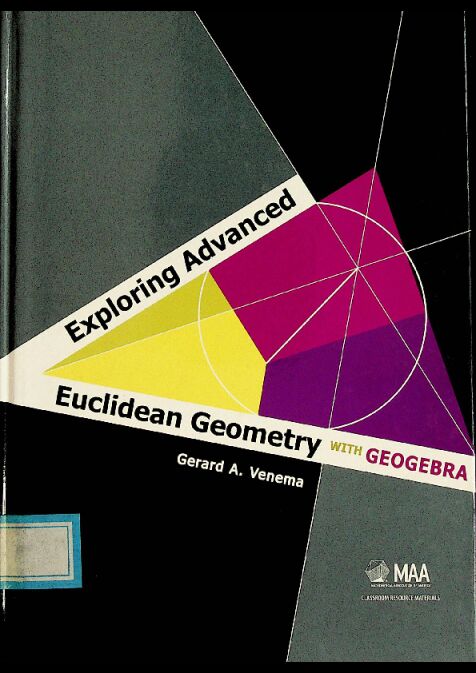
书名:Exploring advanced euclidean geometry with GeoGebra
责任者:Gerard A. Venema | Calvin College.
ISBN\ISSN:9780883857847,0883857847
出版时间:2013
出版社:Mathematical Association of America
前言
This book provides an inquiry-based introduction to advanced Euclidean geometry. It utilizes dynamic geometry software, specifically GeoGebra, to explore the statements and proofs of many of the most interesting theorems in the subject. Topics covered include triangle centers, inscribed, circumscribed, and escribed circles, medial and orthic triangles, the nine-point circle, duality, and the theorems of Ceva and Menelaus, as well as numerous applications of those theorems. The final chapter explores constructions in the Poincaré disk model for hyperbolic geometry.
The book can be used either as a computer laboratory manual to supplement an undergraduate course in geometry or as a stand-alone introduction to advanced topics in Euclidean geometry. The text consists almost entirely of exercises (with hints) that guide students as they discover the geometric relationships for themselves. First the ideas are explored at the computer and then those ideas are assembled into a proof of the result under investigation. The goals are for the reader to experience the joy of discovering geometric relationships, to develop a deeper understanding of geometry, and to encourage an appreciation for the beauty of Euclidean geometry.Contents
查看更多
目录
Preface vii
0 A Quick Review of Elementary Euclidean Geometry 1
0.1 Measurement and congruence 1
0.2 Angle addition 2
0.3 Triangles and triangle congruence conditions 3
0.4 Separation and continuity 4
0.5 The exterior angle theorem 5
0.6 Perpendicular lines and parallel lines 5
0.7 The Pythagorean theorem 7
0.8 Similar triangles 8
0.9 Quadrilaterals 9
0.10 Circles and inscribed angles 10
0.11 Area 11
1 The Elements of GeoGebra 13
1.1 Getting started: the GeoGebra toolbar 13
1.2 Simple constructions and the drag test 16
1.3 Measurement and calculation 18
1.4 Enhancing the sketch 20
2 The Classical Triangle Centers 23
2.1 Concurrent lines 23
2.2 Medians and the centroid 24
2.3 Altitudes and the orthocenter 25
2.4 Perpendicular bisectors and the circumcenter 26
2.5 The Euler line 27
3 Advanced Techniques in GeoGebra 31
3.1 User-defined tools 31
3.2 Check boxes 33
3.3 The Pythagorean theorem revisited 34
4 Circumscribed, Inscribed, and Escribed Circles 39
4.1 The circumscribed circle and the circumcenter 39
4.2 The inscribed circle and the incenter 41
4.3 The escribed circles and the excenters 42
4.4 The Gergonne point and the Nagel point 43
4.5 Heron's formula 44
5 The Medial and Orthic Triangles 47
5.1 The medial triangle 47
5.2 The orthic triangle 48
5.3 Cevian triangles 50
5.4 Pedal triangles 51
6 Quadrilaterals 53
6.1 Basic definitions 53
6.2 Convex and crossed quadrilaterals 54
6.3 Cyclic quadrilaterals 55
6.4 Diagonals 56
7 The Nine-Point Circle 57
7.1 The nine-point circle 57
7.2 The nine-point center 59
7.3 Feuerbach's theorem 60
8 Ceva's Theorem 63
8.1 Exploring Ceva's theorem 63
8.2 Sensed ratios and ideal points 65
8.3 The standard form of Ceva's theorem 68
8.4 The trigonometric form of Ceva's theorem 71
8.5 The concurrence theorems 72
8.6 Isotomic and isogonal conjugates and the symmedian point 73
9 The Theorem of Menelaus 77
9.1 Duality 77
9.2 The theorem of Menelaus 78
10 Circles and Lines 81
10.1 The power of a point 81
10.2 The radical axis 83
10.3 The radical center 84
11 Applications of the Theorem of Menelaus 85
11.1 Tangent lines and angle bisectors 85
11.2 Desargues' theorem 86
11.3 Pascal's mystic hexagram 88
11.4 Brianchon's theorem 90
11.5 Pappus's theorem 91
11.6 Simson's theorem 93
11.7 Ptolemy's theorem 96
11.8 The butterfly theorem 97
12 Additional Topics in Triangle Geometry 99
12.1 Napoleon's theorem and the Napoleon point 99
12.2 The Torricelli point 100
12.3 van Aubel's theorem 100
12.4 Miquel's theorem and Miquel points 101
12.5 The Fermat point 101
12.6 Morley's theorem 102
13 Inversions in Circles 105
13.1 Inverting points 105
13.2 Inverting circles and lines 107
13.3 Othogonality 108
13.4 Angles and distances 110
14 The Poincaré Disk 111
14.1 The Poincaré disk model for hyperbolic geometry 111
14.2 The hyperbolic straightedge 113
14.3 Common perpendiculars 114
14.4 The hyperbolic compass 116
14.5 Other hyperbolic tools 117
14.6 Triangle centers in hyperbolic geometry 118
References 121
Index 123
About the Author 129
查看更多
作者简介
Gerard Venema earned an A.B. in mathematics from Calvin College and a Ph.D. from the University of Utah. After completing his education he spent two years in a postdoctoral position at the University of Texas at Austin and another two years as a Member of the Institute for Advanced Study in Princeton, NJ. He then returned to his alma mater, Calvin College, and has been a faculty member there ever since. While on the Calvin College faculty he has also held visiting faculty positions at the University of Tennesse, the University of Michigan, and Michigan State University. He spent two years as Program Director for Topology, Geometry, and Foundations in the Division of Mathematical Sciences at the National Science Foundation.PA\Venema is a member of the American Mathematical Society and the Mathematical Association of America. He served for ten years as an Associate Editor of the American Mathematical Monthly and currently sits on the editorial board of MAA FOCUS. Venema has served the Michigan Section of the MAA as chair and is the 2013 recipient of the section's distinguished service award. He currently holds the position of MAA Associate Secretary and is a member of the Association's Board of Governors.PA\Venema is the author of two other books. One is an undergraduate textbook, Foundations of Geometry, published by Pearson Education, Inc., which is now in its second edition. The other is a research monograph, Embeddings in Manifolds, coauthored by Robert J. Daverman, that was published by the American Mathematical Society as volume 106 in its Graduate Studies in Mathematics series. In addition to the books, Venema is author of over thirty research articles in geometric topology.
查看更多
馆藏单位
中科院文献情报中心