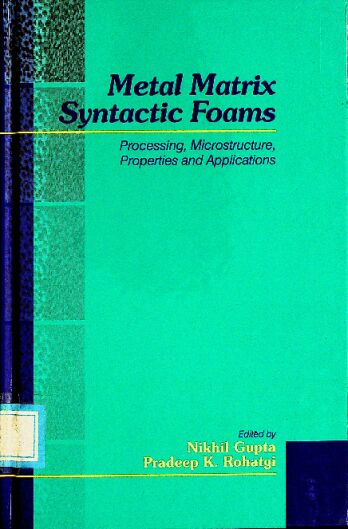
书名:Metal matrix syntactic foams
责任者:Nikhil Gupta | Pradeep K. Rohatgi. | Rohatgi, P. K.,
ISBN\ISSN:1932078835,9781932078831
出版时间:2015
出版社:DEStech Publications, Inc.
前言
INTEREST in metal foams has been increasing for the past several de- cades, due to their low density. Significant progress has been made in the science and technology of open and closed cell foams. Process- ing methods have been developed to synthesize foams with the desired amount, orientation, and size of porosity. Theoretical models have been developed to relate the properties of these foams with their microstruc- ture. Despite these advancements, one critical limitation of these foams is their low strength and modulus. Syntactic foams have been developed specifically to address these limitations in mechanical properties. In these foams, instead of embedding gas voids, hollow particles are dispersed in a matrix to create a foam-like structure. They can be classified as both foams and particulate composites. Pre-fabricated hollow particles are used for synthesizing syntactic foams, including the use of methods in- volving reinforcement with hollow particles which are also used for syn- thesis of metal matrix composites. However, the mechanical behavior of syntactic foams closely matches that of closed cell foams. The density of syntactic foams usually is higher than that of foams containing gas voids, but their strength and stiffness also are higher. Syntactic foams can be synthesized with mechanical properties high enough to enable them to be used for load-bearing applications, raising the possibilities of structural weight reduction in numerous applications.
Metal matrix syntactic foams have the potential for reducing the weight and survivability of civilian and military transportation systems. They also are found promising in developing lightweight ballistic and blast armors. The possibilities with these materials are only emerging and innovative minds can find a very diverse set of applications. Interest in developing biomedical implants, functionally graded foams and automo- tive crash boxes using metal matrix syntactic foams has been noted.
The present book, which is a collection of chapters written by re- searchers in this field who have made major contributions to this field, is intended to present the current state of science and technology re- lated to metal matrix syntactic foams. The book takes two approaches to present the information in detail on individual material systems and also presents a comparison between different material systems: (a) Initial chapters are divided according to the matrix metal to cover the materials' specific processing and properties. (b) Later chapters are intended to compare the syntactic foams of all different material types based on their density, strain rate sensitiv- ity, and applications.
The book is structured to include chapters on processing, microstruc- ture and properties of syntactic foams. Chapter 2 describes the available variety of micro- and macro-sized hollow particles. Synthesis methods are covered in Chapter 3. Chapters 4 through 8 focus on magnesium, aluminum, zinc, titanium, and iron matrix syntactic foams, respectively. These chapters emphasize the microstructure-property correlations. The modeling and simulation approaches are described in Chapters 9 and 10. Some of the available models are tested with experimental data to de- termine their prediction accuracy. In addition, finite element analysis on two- and three-dimensional models also is conducted. A comparison of syntactic foams of various matrix metals is conducted in Chapter II to understand their relative advantages, disadvantages, and weight-saving potential in applications. The last chapter, Chapter 12, covers the current applications and future possibilities for metal matrix syntactic foams.
The field of metal matrix syntactic foams is rapidly progressing and constantly evolving. The present understanding may change over time as new tools and techniques for synthesis and characterization become available, better predictive models are developed, and computational power for simulations increases. The readers should keep an open mind about the future developments in this field and other fields that may di- rectly or indirectly impact syntactic foams. Innovative minds may find the information only as a starting point to envision new applications for these materials based on their unique properties.
查看更多
目录
Preface vii
Acknowledgments ix
Editors xi
Contributors xiiil
1. Introduction to Foams NIKHIL GUPTA 1
1.1. Lightweight Materials 1
1.2. Foams 4
1.3. Syntactic Foams 10
1.4. Outline of the Book 13
1.5. Acknowledgments 14
1.6. References 14
2. Hollow Particles. OLIVER M. STRBIKIII, PE. 17
2.1. Structure 17
2.2. Manufacturing Methods 23
2.3. References 26
3. Synthesis of Metal Matrix Syntactic Foams BENJAMIN F. SCHULTZ and PRADEEP K. ROHATGI 29
3.1. Solidification Processing of Metal Matrix Syntactic Foams 30
3.2.Powder Metallurgy Processing of Metal Matrix Syntactic Foams 50 3.3.Concluding Remarks 53
3.4. Acknowledgements 54
3.5.References 54
4.Aluminum Matrix Syntactic Foams. D.P.MONDAL and NIDHI JHA 59
4.1. Aluminum Syntactic Foams 59
4.2. Possible Applications 61
4.3.Hollow Particles 62
4.4.Methods of Preparations 69
4.5.Microstructure 77
4.6.Compressive Deformation 79
4.7.Tribological Behavior 98
4.8.Corrosion Behavior 108
4.9. Techno-and Socio-economic Analysis 111
4.10.Conclusions 111
4.11.References 112
5.Magnesium Matrix Syntactic Foams TOMOKO SANO,VINCENT HAMMOND and KYU CHO 117
5.1.Introduction 117
5.2. Processing and Microstructure 118
5.3. Concluding Remarks 131
5.4.Reference 132
6. Zinc Matrix Syntactic and Composite Foams A.DAOUD 137
6.1. Introduction 137
6.2.Hollow Particles 138
6.3. Zn Matrix Alloys 140
6.4.Processing Methods of Syntactic Foams 141
6.5.Structures of Syntactic Metal Matrix Composite Foams 144
6.6. Properties of Interest to the Syntactic Foam Application Designers 146
6.7.Suggested Applications of Syntactic Metal Matrix Composite Foams 152
6.8. Research Imperatives 155
6.9.References 155
7. Titanium Matrix Syntactic Foams XUE XIAOBING and ZHAO YUYUAN 159
7.1. Introduction 159
7.2. Manufacture 160
7.3. Structure and Mechanical Properties 163
7.4.Conclusions 195
7.5. References 197
8. Iron Matrix Syntactic Foams DIRK LEHMHUS,JÖRG WEISE and JOACHIM BAUMEISTER 201
8.1. Introduction 201
8.2. Production Processes 202
8.3. Pore and Microstructure 221
8.4. Mechanical Properties 227
8.5. Thermal and other Properties 239
8.6. Conclusion, Outlook and Application Potential 241
8.7. References 243
9. Modeling and Simulations DUNG D.LUONG and NIKHIL GUPTA 247
9.1. Introduction 247
9.2. Density and Porosity 248
9.3. Elastic Properties 251
9.4.Strength 257
9.5. Effect of Strain Rate on Stress-Strain Curves 259
9.6. Finite Element Analysis 261
9.7. Acknowledgments 269
9.8. References 269
10.Modeling Unconstrained Compression of Metal Matrix Syntactic Foams J.B.FERGUSON,JOSEPH A.SANTA MARIA, BENJAMIN F.SCHULTZ and PRADEEP K. ROHATGI 271
10.1. Modeling of Metal Matrix Syntactic Foams 275
10.2. Case Study-Modeling the Mechanical Properties of Al-Alloy/A12O3 Hollow Particle Metal Matrix Syntactic Foams 277
10.3. Concluding Remarks 296
10.4. Acknowledgements 296
10.5. Nomenclature 297
10.6. References 298
11. Weight Saving Potential of Metal Matrix Syntactic Foams NIKHIL GUPTA, DUNG D. LUONG and DINESH PINISETTY 301
11.1. Material Selection for Component Design 302
11.2. Relations Between Density and Mechanica Properties 307
11.3. Acknowledgements 323
11.4. References 323
12. Applications of Metal Matrix Syntactic Foams GONZALO A. ROCHA RIVERO, BENJAMIN F. SCHULTZ and PRADEEP K. ROHATGI 327
12.1. Ground Transportation 329
12.2. Electronic Packaging 335
12.3. Aerospace 336
12.4. Defense 336
12.5. Biomedical 341
12.6. Building Applications 342
12.7. Summary Remarks 343
12.8. Acknowledgements 343
12.9. References 344
Index 347
查看更多
馆藏单位
中科院文献情报中心