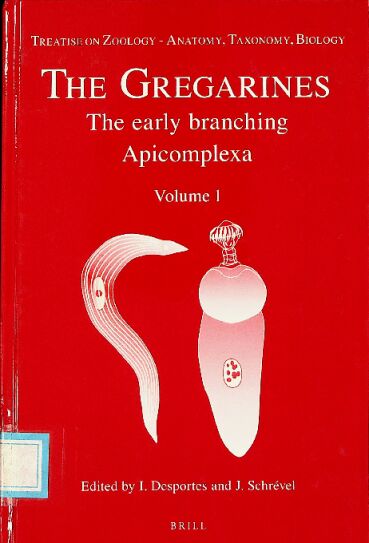
书名:Treatise on zoology-anatomy, taxonomy, biology
责任者:I. Desportes and J. Schrével. | Schrével, Joseph.
ISBN\ISSN:9789004155718,9789004256026
前言
The genus Gregarina was created by Dufour in 1828 for "un nouveau genre de ver qui vit en troupeau dans les intestine de divers insectes". These unicellular parasites were discovered before the cell theory was developed by Schwann & Schleiden in 1839 and completed by Virchow in 1855, and therefore, Dufour supposed that they were helminths. He named Gregarina ovata and G. cuneata, the two first known species found in earwigs and beetles respectively. Many other species were further described over the whole world, aided by the easy detection of their large extracellular stages, even with simple binocular magnifiers, and by their abundance in a wide range of invertebrates, especially insects. The first major contributions to our knowledge of gregarines are due to Moniker (1850-60), Lankaster (1860-85), Schneider (1875), Min-gazzini (1891-93), and Siedlecki (1899) including the first observation of the process of fertilization in the cyst of Lankesteria ascidae. The occurrence of Microsporidia inside marine gregarines was established by Caullery & Mesnil (1897-1919). Leger (1904-1910) accurately described the gametogenesis of Stylocephalus longicollis and other species. In the first part of the zoth century, the occurrence of an asexual schizogonic process was demonstrated in marine gregarines by Brasil (1904-1910). Various classifications were proposed by Pixell-Goodrich (1915-1950), Ray (1930), Ganapati and coworkers (1937-46), Kamm (1922), Reichenow (1929-32) and other authors.
The chapter Gregarines written in 1953 by Pierre-Paul Grasse (Traite de Zoologie, Tome I, Masson Ed.) was the masterwork of what was known about this parasitic group at the middle of the zoth century, both in its biology, cytology at the light micro-scopic level and systematics. Since then, the development of methodological tools has considerably improved our knowledge of Gregarines and their place in the evolution of the Apicomplexa. The present revised and updated edition of the chapter Gre-garines covers more than 6o years of publications, recording scientific investigations conducted in both cell biology and systematics of marine and terrestrial gregarines. In the early 6o's, electron microscopy became the determinant for defining the cellu-lar organization of these parasites. During that period, two main schools emerged in France, one focused on the ultrastructure of marine gregarines under the leadership of Emile Vivier at Lille University, the other on the ultrastructure of terrestrial gregarines under the direction of Pierre-Paul Grasse in the Laboratory 'Evolution des titres organ-ises' (Faculty of Sciences, Paris). Since 1953, gregarine systematics were emphasized by Geus (1969) and Levine (1988) in book chapters and more recently by Clopton & Perkins (z000) in the Illustrated Guide of Protozoa (Lee, Leedale & Bradbury Ed.).
The Apicomplexa (Levine, 1970) are able to parasitise the majority of animal taxa due to their ability to develop outside and also inside host cells. The extracellular de-velopment of most gregarines explains their morphological variability and the pre-dominance of their sexual reproduction with many gametes in large size gamonts. In contrast the Coccidia and Hematozoa are able to enter and develop intracellularly in their vertebrate hosts, while their pathogenicity appears as a consequence of their asexual proliferation, a process additional to the formation of small intracellular gamonts. The systematics of gregarines is based on morphological, biological and molecular criteria that appear to be correlated with their localization in their hosts and to reflect their adaptation to the large diversity of environments, as well as the feeding behaviours and development of their invertebrate hosts. The emphasizing on the distribution of the different gregarines taxa in marine, freshwater and terrestrial hosts is therefore an important theme of this publication. The data presented in chap-ters in and iv is intended to facilitate the identification of species encountered by those who do not specialise in these parasites.
An important part of the information herein reported was collected from 1970 to 1980 by Jean Theodorides for a supplement of the first edition of the Traite de Zoologie. The supplement remained unpublished after the death of P. P. Grasse, in 1985. This volume is dedicated to the memory of Jean Theodorides (1927-1999) and Emile Vivier (1923-2on), for their contribution to the knowledge of Gregarines.
查看更多
目录
VOLUME 1
PREFACE 1
ACKNOWLEDGMENTS 2
CHAPTER I INTRODUCTION: GREGARINES AMONG APICOMPLEXA 7
The high morphological diversity of the vegetative stages of gregarine
trophozoites 12
Schizogony and taxonomy of gregarines 13
Life cycles of gregarines 14
A. Life cycle of a Eugregarine: Lecudina tuzetae 14
B. Life cycle of an Archigregarine: Selenidium pendula, the type species 18
C. Life cycle of a Neogregarine: Mattesia oryzaephili 18
Bibliography 21
CHAPTER II BIOLOGY OF GREGARINES AND THEIR HOST-PARASITE INTERACTIONS 25
II.1 Biology of gregarines 26
II.1.1 Cell and molecular organization of vegetative gregarines: the trophozoites 26
II.1.1.1 Cell and molecular organization of the cortex of trophozoites: the epicyte 26
II.1.1.2 Cytoskeleton and cell motility 54
II.1.1.3 Diversity in nutrition: cell surface, mucron, epimerite 71
II.1.1.4 Cytoplasmic organelles of trophozoites 87
II.1.2 Syzygy and cell recognition between the gamonts 102
II.1.2.1 Types of syzygy 102
II.1.2.2 Syzygy with multiple associations 105
II.1.2.3 Cell junctions between gamonts in syzygy 706
II.1.2.4 Cell recognition and sexual differences between gamonts 108
II.1.3 Biology and cell organization of gregarines during gamogony 110
II.1.3.1 Rotational movements and secretions during cyst formation 110
II.1.3.2 Syncytial nuclear divisions 172
II.1.3.3 Cellularization 176
II.1.3.4 Gametes and fertilization 178
II.1.3.5 Centriole/basal body in Eukaryotes and the mToc/basal body structures
in gregarines 133
II.1.3.6 Abnormal encystment: parthenogenesis? 135
II.1.4 Biology and cell organization of gregarines during sporogony 136
II.1.4.1 Zygote, meiosis and metagamic mitosis 136
II.1.4.2 Secretion of the sporoblast wall and cytoplasmic events within the
sporoblast 139
II.1.4.3 Biogenesis of sporozoites 141
II.1.4.4 Importance of spore structures in taxonomy of Gregarines 144
II.1.4.5 Dissemination of the gregarine spores 144
II.1.5 Transition from sporozoite to trophozoite 150
II.2 Diversity of host-parasite interactions 158
II.2.1 Behaviour of gregarines 158
II.2.1.1 Habitat 158
II.2.1.2 Host specificity 160
II.2.1.3 Effects of gregarines on their hosts 167
II.2.2 Electrophysiological properties of the cortical membranes in gregarine trophozoites 162
II.2.3 Endosymbionts and hyperparasitemia with Microsporidia 162
II.2.3.1 Bacteria 162
II.2.3.2 Microsporidia 162
II.2.4 Experimental control of gregarine life cycles 172
II.2.4.1 Marine gregarines 172
II.2.4.2 Terrestrial gregarines 173
II.2.5 Relationships between host and parasite life cycles and chronology of
gregarine life cycles 173
II.2.5.1 Marine gregarines 173
II.2.5.2 Terrestrial gregarines 175
Bibliography 178
CHAPTER III MARINE GREGARINES 197
III.1 General presentation 197
III.1.1 Definition of Aseptatorina and Septatorina 797
III.1.2 Intermediates between the Aseptatorina and Septatorina 798
III.1.3 Gregarines of Polychaeta and other marine Lophotrochozoa 200
III.1.4 Gregarines of marine Acoela, Nemertodermatida flatworms, and
Chaetognatha 203
III.1.5 Gregarines in the marine Ecdysozoa: crustaceans 203
III.1.6 Gregarines of Echinodermata and Hemichordata: the marine
Deuterostomia Xenambulacria 205
III.1.7 Gregarines of Tunicata: the marine Deuterostomia Urochordata 205
III.2 Archigregarinorida Grasse, 7953: the Archigregarines 206
III.3 Eugregarinorida Leger, 7900 240
III.3.1 Eugregarinida Aseptatorina Chalcravarty, 1960 240
III.3.1.1 Coelomic Eugregarinorida Aseptatorina 240
III.3.1.2 Intestinal Eugregarinorida Aseptatorina 266
III.3.2 Eugregarinida Septatorina Lankester, 1885 325
Bibliography 355
VOLUME II
CHAPTER IV SYSTEMATICS OF TERRESTRIAL AND FRESH WATER
GREGARINES 377
Introduction 377
Classification - diagnosis of families 377
Order Eugregarinorida Leger, rgoo 377
Suborder ASEPTATORINA Chakravarty, 1960 378
Suborder SEPTATORINA Lankester, 1885 380
Order Neogregarinorida Grasse,1953 (Schizogregarinida Léger, rgoo) 389
IV.1 Gregarines of Platyhelminthes: Turbellaria 394
IV.2 Gregarines ofAnnelids: Clitellata 398
IV.2.1 Gregarines of Hirudinea 398
IV.2.2 Gregarines of Oligochaeta 399
IV.3 Gregarines of Chelicerata: Arachnida 427
IV.3.1 Gregarines of Acari (Oribatida) 428
IV.3.2 Gregarines of Opiliones 431
IV.4 Gregarines of Myriapoda 436
IV.15 Gregarines of Hexapoda: Entognatha, Insecta 467
IV.5.1 Gregarines of Entognatha 467
IV5.2 Gregarines of primitive insects 469
IV.5.2.1 Gregarines of Archaeognatha 469
IV.5.2.2 Gregarines of Zygentoma 472
IV.5.3 Gregarines of Odonata 474
IV.5.4 Gregarines of Ephemeroptera 488
IV.5.5 Gregarines of Blattaria 492
IV.5.6 Gregarines of Isoptera 498
IV.5.7 Gregarines of Plecoptera 504
IV.5.8 Gregarines of Orthoptera 506
IV.5.9 Gregarines of Dermaptera 530
IV.5.10 Gregarines of Embioptera 530
IV.5.11 Gregarines of Psocoptera 532
IV.5.12 Gregarines of Hemiptera 533
IV.5.13 Gregarines of Coleoptera 536
IV.5.14 Gregarines of Neuroptera (= Nevroptera) 630
IV.5.15 Gregarines of Raphidioptera 630
IV.5.16 Gregarines of Hymenoptera 637
IV.5.17 Gregarines of Mecoptera 634
IV.5.18 Gregarines of Siphonaptera 635
IV.5.19 Gregarines of Diptera 638
IV.5.20 Gregarines of Trichoptera 654
IV.5.21 Gregarines of Lepidoptera 664
Bibliography 672
CREDITS 711
INDEX ON TAXONOMICAL NAMES 715
查看更多
馆藏单位
中科院文献情报中心