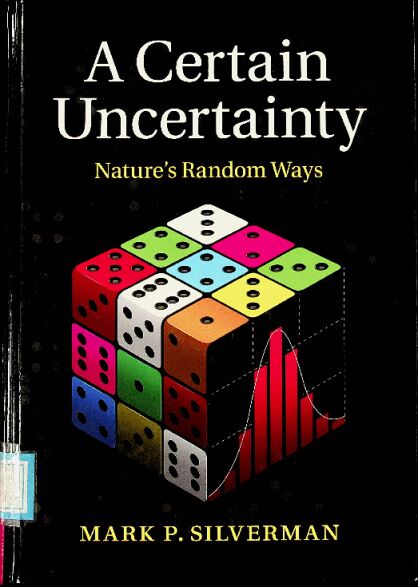
书名:A certain uncertainty
责任者:Mark P. Silverman | G.A. Jarvis Professor of Physics | Trinity College | Connecticut.
出版时间:2014
出版社:Cambridge University Press
前言
I have heard it said that a preface is the part of a book that is written last, placed first, and never read. Still, I will take my chances; this is, after all, a book about probability and uncertainty. The purpose of this preface is to explain what kind of book this is, why I wrote it, for whom I wrote it, and what I hope the reader will gain by it.
This book is a technical narrative. It is not a textbook (although you can certainly use it that way); there are no end-of-chapter questions or tests, and the level of material does not presuppose the reader to have reached some envisioned state of preparedness. It is not a monograph; it does not survey an entire field of intellectual activity, and there is no list of references apart from a few key sources that aided me in my own work. It is not a popularization; the writing does not sensationalize its subject matter, and explanations may in part be heuristic or analytical, but (I hope) never shallow and hand-waving.
A narrative is a story - albeit in this book one that is meant to instruct as well as amuse. Each chapter, apart from some background material in the beginning, is an account of a scientific investigation I have undertaken - sometimes because the questions at issue are of utmost scientific importance; other times on a whim out of pure curiosity. The various narratives are different, but through each runs a common thread of probability, uncertainty, randomness, and, often enough, serendipity.
Why, you may be thinking, should my scientific investigations interest you? To this thought, I can give two answers: one brief, the other longer.
The short answer is that I have written six previous books of the same format (narrative descriptions of my researches), which have sold well. Many people who bought (and presumably read) the books found the diversity of subject matter interesting and the expositions clear and informative, to judge from their unsolicited correspondence. It seems reasonable to me, therefore, that a Bayesian forecast of a reader's response to this book would employ a favorably biased "prior".
The longer answer concerns how people learn things. The principal objective of this book, after ail, is to share with anyone who reads it part of what I have learned in some 50 years (and still counting) as an experimental and theoretical physicist.
查看更多
目录
Preface page xiii
Acknowledgments xvii
1 Tools of the trade 1
1.1 Probability: The calculus of uncertainty 1
1.2 Rules of engagement 3
1.3 Probability density function and moments 5
1.4 The binomial distribution: "bits"[Bin(l, p)] and "pieces" [Bin(n, p)] 7
1.5 The Poisson distribution: counting the improbable 9
1.6 The multinomial distribution: histograms 10
1.7 The Gaussian distribution: measure of normality 12
1.8 The exponential distribution: Waiting for Godot 14
1.9 Moment-generating function 16
1.10 Moment-generating function of a linear combination of variates 17
1.11 Binomial moment-generating function 20
1.12 Poisson moment-generating function 22
1.13 Multinomial moment-generating function 24
1.14 Gaussian moment-generating function 26
1.15 Central Limit Theorem: why things seem mostly normal 28
1.16 Characteristic function 32
1.17 The uniform distribution 34
1.18 The chi-square (χ²) distribution 38
1.19 Studenfs t distribution 41
1.20 Inference and estimation 45
1.21 The principle of maximum entropy 46
1.22 Shannon entropy function 49
1.23 Entropy and prior information 49
1.24 Method of maximum likelihood 54
1.25 Goodness of fit: maximum likelihood, chi-square, and P-values 61
1.26 Order and extremes 72
1.27 Bayes' theorem and the meaning of ignorance 74
Appendices 84
1.28 Rules of conditional probability 84
1.29 Probability density of a sum of uniform variates U(0,1) 85
1.30 Probability density of a χ² variate 86
1.31 Probability density of the order statistic Y_(i) 87
1.32 Probability density of Student's t distribution 89
2 The "fundamental problem" of a practical physicist 91
2.1 Bayes' problem: solution 1 (the uniform prior) 91
2.2 Bayes' problem: solution 2 (Jaynes' prior) 96
2.3 Comparison of the two solutions 98
2.4 The Silverman-Bayes experiment 100
2.5 Variations on a theme of Bayes 104
3 "Mother of all randomness" 112
Part I The random disintegration of matter 112
3.1 Quantum randomness: is "he force" with us? 112
3.2 The gamma coincidence experiment 117
3.3 Delusion of layered histograms 121
3.4 Elementary statistics of nuclear decay 122
3.5 Detrending a time series 128
3.6 Time series: correlations and ergodicity 129
3.7 Periodicity and the sampling theorem 133
3.8 Power spectrum and correlation 138
3.9 Spectral resolution and uncertainty 146
3.10 The non-elementary statistics of nuclear decay 152
3.11 Recurrence, autocorrelation, and periodicity 154
3.12 Limits of detection 160
3.13 Patterns of randomness: runs 163
3.14 Patterns of randomness: intervals 175
3.15 Final test: intervals, runs, and histogram shapes 177
3.16 Conclusions and surprises: the search goes on 181
Appendices 188
3.17Power spectrum completeness relation 188
3.18Distributions of spectral variables and autocorrelation functions 189
4 "Mother of all randomness" 194
Part II The random creation of light 194
4.1 The enigma of light 194
4.2 Quantum vs classical statistics 199
4.3 Occupancy and probability functions 206
4.4 Photon fluctuations 212
4.5 The split-beam experiment: photon correlations 226
4.6 Bits, secrecy, and photons 236
4.7 Correlation experiment with down-converted photons 240
4.8 Theory of recurrent runs 246
4.9 Runs and the single photon: lessons and implications 254
Appendices 260
4.10 Chemical potential of massless particles 260
4.11 Evaluation of Bose-Einstein and Fermi-Dirac integrals 267
4.12 Variation in thermal photon energy with photon number (∂<E>/∂<N>)∣_(T.V) 268
4.13 Combinatorial derivation of the Bose-Einstein probability 269
4.14 Generating function for probability [Pr(N_(n) = k)] of k successes in n trials 270
5 A certain uncertainty 272
5.1 Beyond the "beginning of knowledge" 272
5.2 Simple rules: error propagation theory 274
5.3 Distributions of products and quotients 277
5.4 The uniform distribution: products and ratios 281
5.5 The normal distribution: products and ratios 287
5.6 Generation of negative moments 296
5.7 Gaussian negative moments 299
5.8 Quantum test of composite measurement theory 304
5.9 Cautionary remarks 310
5.10Diagnostic medical indices: what do they signify? 313
5.11Secular equilibrium 315
5.12Half-life determination by statistical sampling: a mysterious Cauchy distribution 318
Appendix 325
5.13 The distribution of W = XY∣Z 325
6 "Doing the numbers" - nuclear physics and the stock market 328
6.1The stock market is a casino 328
6.2 The details - CREF, AAPL, and GRNG 332
6.3 Theory of information H 340
6.4 Is there information in a stock market time series? 347
6.5 Stock price and molecular diffusion 350
6.6 Random walk as an autoregressive process 353
6.7 Stocks go UP and UP ... and DOWN and DOWN 364
6.8 What happened to the law of averages? 372
6.9 Predicting the future 372
6.10 Timing is everything 378
Appendices 384
6.11 Information inequality H (A|B) < H(A) 384
6.12 Power spectral density of an autoregressive time series 385
6.13 Exact maximum likelihood estimate of AR(1) parameters 385
6.14 Statistics of gambling and law of averages 387
7 On target: uncertainties of projectile flight 390
7.1 Knowing where they come down 390
7.2 Distribution of projectile ranges 392
7.3 Energy vs speed: a test of hypotheses 401
7.4 Play ball! - home runs and steroids 404
7.5 Air resistance 409
7.6 Theory of flight 419
7.7 "Fly(ing) ball" - spin and lift 425
7.8 Falling out of the sky is a drag 432
7.9 Descent without power: how to rescue a jumbo jet disabled in flight 441
Appendices 453
7.10 Distribution and variation of projectile range R(V, θ) 453
7.11 Unbiased estimator of skewness 455
8 The guesses of groups 457
8.1A radical hypothesis 457
8.2 A mathematical truism? 463
8.3 Condorcet's jury theorem 465
8.4 Epimenides "paradox of experts" 470
8.5 The Silverman GOG experiments 471
8.6 Interpretation of the GOG experiments 476
8.7 Mining groups for information: Galton's democratic model 480
8.8 Mining groups for information: Silverman's Mixed-NU model 483
8.9 The BBC-Silverman experiments: the reach of television 488
8.10 The log-normal distribution: a fundamental model of group judgment? 495
8.11 Conclusions: so how "wise" are crowds? 506
Appendices 509
8.12 Derivation of the jury theorem 509
8.13 Solution to logic problem #1: how old are the children? 510
8.14 Solution to logic problem #2: where is the treasure? 510
8.15 Origins and features of a log-normal distribution 511
9 The random flow of energy 515
Part I Power to the people 515
9.1 A different kind of law 515
9.2 Examining the data: time and autocorrelations 516
9.3 Examining the data: frequency and power spectra 523
9.4 Seeking a solution: the construction of models 526
9.5 Autoregressive (AR) time series 527
9.6 Moving average (MA) time series 530
9.7 Combinations: autoregressive moving average time series 533
9.8 Phase one: exploration of autoregressive solutions 534
9.9 Phase two: adaptive and deterministic oscillations 543
9.10 Phase three: exploration of moving average solutions 547
9.11 Phase four: judgment - which model is best? 554
9.12 Electric shock! 561
9.13 Two scenarios: coincidence or conspiracy? 565
Appendices 568
9.14 Solution of the AR(12)_(1,12) master equation 568
9.15 Maximum likelihood estimate of AR_(n) parameters 569
9.16 Akaike information criterion and log-likelihood 570
9.17 Line of regression to 12-month moving average 570
10 The random flow of energy 573
Part II A warning from the weather under ground 573
10.1 What lies above? 573
10.2 What lies beneath? 577
10.3 Autocorrelation of underground temperature 580
10.4 Fourier transform and power spectrum of underground temperature 582
10.5 Energy diffusion: approach I 一 deterministic 589
10.6 Energy diffusion: approach II - stochastic 594
10.7 Interpreting the waveforms 597
10.8 Climate implications 602
Appendices 609
10.9 Absorption of solar radiation by a sphere 609
10.10 Autocorrelation of a decaying oscillator 609
Bibliography 611
Index 613
查看更多
馆藏单位
中科院文献情报中心