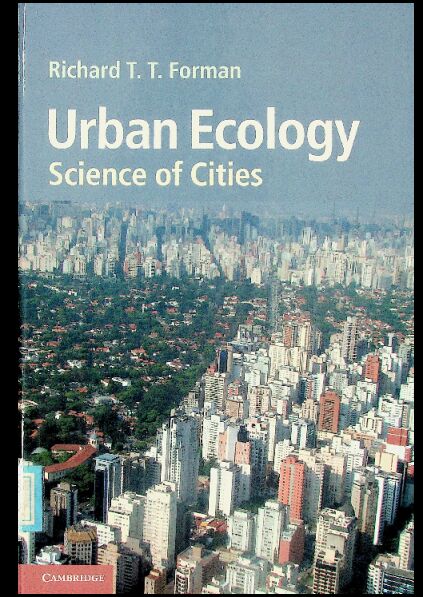
书名:Urban ecology
责任者:Richard T.T. Forman | Harvard University | USA.
ISBN\ISSN:9781107007000,9780521188241
出版时间:2014
出版社:Cambridge University Press
前言
How does nature work in our human-created city, suburb, and exurb/peri-urb? Indeed how is ecology - including its urban water, soil, air, plant, and animal foundations - spatially entwined with this great human enterprise? And how can we improve urban areas for both nature and people? Urban Ecology: Science of Cities explores the entire urban area: from streets, lawns, and parks to riversides, sewer systems, and industrial sites. The book presents models, patterns, and examples from hundreds of cities worldwide. Numerous illustrations enrich the presentation. Cities are analyzed, not as ecologically bad or good, but as places with concentrated rather than dispersed people. Urban ecology principles, traditionally adapted from natural-area ecology, now increasingly emerge from the distinctive features of cities. Spatial patterns and flows, linking organisms, built structures, and the physical environment highlight a treasure chest of useful principles. This pioneering interdisciplinary book opens up frontiers of insight, as a valuable source and text for undergraduates, graduates, researchers, professionals, and others with a thirst for solutions to growing urban problems.
查看更多
目录
Foreword ix
Preface xii
Acknowledgments xiv
Part I – Framework
1 Foundations 1
Urban ecology concept 2
Routes to the present 4
Urban attributes and ecological assays 11
People and their activities 16
Using urban ecology for society’s solutions 26
2 Spatial patterns and mosaics 31
Scale, human, and nature patterns 32
Urban–rural gradient as spatial model 38
Patch–corridor–matrix and other spatial models 44
Neighborhood mosaics and their linkages 49
Urban regions, metro areas, cities 58
3 Flows, movements, change 65
The nature of flows and movements 65
Flows around boundaries and mosaics 69
Change-over-time principles 73
Urbanization 76
Rates and trajectories of ecological change 83
Part II – Ecological features
4 Urban soil and chemicals 91
The essence of urban soil 91
Key natural and human processes 97
Soil texture and associated properties 101
Life in the soil 105
Urban soil chemicals 113
The urban underground 119
5 Urban air 125
Microclimate 126
Energy and radiation 129
Urban heat 133
Diverse airflows 139
Air pollutants and effects 143
6 Urban water systems 149
Urban flows in the water cycle 150
Groundwater 151
Clean water supply 158
Sewage and septic wastewater 160
Stormwater and pollutants 170
7 Urban water bodies 175
Urban wetlands and ponds 175
Constructed basins, ponds, wetlands, biofilters 179
Urban streams 182
Urban rivers 186
Flooding by river and stream 193
Urban coastal zones 197
8 Urban habitat, vegetation, plants 205
Urban vegetation and habitat 205
Urban plants 208
Urban plant biology 215
Trees and shrubs 223
Plant community structure and dynamics 230
Plants and urban habitat fragments 238
9 Urban wildlife 241
Species types 242
Vertical structures, vegetation layers, and animals 255
Spatial habitat patterns and animals 259
Wildlife movement 264
Changing urban wildlife and adaptation 268
Part III – Urban features
10 Human structures 275
Railways 276
Roads and associated features 279
Hard surfaces and cracks 287
House plots, gardens, lawns 292
Buildings 306
11 Residential, commercial, industrial areas 314
City residential areas 315
Suburban and peri-urban/exurban residential areas 321
City center 326
Commercial sites dispersed across the urban area 332
Industrial areas 336
12 Green spaces, corridors, systems 343
Urban agriculture 344
Parks 349
Diverse large greenspaces 353
Green corridors and networks 362
Integrated urban greenspace system 366
Epilogue 372
Appendix A: Positive and negative attributes of an urban region 379
Appendix B: Equations 381
References 386
Index 444
查看更多
作者简介
Richard T. T. Forman is the PAES Professor of Landscape Ecology at Harvard University, where he teaches ecological courses in the Graduate School of Design and in Harvard College. His research and writing include landscape ecology, road ecology, urban ecology, land-use planning and conservation, the netway system, and linking science with spatial pattern to mesh nature and people on the land. His previous title, Urban Regions: Ecology and Planning Beyond the City, was published by Cambridge University Press in 2008.
查看更多
馆藏单位
中科院文献情报中心