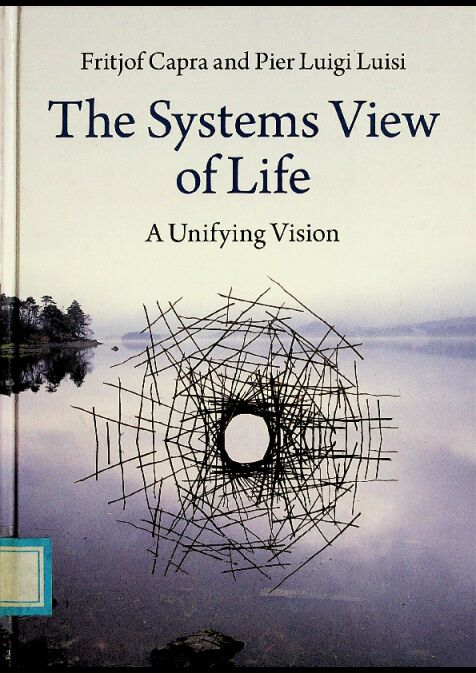
书名:The systems view of life
责任者:Fritjof Capra | formally of the Lawrence Berkeley National Laboratory | CA | USA | Pier Luigi Luisi | University of Rome 3 | Italy.
ISBN\ISSN:9781107011366,1107011361
出版时间:2014
出版社:Cambridge University Press
前言
As the twenty-first century unfolds, it is becoming more and more evident that the major problems of our time-energy, the environment, climate change, food security, financial security-cannot be understood in isolation. They are systemic problems, which means that they are all interconnected and interdependent. Ultimately, these problems must be seen as just different facets of one single crisis, which is largely a crisis of perception. It derives from the fact that most people in our modern society, and especially our large social institutions, subscribe to the concepts of an outdated worldview, a perception of reality inadequate for dealing with our overpopulated, globally interconnected world.
There are solutions to the major problems of our time; some of them even simple. But they require a radical shift in our perceptions, our thinking, our values. And, indeed, we are now at the beginning of such a fundamental change of worldview in science and society, a change of paradigms as radical as the Copernican revolution. Unfortunately, this realization has not yet dawned on most of our political leaders, who are unable to "connect the dots," to use a popular phrase. They fail to see how the major problems of our time are all interrelated. Moreover, they refuse to recognize how their so-called solutions affect future generations. From the systemic point of view, the only viable solutions are those that are sustainable. As we discuss in this book, a sustainable society must be designed in such a way that its ways of life, businesses, economy, physical structures, and technologies do not interfere with nature's inherent ability to sustain life.
Over the past thirty years it has become clear that a full understanding of these issues requires nothing less than a radically new conception of life. And indeed, such a new understanding of life is now emerging. At the forefront of contemporary science, we no longer see the universe as a machine composed of elementary building blocks. We have discovered that the material world, ultimately, is a network of inseparable patterns of relationships; that the planet as a whole is a living, self-regulating system. The view of the human body as a machine and of the mind as a separate entity is being replaced by one that sees not only the brain, but also the immune system, the bodily tissues, and even each cell as a living, cognitive system. Evolution is no longer seen as a competitive struggle for existence, but rather as a cooperative dance in which creativity and the constant emergence of novelty are the driving forces. And with the new emphasis on complexity, networks, and patterns of organization, a new science of qualities is slowly emerging.
This new conception of life involves a new kind of thinking - thinking in terms of relationships, patterns, and context. In science, this way of thinking is known as "systemic thinking," or "systems thinking"; hence, the understanding of life that is informed by it is often identified by the phrase we have chosen for the title of this book: the systems view of life.
The new scientific understanding of life encompasses many concepts and ideas that are being developed by outstanding researchers and their teams around the world. With the present book, we want to offer an interdisciplinary text that integrates these ideas, models and theories into a single coherent framework. We present a unified systemic vision that includes and integrates life's biological, cognitive, social, and ecological dimensions; and we also discuss the philosophical, spiritual, and political implications of our unified view of life.
We believe that such an integrated view is urgently needed today to deal with our global ecological crisis and protect the continuation and flourishing of life on Earth. It will therefore be critical for present and future generations of young researchers and graduate students to understand the new systemic conception of life and its implications for a broad range of professions - from economics, management, and politics to medicine, psychology and law. In addition, our book will be useful for undergraduate students in the life sciences and the humanities.
In the following chapters, we take a broad sweep through the history of ideas and across scientific disciplines. Beginning with the Renaissance and the Scientific Revolution, our historical account includes the evolution of Cartesian mechanism from the seventeenth to the twentieth centuries, the rise of systems thinking, the development of complexity theory, recent discoveries at the forefront of biology, the emergence of the new conception of life at the turn of this century, and its economic, ecological, political, and spiritual implications.
The reader will notice that our text includes not only numerous references to the literature, but also an abundance of cross-references to chapters and sections in this book. There is a good reason for this abundance of references. A central characteristic of the systems view of life is its nonlinearity: all living systems are complex-i.e., highly nonlinear-networks; and there are countless interconnections between the biological, cognitive, social, and ecological dimensions of life. Thus, a conceptual framework integrating these multiple dimensions is bound to reflect life's inherent nonlinearity. In our struggle to communicate such a complex network of concepts and ideas within the linear constraints of written language, we felt that it would help to interconnect the text by a network of cross-references. Our hope is that the reader will find that, like the web of life, this book itself is also a whole that is more than the sum of its parts.
查看更多
目录
Preface page xi
Acknowledgments xiii
Introduction: paradigms in science and society 1
I THE MECHANISTIC WORLDVIEW
1 The Newtonian world-machine 19
1.1 The Scientific Revolution 20
1.2 Newtonian physics 28
1.3 Concluding remarks 33
2 The mechanistic view of life 35
2.1 Early mechanical models of living organisms 35
2.2 From cells to molecules 36
2.3 The century of the gene 39
2.4 Mechanistic medicine 42
2.5 Concluding remarks 43
3 Mechanistic social thought 45
3.1 Birth of the social sciences 45
3.2 Classical political economy 49
3.3 The critics of classical economics 51
3.4 Keynesian economics 54
3.5 The impasse of Cartesian economics 55
3.6 The machine metaphor in management 57
3.7 Concluding remarks 59
II THE RISE OF SYSTEMS THINKING
4 From the parts to the whole 63
4.1 The emergence of systems thinking 63
4.2 The new physics 68
4.3 Concluding remarks 79
5 Classical systems theories 84
5.1 Tektology 84
5.2 General systems theory 85
5.3 Cybernetics 87
5.4 Concluding remarks 97
6 Complexity theory 98
6.1 The mathematics of classical science 99
6.2 Facing nonlinearity 104
6.3 Principles of nonlinear dynamics 109
6.4 Fractal geometry 116
6.5 Concluding remarks 125
III A NEW CONCEPTION OF LIFE
7 What is life? 129
7.1 How to characterize the living 129
7.2 The systems view of life 130
7.3 The fundamentals of autopoiesis 134
7.4 The interaction with the environment 135
7.5 Social autopoiesis 136
7.6 Criteria of autopoiesis, criteria of life 137
7.7 What is death? 139
7.8 Autopoiesis and cognition 140
7.9 Concluding remarks 142
8 Order and complexity in the living world 144
8.1 Self-organization 144
8.2 Emergence and emergent properties 154
8.3 Self-organization and emergence in dynamic systems 158
Guest essay: Daisyworld 166
8.4 Mathematical patterns in the living world 168
8.5 Concluding remarks 180
9 Darwin and biological evolution 182
9.1 Darwin's vision of species interlinked by a network of parenthood 182
9.2 Darwin, Mendel, Lamarck, and Wallace: a multifaceted interconnection 185
9.3 The modern evolutionary synthesis 187
9.4 Applied genetics 193
9.5 The Human Genome Project 194
9.6 Conceptual revolution in genetics 195
Guest essay: The rise and rise of epigenetics 198
9.7 Darwinism and creationism 207
9.8 Chance, contingency, and evolution 210
9.9 Darwinism today 212
9.10 Concluding remarks 214
10 The quest for the origin of life on Earth 216
10.1 Oparin's molecular evolution 216
10.2 Contingency versus determinism in the origin of life 216
10.3 Prebiotic chemistry 220
10.4 Laboratory approaches to minimal life 227
10.5 The synthetic-biology approach to the origin of life 229
10.6 Concluding remarks 239
11 The human adventure 240
11.1 The ages of life 240
11.2 The age of humans 241
11.3 The determinants of being human 245
11.4 Concluding remarks 251
12 Mind and consciousness 252
12.1 Mind is a process! 252
12.2 The Santiago theory of cognition 255
12.3 Cognition and consciousness 257
Guest essay: On the primary nature of consciousness 266
12.4 Cognitive linguistics 271
12.5 Concluding remarks 273
13 Science and spirituality 275
13.1 Science and spirituality: a dialectic relationship 275
13.2 Spirituality and religion 276
13.3 Science versus religion: a "dialogue of the deaf"? 282
13.4 Parallels between science and mysticism 285
13.5 Spiritual practice today 289
13.6 Spirituality, ecology, and education 290
13.7 Concluding remarks 295
14 Life, mind, and society 297
14.1 The evolutionary link between consciousness and social phenomena 297
14.2 Sociology and the social sciences 297
14.3 Extending the systems approach 301
14.4 Networks of communications 308
14.5 Life and leadership in organizations 315
14.6 Concluding remarks 320
15 The systems view of health 322
15.1 Crisis in healthcare 323
15.2 What is health? 326
Guest essay: Placebo and nocebo responses 329
15.3 A systemic approach to healthcare 333
Guest essay: Integrative practice in healthcare and healing 334
15.4 Concluding remarks 338
IV SUSTAINING THE WEB OF LIFE
16 The ecological dimension of life 341
16.1 The science of ecology 341
16.2 Systems ecology 345
16.3 Ecological sustainability 351
16.4 Concluding remarks 361
17 Connecting the dots: systems thinking and the state of the world 362
17.1 Interconnectedness of world problems 362
17.2 The illusion of perpetual growth 366
17.3 The networks of global capitalism 375
17.4 The global civil society 389
17.5 Concluding remarks 392
18 Systemic solutions 394
18.1 Changing the game 394
Guest essay: Living enterprise as the foundation of a generative economy 402
18.2 Energy and climate change 405
18.3 Agroecology - the best chance to feed the world 431
Guest essay: Seeds of life 438
18.4 Designing for life 442
18.5 Concluding remarks 451
Bibliography 453
Index 472
查看更多
馆藏单位
中科院文献情报中心