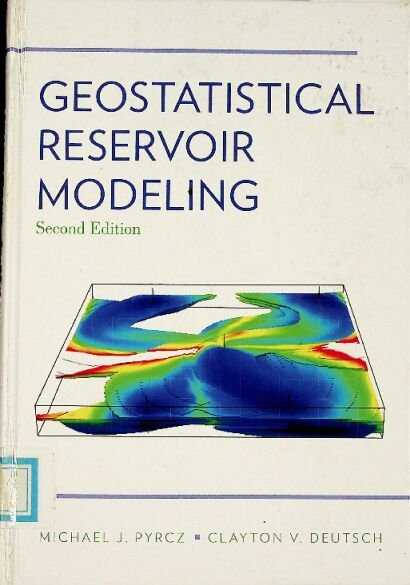
书名:Geostatistical reservoir modeling
责任者:Michael J. Pyrcz | Clayton V. Deutsch.
出版时间:2014
出版社:Oxford University Press
摘要
Published in 2002, the first edition of Geostatistical Reservoir Modeling brought the practice of petroleum geostatistics into a coherent framework, focusing on tools, techniques, examples, and guidance. It emphasized the interaction between geophysicists, geologists, and engineers, and was received well by professionals, academics, and both graduate and undergraduate students.
In this revised second edition, Deutsch collaborates with co-author Michael Pyrcz to provide an expanded (in coverage and format), full color illustrated, more comprehensive treatment of the subject with a full update on the latest tools, methods, practice, and research in the field of petroleum Geostatistics.
Key geostatistical concepts such as integration of geologic data and concepts, scale considerations, and uncertainty models receive greater attention, and new comprehensive sections are provided on preliminary geological modeling concepts, data inventory, conceptual model, problem formulation, large scale modeling, multiple point-based simulation and event-based modeling. Geostatistical methods are extensively illustrated through enhanced schematics, work flows and examples with discussion on method capabilities and selection. For example, this expanded second edition includes extensive discussion on the process of moving from an inventory of data and concepts through conceptual model to problem formulation to solve practical reservoir problems.
A greater number of examples are included, with a set of practical geostatistical studies developed to illustrate the steps from data analysis and cleaning to post-processing, and ranking. New methods, which have developed in the field since the publication of the first edition, are discussed, such as models for integration of diverse data sources, multiple point-based simulation, event-based simulation, spatial bootstrap and methods to summarize geostatistical realizations.
查看更多
目录
Preface ix
Acknowledgments Xi
1.Introduction 1
1.1.Comments on Second Edition 1
1.2.Plan for the Book 2
1.3.Key Concepts 5
1.4.Motivation for Reservoir Models 9
1.5.Data for Reservoir Modeling 10
1.6.The Common Work Flow 12
1.7.An Introductory Example 13
1.8.Work Flow Diagrams 26
2.Modeling Principles 27
2.1.Preliminary Geological Modeling Concepts 27
2.1.1.The Story 28
2.1.2.Geological Models 29
2.1.3.Geological Model Overview 30
2.1.4.Basin Formation and Filling 32
2.1.5.Reservoir Architecture 33
2.1.6.Example Stories and Reservoir Modeling Significance 36
2.1.7.Section Summary 40
2.2.Preliminary Statistical Concepts 40
2.2.1.Geological Populations and Stationarity 41
2.2.2.Notation and Definitions 43
2.2.3.Bivariate Distributions 48
2.2.4.Q-Q Plots and Data Transformation 49
2.2.5.Data Transformation 51
2.2.6.Declustering and Debiasing 53
2.2.7.Histogram and Cross-Plot Smoothing 63
2.2.8.Monte Carlo Simulation 63
2.2.9.Parameter Uncertainty 65
2.2.10.Bayesian Statistics 68
2.2.11.Work Flow 70
2.2.12.Section Summary 71
2.3.Quantifying Spatial Correlation 74
2.3.1.The Random Function Concept 77
2.3.2.Calculating Experimental Variograms 80
2.3.3.Interpreting Experimental Variograms 85
2.3.4.Horizontal Variograms 92
2.3.5.Variogram Modeling 98
2.3.6.Cross Variograms 102
2.3.7.Multiple-Point Statistics 109
2.3.8.Volume Variance Relations 111
2.3.9.Work Flow 112
2.3.10.Section Summary 115
2.4.Preliminary Mapping Concepts 116
2.4.1.Kriging and Cokriging 118
2.4.2.Sequential Gaussian Simulation 122
2.4.3.Indicator Formalism 127
2.4.4.P-Field Methods 132
2.4.5.Multiple-Point Simulation 134
2.4.6.Object-Based Simulation 135
2.4.7.Optimization Algorithms for Modeling 137
2.4.8.Accounting for Trends 137
2.4.9.Alternatives for Secondary Data Integration 141
2.4.10.Work Flow 146
2.4.11.Section Summary 147
3.Modeling Prerequisites 151
3.1.Data Inventory 151
3.1.1.Data Events 152
3.1.2.Well Data 153
3.1.3.Seismic Data 155
3.1.4.Dynamic Data 158
3.1.5.Analog Data 159
3.1.6.Data Considerations 164
3.1.7.Section Summary 167
3.2.Conceptual Model 167
3.2.1.Conceptual Geological Model 168
3.2.2.Model Framework 171
3.2.3.Modeling Method Choice 181
3.2.4.Statistical Inputs and Geological Rules 189
3.2.5.Work Flow 191
3.2.6.Section Summary 191
3.3.Problem Formulation 191
3.3.1.Goal and Purpose Definition 193
3.3.2.Modeling Work Constraints 194
3.3.3.Synthetic Paleo-basin 195
3.3.4.Modeling Work Flows 198
3.3.5.Reporting and Documentation 206
3.3.6.Work Flow 208
3.3.7.Section Summary 208
4.Modeling Methods 209
4.1.Large-Scale Modeling 209
4.1.1.Structure and Bounding Surfaces 210
4.1.2.Identification of Regions 214
4.1.3.Trend Model Construction 215
4.1.4.Multivariate Mapping 224
4.1.5.Summarization and Visualization 227
4.1.6.Section Summary 228
4.2.Variogram-Based Facies Modeling 228
4.2.1.Comments on Facies Modeling 229
4.2.2.Sequential Indicator Simulation 231
4.2.3.Truncated Gaussian Simulation 237
4.2.4.Cleaning Cell-Based Facies Realizations 241
4.2.5.Work Flow 243
4.2.6.Section Summary 243
4.3.Multiple-Point Facies Modeling 244
4.3.1.Multiple-Point Simulation 247
4.3.2.Sequential Simulation with MPS 250
4.3.3.Input Statistics 254
4.3.4.Implementation Details 258
4.3.5.Work Flow 259
4.3.6.Section Summary 259
4.4.Object-Based Facies Modeling 259
4.4.1.Background 261
4.4.2.Stochastic Shales 268
4.4.3.Fluvial Modeling 269
4.4.4.Nonfluvial Depositional Systems 275
4.4.5.Work Flow 276
4.4.6.Section Summary 277
4.5.Process-Mimicking Facies Modeling 277
4.5.1.Background 279
4.5.2.Process-Mimicking Modeling 285
4.5.3.Work Flow 294
4.5.4.Section Summary 294
4.6.Porosity and Permeability Modeling 295
4.6.1.Background 296
4.6.2.Gaussian Techniques for Porosity 298
4.6.3.Seismic Data in SGS for Porosity 299
4.6.4.Porosity/Permeability Transforms 302
4.6.5.Gaussian Techniques for Permeability 307
4.6.6.Indicator Technique for Permeability 310
4.6.7.Work Flow 313
4.6.8.Section Summary 314
4.7.Optimization for Model Construction 316
4.7.1.Background 318
4.7.2.Simulated Annealing 322
4.7.3.Perturbation Mechanism 326
4.7.4.Update Objective Function 328
4.7.5.Decision Rule 329
4.7.6.Problem Areas 329
4.7.7.Other Methods 331
4.7.8.Work Flow 335
4.7.9.Section Summary 335
5.Model Applications 336
5.1.Model Checking 336
5.1.1.Background 337
5.1.2.Minimum Acceptance Checks 339
5.1.3.High-Order Checks 345
5.1.4.Cross Validation and the Jackknife 348
5.1.5.Checking Distributions of Uncertainty 350
5.1.6.Work Flow 357
5.1.7.Section Summary 357
5.2.Model Post-processing 357
5.2.1.Background 360
5.2.2.Model Modification 361
5.2.3.Model Scaling 367
5.2.4.Pointwise Summary Models 369
5.2.5.Joint Summary Models 372
5.2.6.Work Flow 373
5.2.7.Section Summary 374
5.3.Uncertainty Management 375
5.3.1.Background 375
5.3.2.Uncertainty Considerations 377
5.3.3.How Many Realizations? 377
5.3.4.Summarizing Uncertainty 379
5.3.5.Uncertainty Versus Well Spacing 381
5.3.6.Case for Geometric Criteria 381
5.3.7.Ranking Realizations 383
5.3.8.Decision Making with Uncertainty 385
5.3.9.Work Flow 390
5.3.10.Section Summary 390
6.Special Topics 391
6.1.Unstructured Grids 392
6.2.Continuous Variable Heterogeneity 392
6.3.More Estimation Methods 393
6.4.Spectral Methods 393
6.5.Surface-Based Modeling 394
6.6.Ensemble Kalman Filtering 395
6.7.Advanced Geological Characterization 396
6.8.Other Emerging Techniques 397
6.9.Final Thoughts 398
A.Glossary and Notation 399
A.1.Glossary 399
A.2.Notation 407
Bibliography 409
Index 429
查看更多
作者简介
Clayton Deutsch is a professor in the School of Mining and Petroleum Engineering, in the Department of Civil and Environmental Engineering at the University of Alberta. Michael Pyrcz is a Research Scientist at Chevron Energy Technology Company.
查看更多
馆藏单位
中科院文献情报中心