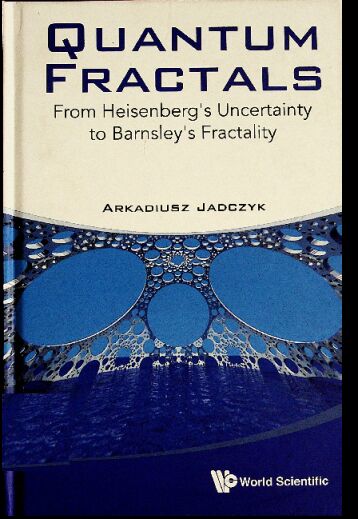
书名:Quantum fractals
责任者:Arkadiusz Jadczyk | Quantum Future Group Inc | USA.
ISBN\ISSN:9789814569866,9814569860
出版时间:2014
出版社:World Scientific
前言
This book provides a handy introduction to quantum fractals — a new kind of fractals arising in quantum-like jump random processes involving non-commuting operations. It describes the basic theoretical concepts, algorithms and also touches upon philosophical questions of the foundations of quantum theory.An overview The science of fractals is young and growing fast. Quantum fractals are even younger and are still crawling on all fours. But the time seems to be ripe for them to get up and look around. As we hope it will become clear from this book — various possible applications abound.Roughly: quantum fractals are patterns generated by iterated function systems, with place dependent probabilities, of M¨obius transformations on spheres or on more general projective spaces. In quantum physics quantum fractals can be interpreted as traces of quantum jumps during simultaneous monitoring of several non-commuting observables. These quantum jumps accompany events with information exchanges between the quantum system and the classical information processing devices.While mathematically completely clear such a concept brings an almost revolutionary novelty into quantum physics. Until now it has usually been assumed that simultaneous “measurements” of non-commuting observables makes no sense, and that it cannot lead to any useful predictions. In this book we challenge the standard position by proposing that such experiments may lead to organized chaotic behavior that can be experimentally verified. The phenomenon is general enough to be present in applications of the quantum formalism beyond physics and beyond quantum computing,for instance in quantum games, quantum psychology etc. Here possible deviations from linearity are also touched upon.
Another area where quantum fractals may appear is relativistic light aberration, though there the particular form of place dependent probabilities that are derived from linear event enhanced quantum theory (EEQT)is not, at the present moment, justified.About the Book This book combines a number of different topics suchas: fractals generation and analysis, elements of geometry, linear and multi-linear algebra and group theory, special relativity, quantum measurements and, in particular, Heisenberg’s uncertainty relations and their interpretation, as well as some elements of random processes.Since it is rather unusual to find a single person that would be interested in all of these areas, this book has been organized in such a way that the reader should be able to extract from it the information that is of aparticular interest in her/his research. Nevertheless the primary idea of the book is to bring together a diversity of ideas and, in this way, encourage cooperation and stimulate mutual interest between various branches of quantum physics and fractal research for the benefit of all. For this reason the book has not been organized in strict linear order. To facilitate the process of extracting the information of interest there are repetitions: the same concept may appear in the book several times,though in a somewhat different context and stressing different aspects. There alder that would like to know more about a given concept can always find additional information by perusing the index.For those who wish to start with looking first at examples: they can start with “the impossible quantum fractal” — Sec. 2.5 — and then check examples of hyperbolic quantum fractals in Sec. 3.1.Those who are simply looking for algorithms and examples of the code that were used for generating these examples may like to start directly with Sec. 3.4.On the other hand readers interested in the foundations of quantum theory can start with Chap. 4 or one of its sections.
查看更多
目录
Preface vii
1. Introduction 1
2. What are Quantum Fractals? 11
2.1 Cantorset 11
2.1.1 Cantor set through “Chaos Game” 13
2.2 Iteratedfunctionsystems 15
2.2.1 DefinitionofIFS 18
2.2.2 Frobenius-Perron operator 22
2.3 Cantorsetthroughmatrixeigenvector 23
2.4 Quantum iterated function systems 25
2.5 Example: The “impossible” quantum fractal 29
2.5.1 24 symmetries — the octahedral group 30
2.5.2 Construction of the 24-elements SQIFS 31
2.5.3 Openproblems 37
2.6 Actionontheplane 41
2.7 Lorentz group, SL(2, C), and relativistic aberration 43
2.7.1 TheLorentzgroup 43
2.7.2 Action of the Lorentz group on the sphere 45
2.7.3 The group SL(2, C) 48
2.7.4 Action of SL(2, C) on the two-sphere S~2 50
2.7.5 Projection operators representations of the Bloch sphere S~2 55
2.7.6 Visualization of quantum spin states and state Vectors 60
2.7.7 Action on orthogonal projections and M¨obius transformations .. 68
2.7.8 Exponential map in SL(2, C) 70
2.7.9 Twodifferenteigenvalues 75
2.7.10 Classification of M¨obius transformations 76
2.7.11 Areatransformationlaw 78
2.7.12 Relativisticaberration 85
2.7.13 Example: Special subgroup of parabolic transformations .. 94
2.7.14 Pythagorean triples and quadruples 96
3. Examples 109
3.1 Hyperbolicquantumfractals 109
3.1.1 Thecircle 110
3.1.2 Platonic quantum fractals for a qubit 120
3.2 Controlling chaotic behavior and fractal dimension 167
3.3 Quantum fractals on n-spheres 171
3.3.1 Cliffordalgebras 173
3.3.2 Stereographicprojection 194
3.3.3 Conformal maps and Frobenius-Perron operator 195
3.4 Algorithms for generating hyperbolic quantum fractals 199
3.4.1 Chaos game on n-sphere 202
3.4.2 Approximation to the invariant measure 208
4. Foundational Questions 213
4.1 Stochastic nature of quantum measurement processes 213
4.2 Are there quantumjumps? 227
4.3 Bohmianmechanics 233
4.4 Event Enhanced Quantum Theory 240
4.4.1 Piecewise deterministic process 242
4.4.2 Algorithm for the piecewise deterministic process(PDP) 244
4.4.3 Association of the semigroup with PDP 244
4.4.4 Central classical observables 245
4.4.5 Quantum Events Theory—Duality 249
4.4.6 Completelypositivemaps 251
4.4.7 Dynamical semigroups on an algebra with a center 254
4.4.8 Liouville equation for states 256
4.4.9 Ensemble and individual descriptions 256
4.5 Ghirardi-Rimini-Weber spontaneous localization 259
4.5.1 Thecoupling 262
4.6 Heisenberg’s uncertainty principle and quantum fractals 264
4.6.1 Simpleexamples 268
4.6.2 Asingledetector 269
4.6.3 Measurement of non-commuting observables 270
4.6.4 The simplest toy model — space and momentum are each only two-points 272
4.7 Arequantumfractalsreal? 279
Appendix A Mathematical Concepts 297
A.1 Metricspaces 297
A.1.1 Compactmetricspaces 300
A.1.2 Locallycompactmetricspaces 300
A.2 Normedspaces 301
A.2.1 Banachspaces 301
A.2.2 The space C(X, Y ) 302
A.3 Measureandintegral 302
A.3.1 Borelsets 303
A.3.2 Measure 303
A.3.3 Integral 304
A.3.4 L~p spaces 306
A.4 Markov, Frobenius-Perron and Koopman operators 308
Appendix B Minkowski Space Generalization of Euler-Rodrigues Formula 311
B.1 Alternative derivation via SL(2, C) 314
Bibliography 317
Index 329
查看更多
馆藏单位
中科院文献情报中心