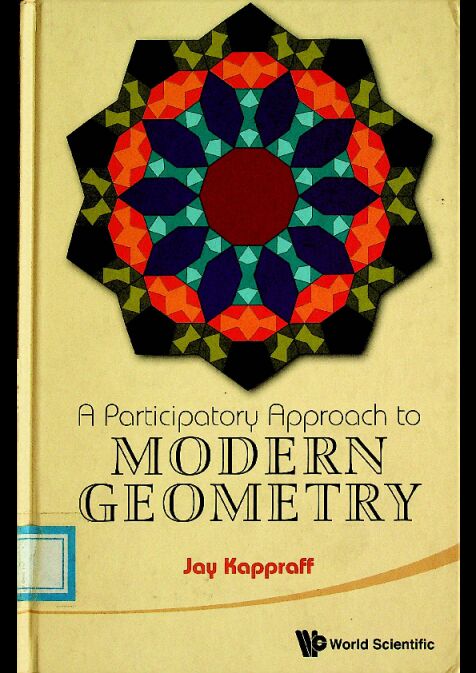
书名:A participatory approach to modern geometry
责任者:Jay Kappraff | New Jersey Institute of Technology | USA.
ISBN\ISSN:9789814556705,981455670X
出版时间:2015
出版社:World Scientific
前言
This book aims to make the subject of geometry and its applications easy and comfortable to understand by students majoring in mathematics or the liberal arts, architecture and design. It can be used to teach students at different levels of computational ability and there is also sufficient novel material to interest students at a higher cognitive level. While the book goes deeply into the applications of geometry, it contains much introductory material which up to now may not have been known to the student. The constructive approach using compass and straightedge engages students, not just on an intellectual level, but also at a tactile level. This may be the only rigorous book offering geometry that attempts to engage students outside of the mathematics discipline.
查看更多
目录
Preface xiii
Chapter 1. Triangle and Square Grids 1
1.1. Introduction 1
1.2. Triangle-Circle and Triangle Grids 1
1.3. Square-Circle and Square Grids 5
1.4. Star Designs Based on the Triangle Grid 6
1.5. Star Exploration 10
1.6. The Two Great Systems of Ancient Geometry 10
Chapter 2. The Pythagorean Theorem 13
2.1. Introduction 13
2.2. Five Proofs of the Pythagorean Theorem 13
2.3. Pythagorean Triples and the Brunes Star 18
2.4. Application of the Pythagorean Theorem 19
Chapter 3. Scan Converting of a Line Segment 21
3.1. Introduction 21
3.2. Lines 22
3.3. Lines and Calculus 23
3.4. Scan Converting of a Line 24
3.5. An Example of Scan Converting 24
Chapter 4. Compass and Straightedge Constructions 27
Part 1: The World Within a Triangle 27
4.1. Geometric Constructions 27
4.2. The Fundamental Constructions 28
4.3. The World Within a Triangle 31
4.4. Special Points in an Equilateral Triangle 31
4.5. A Theorem about Inscribed Circles Within a Triangle 32
4.6. Inscribing Regular Polygons in Circle 32
4.7. The Centroid of a Polygon 33
4.8. Additional Constructions 34
Chapter 5. Congruent Triangles 35
5.1. Introduction 35
5.2. The Sum of the Angles of a Triangle 36
5.3. Conditions for Congruent Triangles 36
5.4. Triangle Inequality 37
5.5. Constructing a Triangle from Partial Information 37
5.6. Two Applications of Congruent Triangles 39
Chapter 6. Introduction to Trigonometry 41
6.1. Introduction 41
6.2. The Trigonometry of a Right Triangle 41
6.3. Given the Value of One Trigonometric Function to Derive the Others 43
6.4. Trigonometry of a Triangle with Angles Greater than 90 Degrees 44
6.5. Periodic Functions and their Inverses 46
6.6. Application of Trigonometry to Compute the Angles and Sides of a Triangle Given Partial Information About the Triangle 47
6.7. Calculation of SSA 51
6.8. Additional Problems to Solve Triangles with Partial Information 52
6.9. An Application of Trigonometry to Finding the Radius of Earth 53
Appendix 6A. Proof of the Law of Sines 54
Chapter 7. The Art of Proof 57
7.1. Introduction 57
7.2. Three Important Theorems 58
7.3. Converses 58
7.4. Equivalence Tautologies and Definitions 59
7.5. Proof 59
Chapter 8. Angle 65
8.1. Introduction 65
8.2. Interior Angles of a Triangle 66
8.3. The Exterior Angles of a Triangle 66
8.4. A Useful Relationship Between Interior and Exterior Angles 67
8.5. Interior Angles of a Regular Polygon 68
8.6. Vertical Angles 69
8.7. Radians and Degrees 70
8.8. Angles Within a Circle 70
Appendix 8A. A Theorem of Importance to Non-Euclidean Geometry 71
Chapter 9. Voronoi Domains 73
9.1. Introduction 73
9.2. Construction of Voronoi Domains 74
9.3. Voronoi Domains and Pattern Recognition 78
9.4. Additional Problems 80
Chapter 10. Parallel Lines 83
10.1. Introduction 83
10.2. Euclid's Parallel Axiom 84
10.3. Parallel Lines in Euclidean Geometry 85
10.4. Conditions for Two Lines Being Parallel 86
10.5. The Sum of the Angles of a Triangle 88
10.6. An Application of Parallel Lines to Finding the Circumference of the Earth 88
Appendix 10A. The Geometry of Lines in the Poincare Plane 90
Chapter 11. Bracing a Framework 93
11.1. Introduction 93
11.2. Frameworks 93
11.3. An Algorithm to Determine Rigidity of a Framework 95
11.4. An Introduction to Graph Theory 96
11.5. Determining Rigidity by Graph Theory 98
Appendix 11A. Proof of the Graphical Method for Determining the Rigidity of Frameworks 99
Chapter 12. Similarity 101
12.1. Similarity 101
12.2. Similar Triangles 101
12.3. Surgery on a Right Triangle 103
12.4. The Pythagorean Theorem 104
12.5. Chords, Secant Lines and Tangents to Circles 105
12.6. Problems 107
Chapter 13. Compass and Straightedge Constructions 111
Part 2: Doing Algebra with Geometry 111
13.1. Introduction 111
13.2. Construction of nl, a+b, and a-b 111
13.3. Construction of a-b and ab 111
13.4. Line Chopper 112
13.5. Doing Algebra with Geometry 113
13.6. Square Roots 114
13.7. Construction of a Sequence of Rectangles with Proportions √n:1 115
14. Area 117
14.1. Introduction 117
14.2. Axioms of Area 117
14.3. Area of a Parallelogram 118
14.4. Area of a Triangle 118
14.5. Area of a Polygon 119
14.6. Area of a Trapezoid 119
14.7. Area of an Equilateral Triangle 120
14.8. Areas of a Family of Similarity Figures 120
14.9. Pythagorean Theorem 122
14.10. Geoboards 123
14.11. Problems 124
15. Vectors and Geoboards 125
15.1. Introduction 125
15.2. What is a Vector? 125
15.3. The Magnitude of a Vector 125
15.4. The Sum and Difference of Vectors 126
15.5. Triangles, Parallelograms and Vectors 128
15.6. Problems 130
15.7. The Law of Cosines 130
15.8. Perpendicular Vectors 131
15.9. Invariance of the Length of a Vector and the Angle between Vectors Under Rotation 132
15.10. Another Way to Name Vectors 133
Appendix 15A. Proof of the Law of Cosines 134
16. Logarithmic Spirals 137
16.1. Introduction 137
16.2. From Right Triangle to Logarithmic Spiral 138
16.3. A Simple Way to Generate a Dense Set of Points on a Logarithmic Spiral 141
16.4. The Law of Repetition of Ratios 142
16.5. Whirling Squares 144
16.6. Additional Constructions 145
Appendix 16A. The Four Turtle Problem 145
Appendix 16B. The Baravelle Spiral 146
17. The Golden and Silver Means 147
17.1. Introduction 147
17.2. The Golden Mean and the Golden Section 147
17.3. The Silver Mean 150
17.4. The Golden Spiral 151
17.5. A Golden Rectangle 152
17.6. A Regular Pentagon 153
17.7. Golden Triangles 153
17.8. Application of the Golden Section to Art and Architecture 154
17.9. A Regular Decagon and Regular Pentagon Within a Circle 155
17.10. Sacred Cut 156
18. Isometries 159
18.1. Introduction 159
18.2. Isometries 159
18.3. Translations 159
18.4. Rotations 160
18.5. Reflections 161
18.6. Glide Reflections 161
18.7. Identity Transformation 162
18.8. Compounding Isometries 162
18.9. Proper and Improper Isometries 163
18.10. Additional Problems 165
Appendix 18A. Proof that an Isometry is Determined by the Transformation of Three Points 166
19. Isometries and Mirrors 169
19.1. Introduction 169
19.2. Reflections in One Mirror 169
19.3. Reflections in Two Mirrors 169
19.4. Reflections in Three Mirrors 170
19.5. Multiple Rotations 173
Appendix 19A. Proof that Any Isometry Can be Carried Out with No More than Three Mirrors 176
Appendix 19B. Three Mirrors in a Configuration of that Results in a Glide Reflection 177
20. Kaleidoscopes and Symmetry 179
20.1. Introduction 179
20.2. Exercises 179
21. Groups and Kaleidoscope Symmetry 183
21.1. Groups and Symmetry 183
21.2. Symmetry of a Square 183
21.3. Multiplications of Symmetry Transformations 185
21.4. Symmetries and Mirrors 187
21.5. Symmetry Groups as an Algebraic System 187
21.6. Group Theory 189
Appendix 21A. Multiplication Table for the Symmetries of a Square 189
22. Frieze Patterns 191
22.1. Introduction 191
22.2. Explanation of the Seven Frieze Patterns 191
22.3. Identifying Frieze Patterns 193
22.4. Additional Problems 194
23. An Introduction to Fractals 197
23.1. Introduction 197
23.2. The Koch Snowflake 198
23.3. A Fractal Tree 199
23.4. A Moonscape 199
23.5. A Cauliflower 200
23.6. A Fractal Wallhanging 200
23.7. Finding the "DNA" of an Iterative Function System 203
23.8. Symmetry Finder 203
23.9. Construction Fractals from the Iterative Function System 206
24. Isometries and Matrices 207
24.1. Introduction 207
24.2. Matrices for Rotations and Reflections in the Plane 207
24.3. Transformations of Mr. Flatlands 210
24.4. Homogeneous Coordinates 212
24.5. Translations 212
24.6. Scaling 214
24.7. Fractals 216
24.8. Projections 218
Appendix 24A. An Introduction to Matrices 221
Appendix A: Projective Geometry Constructions 223
A1. Introduction: Projective Transformations 223
A2. Pappus' Theorem 226
A3. The Dual of Pappus' Theorem 227
A4. Pascal's Theorem 228
A5. Branchion's Theorem 229
A6. Construction of a Conic Section 230
A7. Desargues Theorem 231
A8. A Hexagonal Net 232
A9. Quadrilateral Net 233
A10. Points of the Quadrilateral Net Going to Infinity I 235
A11. Points Going to Infinity II 236
A12. Pole and Polar of an Ellipse or Circle 238
A13. Inversion in a Circle 239
Appendix B: Glossary 243
Appendix C: Essays 249
Bibliography 251
Index 253
查看更多
馆藏单位
中科院文献情报中心