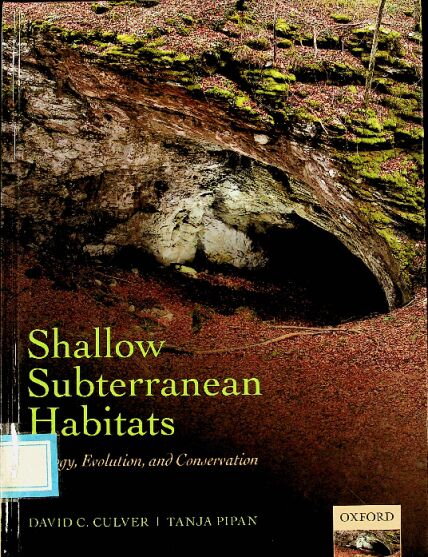
书名:Shallow subterranean habitats
责任者:David C. Culver | Slovenia. | Department of Environmental Science | American University | Washington | DC | USA; Tanja Pipan | Karst Research Institute | Research Centre of the Slovenian Academy of Sciences and Arts | Postojna
ISBN\ISSN:9780199646173,0199646171
出版时间:2014
出版社:Oxford University Press
分类号:生物科学
版次:First edition.
前言
In 2009, we wrote an introductory text, The Biologyof Caves and Other Subterranean Habitats, designedto be a 'first book' on subterranean biology forstudents and others interested in the topic. As wewere writing the book, we became aware that the'other subterranean habitats' part of the topic wasrelatively undeveloped and poorly understood.Much of what we know about subterranean biol-ogy comes from the study of caves, in part becauseof the adventure and excitement of visiting and ex-ploring caves, certainly more exciting than visiting,for example, talus slopes. And part of the reasonthat caves have played an important role in under-standing subterranean life is that they are more ac-cessible than other subterranean habitats, which wecannot directly explore and must sample indirectly.Nevertheless, as other speleobiologists before us,we became aware that caves were only a small partof the picture. One of us (T P) began her study ofsubterranean biology with a non-cave habitat—epikarst—albeit one that was sampled by collectingdripping water from the ceilings of caves. Epikarstwater in the Slovenian caves that she studied con-tained a treasure trove of eyeless, depigmentedspecies, especially copepods. On the other side ofthe Atlantic, one of us (DC) was beginning to studythe eyeless and depigmented 'cave' animals thathad been reported from minute seepage springs inWashington, DC, nearly a hundred kilometres fromany known cave. As we worked together, first onepikarst and then on seepage springs (which havethe wonderful technical name of the hypotelminor-heic), we began to see important connections be-tween these very different habitats in terms of somebasic physical and biological features.
This led us to a more general exploration ofshallow subterranean habitats, ones that were inter-mediate in many parameters between surface anddeeper subsurface habitats, save that of light. Thereis a rich tradition of study, particularly in Europe, ofanother shallow subterranean aquatic habitat—theunderflow of rivers and streams. These hyporheichabitats also harbour eyeless and depigmented spe-cies, albeit typically smaller in size than those foundin caves. We also became aware of the remarkablediscoveries our Australian colleagues were makingin the shallow calcrete aquifers of Western Austral-ia, habitats that may rival caves in terms of speciesrichness. From our study of these aquatic habitats,we became convinced that these less extreme yetaphotic aquatic habitats were key to understandingaquatic subterranean life.
Although our research experience was largelywith aquatic subterranean systems, it became clearto us that parallel habitats and processes occurredin terrestrial shallow subterranean habitats, andthat these shallow habitats included lava tubes andthe soil, as well as intermediate-sized habitats, in-cluding talus slopes and lava clinker. We were veryfortunate in being able to visit a variety of thesesites, visits that were crucial to the developmentof our ideas about shallow subterranean habitats,which are the focus of this book.
Unlike our first book, we see this book as directedtowards researchers and students interested in re-search in subterranean biology. Our first book wasin a way a consensus view of subterranean biology,and we did not emphasize the controversies of thefield. This book is different, and we have put for-ward our views, even when it is perhaps a minorityview. The book has two main parts—the first is adetailed description of shallow subterranean habi-tats, and the second is an exploration of the biologi-cal consequences of the existence of these habitats.It is designed to stimulate research and discussion,and we hope it serves that purpose. It is designedto be a starting point for research, not a 'bible' ofinformation.
A number of colleagues read chapters and offereduseful criticisms: Florian Malard, Université Lyon I,France (chapter 1.); Daniel Fong, American Univer-sity, USA (chapter 2.); Maria Cristina Bruno, Fon-dazione E. Mach Research and Innovation Centre,Trento, Italy (chapter 3.); Pedro Oromi, Universidadde La Laguna, Tenerife, Spain (chapters 4 and 8);William F. Humphreys, Western Australia Museum(chapter 5.); Remko Leijs, South Australia Museum(chapter 5.); Michelle Guzik, University of Adelaide,Australia (chapter 5.); Kym Abrams, University ofAdelaide, Australia (chapter 5.); Pierre Marmonier,Université Lyon I, France (chapter 6.); Louis De-harveng, Museum National d'Histoire Naturelle,Paris, France (chapter 7.); Anne Bedos, MuseumNational d'Histoire Naturelle, Paris, France (chap-ter 7.); Cene Figer, Univerza v Ljubljani, Slovenia(chapters 9 and 12); Vlastimil Råiieka, Czech Acad-emy of Sciences, Ceské Budéjovice, Czech Republic(chapter 10.); Sanja Gottstein, University of Zagreb,Croatia (chapter 10.); Kevin S. Simon, Universityof Auckland, New Zealand (chapter 11.); PeterTrontelj, Univerza v Ljubljani, Slovenia (chapters 13and 14); Maja Zagmajster, Univerza v Ljubljani, Slo-venia (chapter 15.); and William Jeffery, Universityof Maryland, USA (chapter 16.).
This book would not have been possible with-out a number of researchers taking time to showus their research sites and help us understand theirsystems: Marie-José Dole-Olivier (France), CharlesGers (France), Heriberto Löpez (Canary Islands),Pedro Oromi (Canary Islands), Pierre Marmonier(France), Slavko Polak (Slovenia), Ana Sofia Reb-oleira (Portugal), Vlastimil Råii&a (Czech Repub-lic), Fred Stone (Hawaii), and Miloslav Zacharda(Czech Republic).
A number of colleagues gave us comments, an-swers to questions, preprints, reprints etc.: AnneBedos, Gloria J. Chepko, Louis Deharveng, LeonDrame, David Eme, Cene Figer, Daniel W. Fong,William F. Humphreys, William R. Jeffery, WilliamK. Jones, Leonardo Latella, Florian Malard, PierreMarmonier, Janez Mulec, Diana Northup, ToneNovak, Pedro Oromi, Slavko Polak, Megan Por-ter, Ana Sofia Reboleira, Vlastimil Råiiéka, TrevorShaw, Kevin S. Simon, Tadej Slabe, Stanka Sebela,Peter Trontelj, Maja Zagmajster, and Nadja ZupanHajna.
Jure Hajna of the Karst Research Institute at ZRCSAZU provided professional help with the illus-trations. Florita Gunasekara and Kristina Hsu ofAmerican University helped draft the maps. All rea-sonable effort has been made to contact the holdersof copyright in materials reproduced in this book.Any omissions will be rectified in future printings ifnotice is given to the publishers.
Financial support came from the College of Artsand Sciences of American University to DCC, KarstResearch Institute at ZRC SAZU (Slovenia) to DCCand TP, and Slovenian Research Agency to DCCand TP.
A project of this magnitude was a burden on bothof our families, and we are especially grateful to ourspouses, Gloria Chepko and Miran Pipan, for pro-viding both understanding and support.
查看更多
目录
Glossary xiii
Gazetteer xxi
1 The shallow subterranean domain 1
1.1 Introduction 1
1.2 Shallow subterranean habitats 3
1.2.1 Hypotelminorheic habitats 3
1.2.2 Epikarst 4
1.2.3 Milieu souterrain superficiel 5
1.2.4 Calcrete aquifers 5
1.2.5 Aquatic in terstitial—hyporheic 6
1.2.6 Soil 7
1.2.7 Lava tubes 8
1.3 General features of shallow subterranean habitats 9
1.3.1 Absence of light 9
1.3.2 Surface—subsurface connections 9
1.3.3 Availability of organic carbon and nutrients 13
1.3.4 Geographical distribution pa tterns of SSHs 13
1.3.5 Habitat size 16
1.4 Features of SSHs of general ecological and evolutionary interest 16
1.4.1 Are SSHs ecotones? 16
1.4.2 Are SSHs staging areas for colonization of deep subterranean habitats? 18
1.4.3 Evolution of eye and pigment loss 18
1.4.4 What is the geographical pattern of species richness in SSH faunas, and is it similar to that of cave faunas? 18
1.4.5 Are there special conservation concerns associated with the SSH fauna? 19
1.5 Overview of chapters 19
1.6 Summary 21
2 Seepage springs and the hypotelminorheic habitat 22
2.1 Introduction 22
2.2 Chemical and physical characteristics of the hypotelminorheic 24
2.2.1 Hydrology of the hypotelminorheic 24
2.2.2 Geography of the hypotelminorheic 25
2.2.3 Physico-chemistry of the hypotelminorheic 25
2.2.4 Analogues with other habitats 28
2.3 Biological characteristics of the hypotelminorheic 30
2.3.1 Organic carbon and nutrients in the hypotelminorheic 30
Box 2.1 Collecting in the hypotelminorheic 30
2.3.2 History of biological studies of the hypotelminorheic 31
2.3.3 Overview of the hypotelminorheic fauna 31
2.3.4 Species richness in hypotelminorheic habitats 34
Box 2.2 Estimating species richness 36
2.3.5 Ecology of hypotelminorheic organisms 36
2.3.6 Adaptations to the hypotelminorheic 38
2.4 Summary 39
3 Epikarst: the soil-rock interface in karst 40
3.1 In trod uction 40
3.2 Chemical and physical characteristics of epikarst 40
3.2.1 Hydrology of epikarst 40
3.2.2 Epikarst evolution 43
3.2.3 Geographical variation of epikarst 44
3.2.4 Physico-chemistry of epikarst 44
3.2.5 Non-karst analogues of epikarst 45
3.3 Biological characteristics of epikarst 48
3.3.1 Organic carbon and nutrients in epikarst 48
3.3.2 History of biological studies of epikarst 50
Box 3.1 Methods for collecting epikarst fauna 51
3.3.3 Faunal differences between drips and drip pools 52
3.3.4 Overview of the epikarst fauna 53
Box 3.2 Why do animals wash out of epikarst habitats? 53
3.3.5 Copepod species diversity and richness in epikarst 56
3.3.6 Ecology of epikarst fauna 59
3.3.7 Terrestrial epikarst communities 63
3.3.8 Life-history characteristics of epikarst species 66
3.3.9 Morphological characteristics of epikarst species 67
3.3.10 Species ranges and dispersal ability 68
3.4 Summary 69
4. Intermediate-sized terrestrial shallow subterranean habitats 71
4.1 Introduction 71
4.2 Chemical and physical characteristics of intermediate-sized terrestrial SSHs 73
4.2.1 Representative intermediate-sized terrestrial SSHs 73
4.2.2 Overall differences and similarities among intermediate-sized terrestrial SSHs 75
4.2.3 Evolution of intermediate-sized terrestrial SSHs 75
4.2.4 Geographical extent 76
4.2.5 Physico-chemistry of intermediate-sized terrestrial habitats 76
4.2.6 Analogues with other habitats 80
4.3 Biological characteristics of intermediate-sized terrestrial SSHs 82
4.3.1 Organic carbon and nutrients in intermediate-sized terrestrial SSHs 82
4.3.2 History of biological studies of terrestrial SSHs 83
Box 4.1 Collecting in intermediate-sized terrestrial SSHs 84
4.3.3 Overview of the fauna of intermediate-sized terrestrial SSHs 86
4.3.4 Species composition and richness in intermediate-sized
terrestrial SSHs 88
4.3.5 Adaptations in intermediate-sized terrestrial SSHs 90
4.4 Summary 92
5 Calcrete aquifers 93
5.1 Introduction 93
5.2 Chemical and physical characteristics of calcrete aquifers 93
5.2.1 Evolution of calcrete aquifers 93
5.2.2 Physico-chemistry of calcrete aquifers 95
5.2.3 Analogues with other habitats 97
5.3 Biological characteristics of calcrete aquifers 97
5.3.1 Organic carbon and nutrients in calcrete aquifers 97
5.3.2 Overview of the fauna of calcrete aquifers 98
5.3.3 Colonization of calcrete aquifers 100
Box 5.1 Biological sampling of calcrete aquifers 101
5.3.4 Speciation in calcrete aquifers 102
5.3.5 Interspecific competition in calcrete aquifers 104
5.3.6 How species-rich is the calcrete aquifer fauna of the Yilgam? 104
5.4 Summary 105
6 Interstitial habitats along rivers and streams 106
6.1 Introduction 106
6.2 Chemical and physical characteristics of the hyporheic 109
6.2.1 Geological setting of the hyporheic 109
6.2.2 Hydrology of the hyporheic 110
6.2.3 Geography of the hyporheic 111
6.2.4 Physico-chemistry of hyporheic habitats 111
6.2.5 Analogues to the hyporheic 114
6.3 Biological characteristics of hyporheic habitats 114
6.3.1 Organic carbon and nutrients in the hyporheic 114
6.3.2 History of biological study of the hyporheic 117
6.3.3 Overview of the fauna of hyporheic habitats 117
Box 6.1 Collecting devices for hyporheic habitats 118
6.3.4 Species richness in the hyporheos 121
6.3.5 Ecology of hyporheic organisms 123
6.3.6 Adaptations to hyporheic habitats 126
6.4 Summary 126
7. Soil 128
7.1 Introduction 128
7.2 Chemical and physical characteristics of the soil 129
7.2.1 Relationship of soil to other SSHs 129
7.2.2 Soil structure 129
7.2.3 Soil temperature 131
7.3 Biological characteristics of the soil 131
7.3.1 Organic matter and nutrients in soil 131
7.3.2 Overview of the soil fauna 133
Box 7.1 Collecting the soil fauna 135
7.3.3 Species richness in the soil 136
7.3.4 Morphology of the soil fauna 138
7.3.5 Community differences in morphology 140
7.4 Summary 141
8 Lava tubes 142
8.1 Introduction 142
8.2 Chemical and physical characteristics of lava tubes 143
8.2.1 Geological setting of lava tubes 143
8.2.2 Physico-chemistry of lava tubes 146
8.3 Biological characteristics of lava tubes 147
8.3.1 Organic carbon and nutrients in lava tubes 147
8.3.2 Origin of the lava tube fauna 149
8.3.3 Adaptations to lava tubes 152
8.3.4 Age of lava tube species 153
8.3.5 Faunal composition and species richness in lava tubes 153
Box 8.1 The perils and promise of single-site subterranean biodiversity studies 155
8.4 Summary 157
9 The role of light in shallow subterranean habitats 158
9.1 Introduction 158
9.2 Gradients with respect to light 158
9.2.1 Physical gradients of light with depth 158
9.2.2 Faunal gradients with respect to light 159
9.2.3 Biological clocks, light, and visual systems in SSHs 161
9.2.4 Distribution of eyelessness among habitats 162
9.3 Summary 163
10 Environmental fluctuations and stresses in shallow subterranean habitats 164
10.1 Introduction 164
10.2 Environmental variation in SSHs 165
10.2.1 Overall patterns in SSHs 165
10.2.2 Environmental variation in hypotelminorheic habitats 167
10.2.3 Environmental variation in epikarst habitats 167
10.2.4 Environmental variation in intermediate-sized terrestrial SSHs 168
10.2.5 Environmental variation in interstitial habitats along rivers and streams 168
10.2.6 Environmental variation in lava tubes 169
10.3 Are SSHs extreme environments? 169
10.4 Summary 170
11 Organic carbon and nutrients in shallow subterranean habitats 171
11.1 Introduction 171
11.2 Sources of organic carbon and nutrients in SSHs 173
11.3 Amount and pattern of spatial subsidies of organic matter in SSHs 174
11.4 Are SSHs carbon or nutrient limited? 175
11.5 Summary 176
Box 11.1 Guano 177
12 Evolution of morphology in shallow subterranean habitats 179
12.1 Introduction—the status of troglomorphy 179
12.2 Morphology of SSH species 180
12.2.1 Aquatic SSH species 180
12.2.2 Terrestrial SSH species 183
12.3 A new look at troglomorphy 184
12.4 Summary 187
13 Colonization and dispersal in shallow subterranean habitats 188
13.1 Introduction 188
13.2 What causes animals to enter (and colonize) SSHs? 189
13.3 What factors contribute to the success or failure of colonizations? 190
13.4 Allopatric versus parapatric speciation 192
13.5 Post-isolation biogeography 193
13.6 Summary 199
14 Phylogeny in shallow subterranean habitats 200
14.1 Introduction 200
14.2 Diving beetles in calcrete aquifers 200
14.3 Cave and SSH opilionids in western USA 202
14.4 Dysdera spiders in Canary Islands MSS and lava tubes 202
14.5 Proasellus isopods along hyporheic corridors 205
14.6 Scorpions in caves, leaf litter, and soil 206
14.7 Phylogeny and troglomorphy 208
14.8 Summary 209
15 Conservation and protection of shallow subterranean habitats 211
15.1 Introduction 211
15.2 Biological risk factors 212
15.2.1 Rarity 211
15.2.2 Other biological risk factors 214
Box 15.1 Estimating population size 214
15.3 Physical threats to the SSH fauna 215
15.3.1 Alteration of the physical habitat 215
15.3.2 Water quality and quantity 216
15.3.3 Direct changes to the SSH fauna 217
15.4 A landscape approach to conservation and protection of SSHs 217
15.5 Examples of conservation and protection of the SSH fauna 218
15.5.1 Hypotelminorheic 218
15.5.2 Epikarst 220
15.5.3 Intermediate-sized terrestrial shallow subterranean habitats 221
15.5.4 Calcrete aquifers 221
15.5.5 Hyporheic 222
15.5.6 Lava tubes 222
15.6 Summary 224
16 Epilogue and prospects 225
16.1 What unites SSHs? 225
16.2 What divides SSHs? 226
16.3 Are SSHs staging areas for the colonization of deep subterranean habitats? 226
16.4 SSH terminology 227
16.5 What about troglomorphy? 229
Literature Cited 231
Index 251
查看更多
馆藏单位
中科院文献情报中心