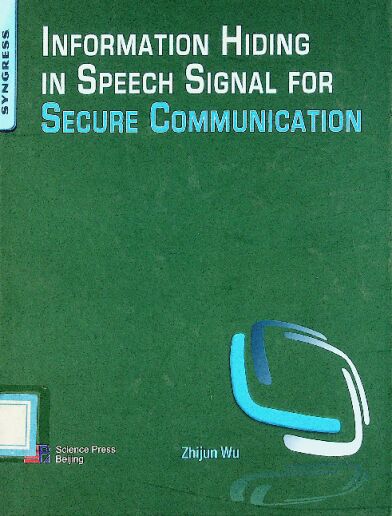
书名:Information hiding in speech signals for secure communication
出版时间:2015
出版社:Science Press
摘要
In the digital world, the need to protect communications increases every day. While traditional digital encryption methods are useful, there are many other options for hiding your information. Information Hiding in Speech Signals for Secure Communication provides a number of methods to hide secret speech information using a variety of digital speech coding standards. Professor Zhijun Wu has conducted years of research in the field of speech information hiding, and brings his state-of-the-art techniques to readers of this book, including a mathematical model for information hiding, the core concepts of secure speech communication, the ABS-based information hiding algorithm, and much more.
This book shows how to implement a secure speech communication system, including applications to various network security states. Readers will find information hiding algorithms and techniques (embedding and extracting) that are capable of withstanding the advanced forms of attack. The book presents concepts and applications for all of the most widely used speech coding standards, including G. 711, G. 721, G. 728, G. 729 and GSM, along with corresponding hiding and extraction algorithms. Readers will also learn how to use a speech covert communication system over an IP network as well as a speech secure communication system applied in PSTN.
查看更多
前言
In the information communication field, speech communication via network becomes an important way to transfer information. With the development of information tech-nology, speech communication is widely used for military, diplomatic, and economic purposes as well as in cultural life and scientific research. Therefore, speech secure communication and the security of communication information have attracted more and more attention. The rapid growth of the Internet as both an individual and busi-ness communication channel has created a growing demand for security and privacy in the network communication channel. Security and privacy are essential for indi-vidual communication to continue and for e-commerce to thrive in cyberspace.
Any type of multimedia data—for example speech, transmitted via network—needs to be protected from manipulation, forgery, and theft. More sophisticated at-tacks require that more advanced security technologies be avoided, which have to be optimized for the particular requirements of each application scenario. As a develop-ment tendency of information security and a fresh-born technique, information hiding breaks the mentality of traditional cryptology. Information hiding technology care-fully examines information security from a new perspective. Traditional secure com-munication approaches cannot satisfy current security requirements, and the garbled bits are likely to attract attention, or even encounter attacks from others. It is urgent to introduce a new mechanism for secure communication; thus the author undertakes it as his task to investigate a more secure communication, based on information hid-ing technology, which has many distinguishing characteristics. The most important characteristic is that there are univocal and continuous plaintext speech signals on the communication line, so the secure communication will be more covert and safe.
OBJECTIVES
This book intends to develop the theory and system of real-time secure speech com-munication over a network based on information hiding technology, and to provide an overview of the research area of information hiding insecure communication. In the book, the author attempts to break the massive subject into comprehensible parts and to build, piece by piece, a development of information hiding technology insecure communication. The book emphasizes the fundamentals of algorithms and approaches concerning the technology and architecture of a secure communication field, providing a detailed discussion of leading-edge topics such as filter similarity and linear predictive coding (LPC) parameters substitution.
ORGANIZATION OF THE BOOK
This book introduces several methods to hide secret speech information in different types of digital speech coding standards. In the past 10 years, the continued ad-van cement and exponential increase of network processing ability have enhanced the efficiency and scope of speech communication over the network. Therefore, the author summarizes his years of research achievements in the speech information hiding realm to form this book, including a mathematical model for information hiding, the scheme of speech secure communication, an ABS-based information hid-ing algorithm, and an implemented speech secure communication system, which are organized into different sections in accordance with the security situation of the net-work. This book includes nine chapters, which introduce speech information hiding algorithms and techniques (embedding and extracting) capable of withstanding the evolved forms of attacks
The four parts of this book are as follows:
I. Introduction, includes Chapter 1. This book begins with an introductory chapter, where the approaches of secure communication and their realization are discussed in general terms. This chapter ends with an overview of speech coding standards. This part provides a source of motivation for interested readers to wade through the rich history of the subject. The concept and algorithms involved in this part are explained in details in subsequent chapters.
II. Theory, consists of Chapters 2 and 3. This part proposes a mathematical mod-el, and embedding and extracting algorithms of secure communication based on in-formation hiding. The design of a speech information hiding model and algorithm for secure communication focuses on security, hiding capacity, and speech quality. The model and algorithm may help readers to develop a deep understanding of what information-hiding-based secure communication is all about.
III. Approaches, consists of Chapters 4 through 7. This part presents a detailed embedding secret speech coded in MELP 2. 4K, with the secret speech coded in ac-cordance with five important families of the speech coding standard, such as G. 721, G. 728, G. 729, and GSM, which are used in Voice over Internet Protocol (VoIP) or Public Switched Telephone Network (PSTN). Next is the introduction of the process of extracting secret speech coded in MELP 2. 4KintheG. 721, G. 728, G. 729, and GSM standards. The procedure of the realization of secure communication based on specific speech coding standards is developed.
IV. Realization, consists of Chapters 8 and 9. This part gives two applications of secure communication based on the technology of information hiding. Each chapter sets up one example to show how to implement secure communication over VoIP and PSTN by using the information-hiding-based model and algorithm individually.
Each chapter begins with a high-level summary for those who wish to under-stand the concepts without wading through technical explanations. Then exam-ples and more details are provided for those who want to write their own pro-grams. The combination of practicality and theory allows engineers and system designers to implement true secure communication procedures, and to consider probable future developments in their designs, therefore fulfilling the require-ments of social development and technological progress for new types of secure communication.
CHARACTERISTICS OF THE BOOK The author introduces readers to earlier research regarding security of transmit-ted speech information over networks, and combines information technology and speech signal processing to form a speech hiding model for solving the problem of secure speech communication. Taking into consideration the requirements of real time and security, the author puts forward the algorithm of LPC coefficients substitu-tion for secret speech information hiding based on filter similarity (LPC-IH-FS) and information extraction with blind-detection-based minimum mean square error (BD-IE-MES). Compared with traditional secure communication, those proposed the o-ries and algorithms have distinct advantages in the field of secure communication. Moreover, the chapters and sections of this book are arranged from the simple to the complex, and the chapters relate to each other closely, with a reasonable knowledge structure. The book is scientifically and systematically organized. Plenty of tables and diagrams work jointly to interpret how the approach works and to demonstrate superior performance of the proposed approach. In addition, to validate the per for-mance of the proposed approach, plenty of experiments are conducted, and detailed experiment results and analyses are available in the book.
A few topics maybe of great interest for readers, such as the new idea of speech secure communication, the introduced mathematical model for information hiding, the proposed LPC-IH-FS and BD-IE-MES algorithms, and the corresponding experi-mental results. The highlight of the book is that the author applied information hiding technology insecure communication for the first time and then addressed a new em-bedding and extracting approach based on the analysis-by-synthesis (ABS) algorithm.
NEW IDEA OF SPEECH SECURE COMMUNICATION
This new idea of speech secure communication is based on information hiding tech-nology, which differs from the traditional speech secure communication. Conven-tional secure communication systems transmit encrypted or transformed noisy sig-nals over the public channel. The proposed speech secure communication system in this book delivers clear, comprehensive and meaningful stego speech, with secret speech embedded, over the public channel. The stego speech is explicit but secret speech is implicit
NEWLY PROPOSED SPEECH INFORMATION HIDING TECHNOLOGY
The ABS algorithm introduces speech synthesizing into speech coding, and speech embedding and coding are synchronously completed. Combined with conventional embedding approaches, ABS is capable of adjusting hiding capacity on the basis of secret speech. It may achieve a maximum hiding capacity of 3. 2 kbps, under the condition of G. 72816 kbps carrier speech with MELP 2. 4 kbps secret speech. The proposed approach has the advantages of high hiding capacity, good imperceptibility, and high embedding rate.
In the book, the embedding and corresponding extracting methods are illustrated with elaborate diagrams and tables. Analyses and comparisons are also given. The proposed method puts emphasis on solving the secure problems occurring in real-time speech communication, and it achieves a relatively high hiding capacity, thus the requirements of real-time communication are met.
The major contributions of this book lie in extending a new hotspot in a secure communication scope and opening up a perspective application realm of information hiding technology. The particular insight of information security and the unique ABS approach infuses this newborn technology with vitality.
POTENTIAL READERS OF THE BOOK
This book can be a valuable reference book for anyone whose profession is informa-tion security. Readers maybe scientists and researchers, lecturers and tutors, aca-demic and corporate professionals, even postgraduate and undergraduate students.
Readers will learn related concepts and theory about speech secure communi-cation. This book offers readers in-depth knowledge of the theory, modules, algo-rithms, and systems about information hiding or secure communication proposed by the author. The knowledge allows potential customers to protect their secure speech communication against even the most evolved wiretapping and information analysis attacks. Furthermore, by combining the theory with practice, readers can not only conduct related experiments in accordance with the contents of the book, but also implement a secure communication system by programming. In short, the achieve-ments presented in this book can be used for network security in practice.
To better understand this book, readers should have prerequisite knowledge in communication principles, networking theory, basic theory of information hiding, and speech signal processing technology.
查看更多
目录
Preface v
Acknowledgments ix
Overview xi
CHAPTER 1 Introduction 1
1.1 Background 1
1.1.1 Progress inSecure Communication 2
1.1.2 A New Technique for Secure Communication: Information Hiding 4
1.2 Introduction to Speech Coding 9
1.2.1 Basic Principles of Speech Coding 10
1.2.2 Speech Coding Standards 11
1.3 Related Work 14
1.4 Analysis of Available Information Hiding Methods 19
1.4.1 Least Significant Bit 19
1.4.2 Phase Hiding Method 20
1.4.3 Echo Hiding Method 20
1.4.4 Hiding Method Based on Statistics 21
1.4.5 Transform Domain Method 21
1.5 Organization of This Book 23
CHAPTER 2 The Information Hiding Model for Speech Secure Communication 27
2.1 Introduction and Motivation 27
2.2 Model of Information Hiding as a Communication Problem 29
2.3 Speech Information Hiding Model 31 2.3.1 Hiding Capacity 33
2.3.2 Security 33
2.3.3 Speech Quality 35
2.4 Experiments and Results Analysis 37
2.4.1 Hiding Capacity 37
2.4.2 Security 37
2.4.3 Speech Quality 38
2.5 Summary 40
CHAPTER 3 The ABS Speech Information Hiding Algorithm Based on Filter Similarity 41
3.1 Introduction and Motivation 41
3.1.1 Brief Introduction to the ABS Scheme 41
3.1.2 Analysis of the ABS Scheme 44
3.2 Filter Similarity 46
3.3 LPC Coefficient Substitution Based on Filter Similarity 50
3.3.1 LPC Substitution Algorithm 51
3.3.2 Multi codebook 52
3.4 Secret Speech Information Hiding and Extraction Algorithm 52
3.4.1 Speech Information Hiding Algorithm 54
3.4.2 Speech Information Extraction Algorithm 55
3.5 Experimental Results and Analysis 55
3.5.1 Selection of Test Parameters 56
3.5.2 Experimental Results 57
3.5.3 Calculation Complexity 58
3.5.4 Speech Quality 59
3.6 Summary 59
CHAPTER 4 The G.721-Based Speech Information Hiding Approach 65
4.1 Introduction to the G.721 Coding Standard 65
4.1.1 Differential Pulse Code Modulation 65
4.1.2 Adaptive Schemes 66
4.2 The Approach to Hide Secret Speech in G.721 71
4.2.1 Embedding Algorithm 71
4.2.2 Extraction Algorithm 76
4.3 Experimental Results and Analysis 77
4.3.1 Hiding Capacity 77
4.3.2 Speech Quality 78
4.4 Summary 80
CHAPTER 5 The G.728-Based Speech Information Hiding Approach 81
5.1 Code Excited Linear Prediction 81
5.1.1 The CELP Speech Production Model 81
5.1.2 Coding Principles 82
5.1.3 Encoder Operation 83
5.1.4 Perceptual Weighting 84
5.1.5 Vector Quantization 85
5.2 Introduction to the G.728 Coding Standard 85
5.3 The CELP-Based Scheme of Speech Information Hiding and Extraction 87
5.3.1 Embedding Scheme 87
5.3.2 Extraction Scheme 90
5.4 Approach to Hide Secret Speech in G.728 90
5.4.1 Embedding Algorithm 91
5.4.2 Extraction Algorithm 92
5.5 Experimental Results and Analysis 93
5.6 Summary 94
CHAPTER 6 The G.729-Based Speech Information Hiding Approach 97
6.1 Introduction to the G.729 Coding Standard 97
6.1.1 Algebraic Codebook Structure 97
6.1.2 Adaptive Codebook 98
6.1.3 G.729 Coding Scheme 102
6.2 The ACELP-Based Scheme of Speech Information Hiding and Extraction 104
6.2.1 Embedding Scheme 104
6.2.2 Extraction Scheme 108
6.3 Approach to Hide Secret Speech in G.729 108
6.3.1 Embedding Algorithm 108
6.3.2 Extraction Algorithm 110
6.4 Experimental Results and Analysis 110
6.5 Summary 111
CHAPTER 7 The GSM(RPE-LTP) -Based Speech Information Hiding Approach 113
7.1 Introduction to the GSM(RPE-LTP) Coding Standard 113
7.1.1 RPE-LTP Coding Scheme 114
7.1.2 GSM Coding Scheme 116
7.2 Approach to Hide Secret Speech in GSM(RPE-LTP) 120
7.2.1 Embedding Algorithm 120
7.2.2 Extraction Algorithm 121
7.3 Experimental Results and Analysis 122
7.4 Summary 126
CHAPTER 8 Covert Communication Based on the VolP System 127
8.1 Introduction to the VoIP-Based Covert Communication System 127
8.1.1 Introduction to the VoIP System 127
8.1.2 An Outline for VoIP Steganography 128
8.1.3 Classifications of the Embedding Method 129
8.2 Modeling and Realization of VoIP-Based Covert Communication 130
8.3 Embedding Secret Speech into VoIP G.729 Speech Flows 131
8.3.1TheCNTofG. 729 Parameters 132
8.3.2 Embedding Approach Based on Matrix Coding 134
8.3.3 Embedding Procedure 136
8.3.4 Experimental Results and Analysis 138
8.4 Summary 142
CHAPTER 9 Design of Real-Time Speech Secure Communication over PSTN 143
9.1 Secure Communication Plan 143
9.1.1 Introduction 143
9.1.2 Requirements Analysis 144
9.2 Design and Realization of a Secure Communication System Based on PC 145
9.2.1 Framework for Design 145
9.2.2 Coding Scheme Selection 147
9.2.3 Multimedia Programming 147
9.2.4 System Realization 150
9.3 Speech Information Hiding Telephony(SIHT) Based on PSTN 152
9.3.1 Introduction 152
9.3.2 Description of the SIHT 153
9.3.3 Speech Information Hiding Scheme 155
9.3.4 SIHT Module 156
9.3.5 SIHT Operating Modes 160
9.3.6 Architecture of SIHT 161
9.4 Summary 163
References 165
Index 175
查看更多
作者简介
Professor Zhijun Wu achieved his post-doctoral work of Information security in July 2005 at Tsinghua University. He is currently a professor and doctoral tutor in the Civil Aviation University of China, and he is an expert of network information security in The Chinese Institute of Electronics. His research interests are in the field of networking and information security, and security protocol analysis and design.
查看更多
馆藏单位
中科院文献情报中心