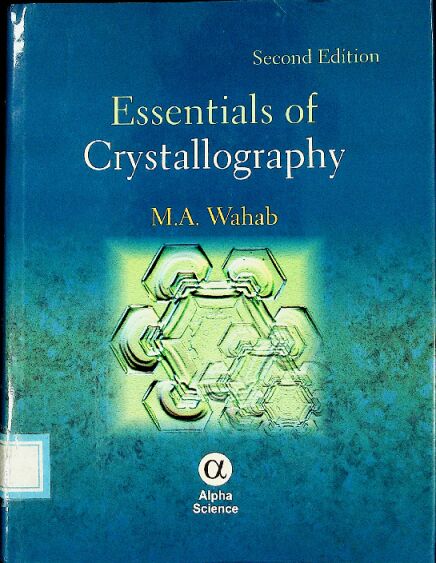
书名:Essentials of crystallography
责任者:M.A. Wahab. | Wahab, M. A.
出版时间:2014
出版社:Alpha Science International
摘要
SSENTIALS OF CRYSTALLOGRAPHY presents a comprehensive study of the essential aspects of crystallography. The topics include a detail discussion of geometry and symmetry of crystals, a simplified approach to derive the point groups and space groups, methods of crystal growth and related theories, imperfections in crystalline solids, various diffraction methods, procedures for solving crystal structures and computing methods in crystallography. Keeping in view the diverse nature of readers, the treatments and the mathematics used in the book have been kept as simple as possible. This book will serve as a textbook to any crystallographic course at Postgraduate and M. Phil. level. In addition, this will be helpful for all researchers in physics, chemistry, biology, mineralogy etc. who are working with crystallography related problems.
查看更多
目录
Preface to the Second Edition v
Preface to the First Edition vll
1. Brava is Lattices in Two Diomensions ’
1.1 Inroduction
1.2 Development of One and Two Dimensional Lattices
1.3 Basis and the Crystal Structure 3
1.4 Choice of a Unit Cell 4
1.5 Wigner-Seitz Unit Cell 4
1.6 Primitive Lattice Types and Crystal Systems 6
1.7 Centering of Plane Lattices 8
1. Oblique Lattice 8
2. Rectangular Lattice 9
3. Square and Hexagonal Lattices 9
1.8 Two Dimensional Bravais Lattices (Plane Lattices) 10
1.9 Unit Cell Calculations J O
Distance between Two Lattice Points (Oblique System) 10
Linear and Planar Atomic Density 12
Planar Packing Efficiency 13
1.10 Summary 14
1.1.1 Definitions 14
Revie-w Questions and Problems 15
2. Bravais Lattices in Three Dimensi o ns 16
2.1 Introduction 16
2.2 Development of Three-dimensional Lattices 16
2.3 Choice of Axes and Unit Cells 17
2.4 Derivation of Seven Primitive Lattices/Unit Cells 19
(i) Oblique Lattice 19
(ii) Rectangular Lattice 19
(iii) Square Lattice 19
(iv) R11ombic Lattice 21
(v) Hexagonal Lattice 21
2.5 Types of Lattice Centering 21
1. Body Centering (I) 21
2. Face Centering (F) 22
3. Base Centering (A-, B-, C一) 22
4. Rhombohedra l Centering 23
2.6 Derivation of Non-primitive (Centered) Lattices 25
Monoclinic System 26
Orthorhombic System 27
Tetragona l System 29
Cubic System 29
2.7 Number of Lattice Points Per Unit Cell 30
2.8 Fractional Coordinates (Oblique System) 30
2.9 Unit Cell Calculations 31
1. Volume of the Unit Cell 31
2. Distance Between Two Lattice Points (Oblique System) 32
3. Linear, Planar and Volume Atomic Density in Crystals 35
4. Volume Packing Efficiency 36
2.10 Interplanar Spacing 37
2.11 Summary 39
2.12 Definitions 39
Review Questions αnd Problems 39
3. Symmetry Elements in Two Dimensions 41
3.1 1ntroduction 41
3.2 Symmetry Elements 41
1. Translation 42
2. Proper Rotation 42
3. Reflection (Mirror Line) 43
3.3 Consistent Combinations of Symmetry Operations 43
3.4 Combinations of Macroscopic Symmetry Operations 44
(i) Rotation with a Translationt 44
(ii) Rotation and Reflection (Two Reflections) 44
3.5 Point Groups in Two Dimensions 46
3.6 Plane Lattice Consistent with Rotational Symmetry 47
3.7 Plane Lattice Consistent with Mirror Symmetry 54
3.8 Combinations of Microscopic Symmetry Operations 55
3.9 Space Group in Two Dimensions (Plane Groups) 55
3.10 Summary 57
3.11 Definitions 58
Review Questions and Problems 59
4. Symmetry Elements in Three Dimensions 60
4.1 Introduction 60
4.2 Symmetry Elements 60
4.3 Macroscopic Symme盯F Elements 62
4.4 Combinations of Macroscopic Symmetry Operations 62
4.5 Rotation at a Point 62
4.6 Axial Combinations (Two Proper Rotations) 64
4.7 Rotation and Reflection (Rotoreflection) 67
4.8 Rotation and Inversion (Rotoinversion) 68
4.9 Proper and Improper Rotations 69
(a) Monoaxia l Combinations 70
(b) Polyaxial Combinations 70
(c) Coexistence of Proper and Improper Polyaxia ls 72
4.10 Reflection and Inversion 73
4.11 Classification of Symmetry Operations 76
4.12 Summary 76
4.13 Defin itions 77
Review Questions and Problems 77
5. Derivatio n o f po int Gro u ps 79
5.1 Introduction 79
5.2 Derivation of Point Groups (Conventional Method) 79
Rotoreflection Channel 79
1. Proper Rotation :X 80
2. Reflection 仙1irror Plane): m 80
3. Rotoretlection (= Rotoinversion): X 80
4. Axial Combinations:XXX 80
5. Mirror I- to Rotation Axis:一-X/m 80
6. Mirror II to Rotation Axis:Xm 81
7. Mirror I to Axial Combinations:XXX/m 81
8. Mirror II to Axial combinations: XXXm 81
Rotoinversion Channel 81
5.3 Point Group Notations 83
Schoenflies Notation 85
Herrnann-Mauguin (International) Notation 87
5.4 Linear Orthogonal Transformation 88
5.5 Symmetry Operations and Group Theory 90
Group 90
Order of the Group 91
Cyclic Group 92
Generators of a Finite Group 92
Subgroups and Super Groups 92
5.6 Matrix Representation of Symmetry Operations 92
(i) Orthogonal Axes 93
(ii) Crystallographic Axes 96
5.7 Derivation of Point Group (Matrix Method) 97
1. Triclinic Crystal System 97
2. Monoclinic Crystal System 98
3. Orthorhombic Crystal System 99
4. Tetragonal Crystal System J OO
5. Trigonal Crystal System 102
6. Hexagonal Crystal System 104
7. Cubic Crystal System 104
5.8 Equivalent Positions in Point Groups 105
5.9 Laue Symmetry 107
5.10 Point Groups, Crystal Classes and Crystal Systems 107
5.11 Summary 108
5.12 Definitions 109
Review Questions and Problems 110
Appendix 1 112
Appendix 2 112
6. Derivation of Space Groups 114
6.1 Introduction 114
6.2 Microscopic Symmetry Elements 114
6.3 Combination of M icroscopic Symmetry Operations 114
Glide Planes 114
Axial Glide 115
Diagonal Glide 115
Diamond Gl ide 116
Screw Axes 116
6.4 Genera l Equiva lent Positions and Special Positions 117
6.5 Systematic Absences 119
Systematic Absences Due to Lattice Centering 119
Systematic Absences Due to Microscopic Symmetries 119
6.6 Space Groups 121
6.7 Classi fication of Space Groups 121
The Symmorphic Space Groups 121
The Non-symmorphic Space Groups 122
6.8 Derivation of Space Groups 122
Triclinic Crystal System 123
Monoclinic Crystal System 123
Orthorhombic Crystal System 123
Tetragonal Crystal System 123
Trigonal Crystal System 125
Hexagonal Crystal System 125
Cubic Crystal System 125
6.9 Suinmary 125
6.10 Definitions 125
Review Questions αnd Problems 126
7. Crystal Planes, Directio ns and Projecti o ns 127
7.1 Crystal Planes and Zones 127
7.2 Crystal Directions and Zone Axes 128
1. The Zone Law 130
2. Zone Axis at the Intersection of two Planes 130
3. Plane Para llel to Two Directions 130
4. The Addition Rule 131
7.3 Miller-bravais Indices 131
7.4 Transfornation of Indices 132
Transfonnation of Lndices of Crystal Planes (Unit Cell) 133
(i) Rhombohedra l and FCC 133
(ii) Hexagonal and Orthorhombic 134
(iii) Rhombohedra l and Hexagonal 135
Transformation of Indices of Direction (Zone Axes) 137
Hexagonal (4-index System) and Trigonal (3-index System) 137
7.5 Crystal Projections 138
(i) Projection of Atoms/ions in the Un it Cell 138
(ii) Projection of Crystal Faces (Miller Planes) 139
Spherical Projection 140
Gnomonic Projection 141
Stereographic Projection 141
7.6 The Reciprocal Lattice 142
Some Geometrical Relationships 145
1. The Zone Law 145
2. Zone Axis at the Intersection of Two Planes 146
3. A Plane (hkl) Containing Two Directions [u1v 1w1] and [u2v2w2] 146
7.7 Summary 147
7.8 Definitions 148
Review Queslions and Problems 149
8. Experiment and Theory of Crystal Growth 150
8.1 Introduction 150
8.2 Methods of Crystal Growth 150
8.3 Solution Growth 151
(a) Aqueous Solution Method 152
(b) Flux Method 152
(c) Hydrotherma l Method 154
8.4 Melt growth 157
(a) Bridgman-Stockbarger Method 157
(b) Czocbralslci Method 158
(c) Zone Refining Method 160
(d) Float Zone Method 161
8.5 Nucleation 161
8.6 Energy of Formation of a Nucleus 162
(i) Homogeneous Nucleation 162
(ii) Hetrogeneous Nucleation 167
Cap Shaped Nucleus 167
Disc-shaped (Cylinderical) Nucleus 169
8.7 Velocity of Growth 170
8.8 Theories/Model of Crystal Growth 172
8.9 Theories Based on Atomic Model 172
1. Kossel’s Theory 172
2. Screw Dislocation Theory 174
8.10 Theories Based on Thermodynamics Considerations 175
1. The Diffusion Theory 175
2. Bulk Diffusion Model 178
3. BCF Bulk Diffusion Model 179
(i) Hemi-spherical Force Field 180
(ii) Semi-cylinderical Force Field 181
(iii) Plane Force Field 182
8.11 Concentration of Kinks and Mobility of Adsorbed Molecules 184
8.12 Summary 185
8.13 Definitions 186
Review Questions and Problems 186
9. Crystal Imperfections 188
9.1 Introduction 188
9.2 Concentration of Point Imperfections 188
Schottky Imperfection (Moooatomic Solid) 188
Frenkel Imperfection (Moooatomic Solid) 190
Schottky Imperfection (Ionic solid) 191
9.3 The Geometry of Dislocations 192
9.4 Burgers Vector and Burgers Circuit 193
9.5 Energy of a Dislocation 194
9.6 Slip Planes and Slip Directions 196
9.7 Dislocation Reactions 196
9.8 Density of Dislocations 199
9.9 Observation of Dislocations 200
(a) Method Based on Growth Spirals 200
(b) Method Based on Etch Pits 200
(c) Optical and Electron-optical Methods 201
(d) Decoration Method 201
(e) X-ray Diffraction Topography 201
9.10 Surface Imperfections 203
Grain Boundary 203
Tilt and Twist Boundary 203
Stacking Faults 205
(i) Stacking Faults in FCC Crystals 205
(ii) Stacking Faults in HCP Crystals 206
9.11 Summary 208
9.12 Definitions 208
Review Questions and Problems 210
10. Diffraction Methods 212
10.1 Introduction 212
10.2 Production of X-rays 212
10.3 X-ray Diffraction 215
Bragg’s Law 215
The Laue Equations 217
10.4 Diffraction Condition and Bragg’s Law 220
10.5 The X-ray Diffraction Experiments 222
10.6 The Powder Method 222
Indexing of Powder Lines 223
10.7 The Laue Method 227
Indexing of Laue Photographs 228
10.8 The Rotation/Oscillation Method 230
Interpretation of Rotation/Oscillation Photographs (Formation of Layer Lines) 231
Indexing of Rotation/Oscillation Photographs 233
10.9 The Weissenberg Method 236
Equi-i nclination Setting 241
Indexing of Weissenberg Photographs 242
10.10 The Precession Method 246
10.11 X-ray Diffractometer s 247
Powder X-ray Dif丘actometer 248
Single Crystal X-ray Diffractometer 248
10.12 Other Diffraction Methods 250
Neutron Diffraction 250
Electron Diffraction 252
10.13 Summary 253
10.14 Definitions 255
Review Questions and Problems 255
11. Facto rs Affecti ng X-ray Intensities 258
11.1 Introduction 258
11.2 The Structure Factor 258
11.3 The Lorentz Factor 260
11.4 The Polarization Factor 262
11.5 The Temperature Factor 264
11.6 The Multiplicity Factor 264
11.7 The Absorption Factor 265
11.8 Extinction 266
11.9 The R-factor 268
11.10 Summary 268
11.1 1 Definitions 269
Review Questions and Problems 270
12. Structure Factors and Fourier Synthesis 272
12.1 Introduction 272
12.2 Waves Motion 272
12.3 Superposition of Waves 273
12.4 Phase of a Wave in Three Dimensions (Unit Cell) 275
12.5 The Structure Factor of a Crystal 276
12.6 The Fourier Synthesis 277
12.7 Special Structure Factors Due to S归runetry 279
Case I: Center of Symme盯f 280
Case II: 2-fold Rotation (z-axis) 280
Case III: m L z-axis 280
Case IV: 2-fold Screw Axis Along [001], 21 281
Case V:α-glide Oriented Along [010] 281
12.8 Special Structure Factors Due to Lattice Centering 282
Case I: Body Centering in a Cubic Lattice 282
Case II: Face Centering in a Cubic Lattice 283
12.9 Anomalous Scattering 284
12.10 Swnmary 285
12.11 Definitions 286
Review Questions and Problems 287
13. Crystal Structure Analysis 289
13.1 Introduction 289
13.2 Trial and Error Method 289
13.3 The Patterson Function 290
13.4 The Heavy Atom Method 292
13.5 Isomorphous Replacement 293
13.6 Superposition Method 294
13.7 Direct Methods 294
Inequality Relationship 295
Case I. Center of Symmetry 296
Case II. 2-fold Axis (II to z) 297
Statistical Method 297
13.8 Summary 299
13.9 Definitions 299
Review Questions and Problems 300
14. Crystal StructUTe Refinements 301
14.1 Introduction 301
14.2 Successive Fourier Syntheses 301
14.3 DifTerencε Fourier Synthesis 302
(i) Position Error 303
(ii) Missinε Atoms 303
(iii) Errors in the Thermal Parameters 304
14.4 Least-squares Refinement 305
14.5 Constrained Least-squares Refinement 307
14.6 Automation of Structure Analysis 307
14.7 Summary 309
14.8 Definitions 309
Review Questions and Problems 310
15 Groups, Matrices and Representation of Symmetry Operations 311
15.1 Introduction 311
15.2 Elements of Group Theory 311
15.3 Construction of Group Multiptication Table 313
15.4 Elements of Maltices 316
Transpose of a Matrix 318
Orthogonal Matrix 318
Trace/Character of a Matrix 318
Propterty of Trace/Character 319
15.5 Representation 319
15.6 Orthogonality Theorem 320
15.7 Properties of Irreducible Representations 321
15.8 Mulliken Symbols 322
15.9 Construction of Character Tables for Point Groups 323
15.10 Summary 327
15.11 Definitions 328
Review Questions and Problems 329
Bibliography 331
Subject Index 333
查看更多
馆藏单位
中科院文献情报中心