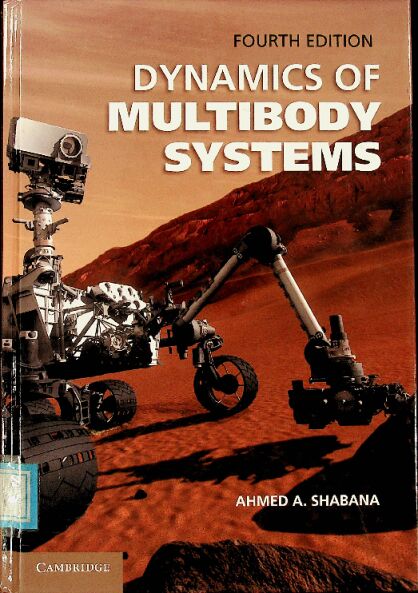
书名:Dynamics of multibody systems
责任者:Ahmed A. Shabana | Richard and Loan Hill Professor of Engineering | University of Illinois at Chicago.
ISBN\ISSN:9781107042650,1107042658
出版时间:2013
出版社:Cambridge University Press
分类号:力学
版次:Fourth edition.
前言
The methods for the nonlinear analysis of physical and mechanical systems devel�oped for use on modern digital computers provide means for accurate analysis of large-scale systems under dynamic loading conditions. These methods are based on the concept of replacing the actual system by an equivalent model made up from discrete bodies having known elastic and inertia properties. The actual systems, in fact, form multibody systems consisting of interconnected rigid and deformable bod�ies, each of which may undergo large translational and rotational displacements. Examples of physical and mechanical systems that can be modeled as multibody sys�tems are machines, mechanisms, vehicles, robotic manipulators, and space structures. Clearly, these systems consist of a set of interconnected bodies that may be rigid or deformable. Furthermore, the bodies may undergo large relative translational and rotational displacements. The dynamic equations that govern the motion of these sys�tems are highly nonlinear and in most cases cannot be solved analytically in a closed form. One must resort to the numerical solution of the resulting dynamic equations.
The aim of this text, which is based on lectures that I have given during the past several years, is to provide an introduction to the subject of multibody mechanics in a form suitable for senior undergraduate and graduate students. The initial notes for the text were developed for two first-year graduate courses introduced and offered at the University of Illinois at Chicago. These courses were developed to emphasize both the general methodology of the nonlinear dynamic analysis of multibody systems and its actual implementation on a high-speed digital computer. This was prompted by the necessity to deal with complex problems arising in modem engineering and science. In this text, an attempt has been made to provide the rational development of the methods from their foundations and to develop the techniques in clearly understandable stages. By understanding the basis of each step, readers can apply the method to their own problems.
查看更多
目录
PREFACE page xi
1 INTRODUCTION 1
1.1 Multibody Systems 1
1.2 Reference Frames 3
1.3 Particle Mechanics 6
1.4 Rigid Body Mechanics 10
1.5 Deformable Bodies 15
1.6 Constrained Motion 18
1.7 Computer Formulation and Coordinate Selection 22
1.8 Objectives and Scope of This Book 25
2 REFERENCE KINEMATICS 28
2.1Rotation Matrix 29
2.2 Properties of the Rotation Matrix 35
2.3 Successive Rotations 39
2.4 Velocity Equations 47
2.5 Accelerations and Important Identities 55
2.6 Rodriguez Parameters 58
2.7 Euler Angles 61
2.8 Direction Cosines 67
2.9 The 4x4 Transformation Matrix 70
2.10 Relationship between Different Orientation Coordinates 78
Problems 80
3 ANALYTICAL TECHNIQUES 83
3.1Generalized Coordinates and Kinematic Constraints 84
3.2 Degrees of Freedom and Generalized Coordinate Partitioning 92
3.3 Virtual Work and Generalized Forces 100
3.4 Lagrangian Dynamics 113
3.5 Application to Rigid Body Dynamics 121
3.6 Calculus of Variations 127
3.7 Euler's Equation in the Case of Several Variables 133
3.8 Equations of Motion of Rigid Body Systems 140
3.9 Newton-Euler Equations 148
3.10 Concluding Remarks 151
Problems 154
4 MECHANICS OF DEFORMABLE BODIES 157
4.1 Kinematics of Deformable Bodies 158
4.2 Strain Components 162
4.3 Physical Interpretation of Strains 165
4.4 Rigid Body Motion 167
4.5 Stress Components 169
4.6 Equations of Equilibrium 172
4.7 Constitutive Equations 175
4.8 Virtual Work and Elastic Forces 180
Problems 183
5 FLOATING FRAME OF REFERENCE FORMULATION 185
5.1 Kinematic Description 186
5.2 Inertia of Deformable Bodies 197
5.3 Generalized Forces 210
5.4 Kinematic Constraints 216
5.5 Equations of Motion 220
5.6 Coupling between Reference and Elastic Displacements 225
5.7 Application to a Multibody System 228
5.8 Use of Independent Coordinates 237
5.9 Dynamic Equations with Multipliers 241
5.10 Generalized Coordinate Partitioning 244
5.11 Organization of Multibody Computer Programs 247
5.12 Numerical Algorithms 250
Problems 259
6 FINITE-ELEMENT FORMULATION 263
6.1 Element Shape Functions 264
6.2 Reference Conditions 272
6.3 Kinetic Energy 274
6.4 Generalized Elastic Forces 282
6.5 Characterization of Planar Elastic Systems 284
6.6 Characterization of Spatial Elastic Systems 289
6.7 Coordinate Reduction 295
6.8The Floating Frame of Reference and Large Deformation Problem 299
Problems 302
7 THE LARGE DEFORMATION PROBLEM 304
7.1Background 305
7.2 Absolute Nodal Coordinate Formulation 309
7.3 Formulation of the Stiffness Matrix 313
7.4 Equations of Motion 317
7.5 Relationship to the Floating Frame of Reference Formulation 318
7.6 Coordinate Transformation 320
7.7 Consistent Mass Formulation 323
7.8 The Velocity Transformation Matrix 326
7.9 Lumped Mass Formulation 327
7.10 Extension of the Method 330
7.11 Comparison with Large Rotation Vector Formulation 334
Problems 337
8 CONCEPTS AND ESSENTIAL DETAILS 339
8.1 Centrifugal and Coriolis Inertia Forces 340
8.2 Use of Virtual Work 344
8.3 Arbitrary Orientation Parameters 345
8.4 Parallel Axis Theorem: Rigid Body Analysis 346
8.5 Rigid Body Rotation and Finite Element Interpolation 348
8.6 Finite and Infinitesimal Rotations 350
APPENDIX: LINEAR ALGEBRA 353
A.1 Matrix Algebra 353
A.2 Eigenvalue Analysis 357
A.3 Vector Spaces 358
A.4 Chain Rule of Differentiation 361
A.5 Principle of Mathematical Induction 362
Problems 363
REFERENCES 365
INDEX 379
查看更多
作者简介
AHMED A. SHABANA is a University Distinguished Professor and the Richard and loan Hill Professor of Engineering at the University of Illionis at Chicago. He is the author of seceral books and serves on the Editioral Board of several journals. He severed as the Chair of the ASME Design Engineering Division, and he si the Founding Chair of the ASME Technical Committee on Multibody Systems and Nonlinear Dynamics and the Founding Chair of the ASME International Conferece on Multibody Systems, Nonlinear Dynamics, and Control. He has received several awards including the Humboldt Prize, the Fubright Research Scholar Award, the Asme d'Alembert Award, and Honorary Doctorate Degree, Honorary Professorship, and Best Paper awards as well as sveral teaching and research awards from the University of Illinois at Chicago.
查看更多
馆藏单位
中科院文献情报中心