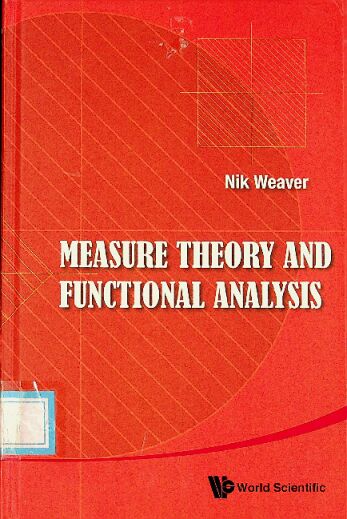
书名:Measure theory and functional analysis
责任者:Nik Weaver. | Weaver, Nik.
ISBN\ISSN:9789814508568,981450856X
出版时间:2013
出版社:World Scientific
摘要
This book is based on a set of notes I developed over several years of teaching a graduate course on measure theory and functional a nalysis. Its focal point is the s tunning interplay between topology, measure, and Hilber t space exhibited in t he spectra l theorem and its generalizations. The prerequisites are minimal: readers need to be familiar with little beyond metric spaces and abstract real and complex vector spaces.
I have striven t o eliminate unnecessary generality. Thus, whenever possible I assume topological spaces are metrizable, measure spaces are a-finite,Banach spaces are eit her sepa ra ble or have separable preduals, and so on, if there is any adva ntage in doing so. My rationale is that the objects of central importance in the subject all seem to be, in various senses, essentially countable, whereas the essentially uncountable setting houses a raft of pathology of no obvious interest . There are other benefits, as well: the machinery of genera lized convergence (i.e., nets and filters) becomes largely superfluous, and appeals to the axiom of choice can generally be weakened to countable choice or even dropped altogether .I wonder how many analystsrealize that the Hahn-Banach theorem, famous for its nonconstructive nature, requires no choice principle at all in the setting of separable Banachspaces.
Expert readers will notice muuerous minor innovations throughout the book. Perhaps the most fruitful original idea is my incorporation of Hilbert bundles into the spectra l theorem, a device I introduced in my book Mathematical Qiwntization (CRC Press, 2001 ). When I was a graduate student a friend advised me that the multiplication operator version of the spectral theorem is the form you unders tand, but the spectral measure version is the form you use. This is a pithy way of pointing out that although multiplication operators are more intuitive than spectral measures, they appear in spectral theory in a noncanonicaJ and therefore somewhat inelegant manner.The Hilbert bundle approach neatlyresolves this dilemma. Using only the elementary notions of Hilbert space direct sums and tensor products,one is able to formulate a more canonical multiplication operator version of the spectral theorem which, moreover, transparently exhibits both the underlying spectral measure a nd its multiplicity. Even more benefits accrue when we generalize spectral theory to families of commuting operators: the standard structure theorems for concrete abelian C*- and von Neumann algebras are augmented with spatial information which not only tells us that such a lgebras a re abstractly isomorphic to C0(X) and L (X) spaces,but also cleanly exhibits the way these abstract spaces are situated within B(H ).
I wish to exrpress my gratitude to a ll of my students who took this course over the past several years. Those were some very talented classes,and teaching them was a real pleasure.
This work was partially supported by NSF grant DMS-1067726.
查看更多
目录
1 Topological Spaces 1
1.1 Countability 1
1.2 Topologies 4
1.3 Continuous functions 9
1.4 Metrizability and separability 13
1.5 Compactness 17
1.6 Separation principles 21
1.7 Loca l compactness 24
1.8 Sequential convergence 27
1.9 Exercises 31
2 Measure and Integration 35
2.1 Measurable spaces and functions 35
2.2 Positive measures 39
2.3 Premeasures 43
2.4 Lebesgue measure 47
2.5 Lebesgue integration 52
2.6 Product measures 59
2.7 Scalar-valued measures 63
2.8 Exercises 71
3 Banach Spaces 75
3.1 Normed vector spaces 75
3.2 Basic constructions 83
3.3 The Hahn-Banach theorem 89
3.4 The Banach isomorphism theorem 95
3.5 C(X) and Co(X) spaces 100
3.6 Subalgebras 104
3.7 Ideals and homomorphisms 109
3.8 Exercises 115
4 Dual Banach Spaces 119
4.1 Weak* topologies 119
4.2 Duality 122
4.3 Separation theorems 127
4.4 The Krein-Milman theorem 131
4.5 The Riesz-Markov theorem 134
4.6 L1 and L00 spaces 141
4.7 LP spaces 148
4.8 Exercises 153
5 Spectral Theory 157
5.1 Hilbert spaces 157
5.2 Hilbert bun1dles 164
5.3 Operators 172
5.4 The continuous functional calculus 176
5.5 The spectral theorem 182
5.6 Abelian operator algebras 187
5.7 Exercises 192
Notation Index 197
Subject Index 199
查看PDF
查看更多
馆藏单位
中科院文献情报中心