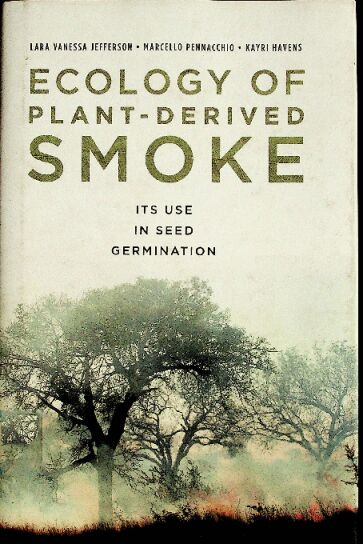
书名:Ecology of plant-derived smoke
责任者:Lara Vanessa Jefferson | Marcello Pennacchio | and Kayri Havens-Young ; David S. Sollenberger. | Havens-Young, Kayri.
出版时间:2014
出版社:Oxford University Press
前言
Ever since our early ancestors learned how to make fire,the smoke it produces has also found a number of uses.Plants that release chemical substances when burned have served as medicines,incense for magico-religious ceremonies, recreational drugs,perfumes,and for flavoring food and beverages.These and other uses have, in the past and present, spawned large organizations that have earned billions of dollars from the sale of smoke products. One needs look only at tobacco or the Arabian incense trade that existed at the time of Christ to realize the enormous socioeconomic importance of smoke. The earnings from these two industries alone have rivaled those of the contemporary oil industry. Plant-derived smoke has also been employed as a variety of lucky charms. Native Americans once used it to lure game and even lovers.Elsewhere in Africa and Europe,it had a more interesting use,one that is of greater relevance to the smoke ecology story. Members of Zulu tribes,for example,used smokeas afertility charm to promote better crops,a lesson they may have learned by observing nature. Those tribes that used smoke for this purpose were almost certainly unaware that chemicals in the smoke may have been responsible for improvingtheir crops. It is only in more recent times that researchers have discovered the active constituent in smoke,karrikinolide,as well as other related substances.These sub- stances work both synergistically and antagonistically,perhaps ensuring that conditions are not only right for germination,but also for the continued growth and improved vigor of plant communities. To date, most smoke-germination studies have focused primarily on plants occurring in the fire prone Mediterranean environments of the western United States, Western Australia,and South Africa. These environments are among the richest floristic regions of the world, with thousands of species occurring in each of them. Not all plant species respond to smoke, however.Some require other environmental cues, while many require multiple cues to germinate. The dormancy mechanism existing in each species often determines which cue or groups of cues are required. A brief account of all relevant types,along with a brief history of smoke ecology and evolution,inhibition of germination by smoke,and the chemistry of smoke products, is therefore provided. Also described are the probable mechanisms of action for these chemicals, the effect of smoke and its products on plant growth and vigor, the different smoke application types,and implications for conservation and land management. Finally, a total of 1,355 plant species, whose seed have been tested for their response to smoke and its products are listed,along This book should serve as an excellent springboard for scientists wanting to learn about the fascinating field of smoke-related seed germination, ecology evolutionary, and physiology. The specific purposes of this book are to provide a comprehensive literature review of research conducted to date on the subject. The intended audiences are:() the scientific community in general,specifically those interested in the ecology, evolution, or physiology of plants;(2)land managers who can use this knowledge in their practices; and (3)biology or science students who will benefit from the history and background of this science and the interdisciplinary approach necessary for studies of this type.
查看更多
目录
Preface ix
Acknowledgments xi
Introduction 1
Chemicals That Affect Germination 4
Multiple Cues 6
Evolution 7
Mechanism of Action 10
Plant Growth and Vigor 14
Methods for Using Smoke 14
Conservation and Land Management and Other Implications 15
LIst of Plants 19
Glossary 271
References 275
Subject Index 289
Species Index 293
Index of Common Names 307
查看更多
馆藏单位
中科院文献情报中心