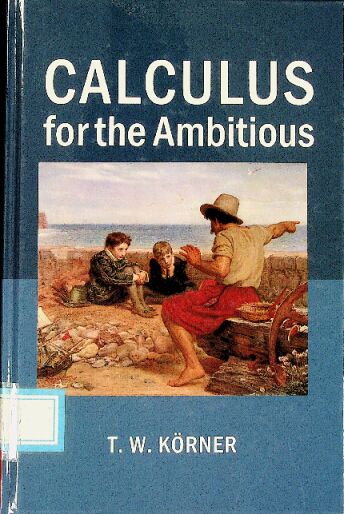
书名:Calculus for the ambitious
责任者:T.W. Korner | Trinity Hall | Cambridge.
ISBN\ISSN:9781107063921,1107063922,9781107686748,1107686741
出版时间:2014
出版社:Cambridge University Press
摘要
From the author of The Pleasures of Counting and Naïve Decision Making comes a calculus book perfect for self-study. It will open up the ideas of the calculus for any 16- to 18-year-old, about to begin studies in mathematics, and will be useful for anyone who would like to see a different account of the calculus from that given in the standard texts. In a lively and easy-to-read style, Professor Körner uses approximation and estimates in a way that will easily merge into the standard development of analysis. By using Taylor's theorem with error bounds he is able to discuss topics that are rarely covered at this introductory level. This book describes important and interesting ideas in a way that will enthuse a new generation of mathematicians.
查看更多
目录
Introduction page ix
1 Preliminary ideas 1
1.1 Why is calculus hard? 1
1.2 A simple trick 4
1.3 The art of prophecy 11
1.4 Better prophecy 15
1.5 Tangents 23
2 The integral 29
2.1 Area 29
2.2 Integration 31
2.3 The fundamental theorem 40
2.4 Growth 45
2.5 Maxima and minima 47
2.6 Snell' s law 52
3 Functions, old and new 56
3.1 The logarithm 56
3.2 The exponential function 59
3.3 Trigonometric functions 65
4 Falling bodies 71
4.1 Galileo 71
4.2 Ai.r resistance 76
4.3 A dose of reality 80
5 Compound interest and horse kicks 84
5.1 Compound interest 84
5.2 Digging tunnels 87
5.3 Horse kicks 90
5.4 Gremlins 93
6 Taylor' s theorem 95
6.1 Do the higher derivatives exist? 95
6.2 Taylor' S theorem 97
6.3 Calculation with Taylor' s theorem 101
7 Approximations, good and bad 108
7.1 Find the root 108
7.2 The Newton-Raphson method 110
7.3 There are lots of numbers 113
8 Hills and dales 117
8.1 More than one variable 117
8.2 Taylor' s theorem in two variables 120
8.3 On the persistence of passes 126
9 Differential equations via computers 130
9.1 Firing tables 130
9.2 Euler' s method 131
9.3 A good idea badly implemented 135
10 Paradise lost 141
10.1 The snake enters the garden 141
10.2 Too beautiful to lose 146
11 Paradise regained 151
11.1 A short pep talk 151
11.2 The Euclidean method 152
11.3 Are there enough numbers? 154
11.4 Can we guarantee a maximum? 158
11.5 A glass wall problem 159
11.6 What next? 161
11.7 The second turtle 162
Further reading 163
Index 164
查看PDF
查看更多
馆藏单位
中科院文献情报中心