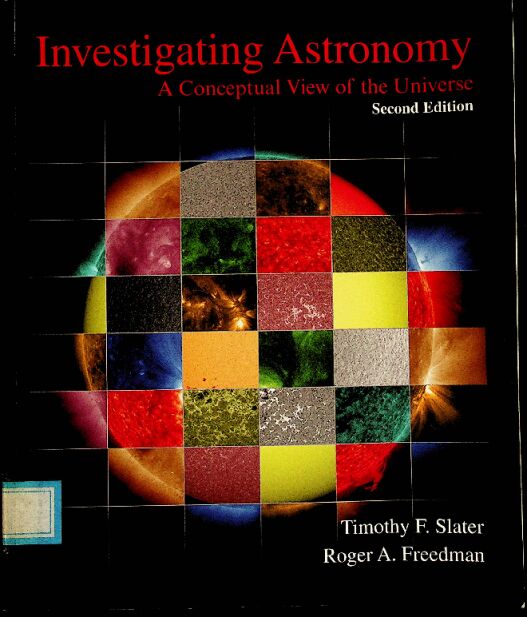
书名:Investigating astronomy
责任者:Timothy F. Slater | University of Wyoming | Roger A. Freedman | University of California | Santa Barbara.
ISBN\ISSN:9781464140853,1464140855
出版时间:2014
出版社:W.H. Freeman and Company, a Macmillan Higher Education Company
摘要
parked by the latest developments in astronomy education research, "Investigating Astronomy" focuses on conceptual understanding, visual literacy, and inquiry-based learning. Tim Slater and Roger Freedman's concise (15 chapter) text explores core topics to show how astronomers study and decipher the universe's underlying processes, helping students approach the subject from a professional scientist's perspective.
The new edition features the latest discoveries, new pedagogy and art, and an expanded media/supplements package centered on W.H. Freeman's breakthrough online course space, LaunchPad.
查看更多
目录
A Letter from the Authors xiii
Preface xv
Acknowledgments xxii
1 Predicting the Motions of the Stars,Sun,and Moon 1
1-1 Astronomy is both an ancient cultural practice and a cutting-edge science 2
1-2 The stars are grouped by constellations 5
COSMIC CONNECTIONS Size and Structure of the Universe 6
1-3 All of the observed celestial motions can be described if our planet Earth spins once each day while it orbits around our Sun each year 8
BOX 1- 1 MEASURING POSITIONS IN THE SKY 12
1-4 The Sun appears to change position over the day and throughout the year, and these changes result in Earth’s seasons 13
1-5 The Moon appears to change its position in the sky hourly and its phase throughout each month 17
BOX 1-2 PHASES AND SHADOWS 19
1-6 Eclipses occur only during rarely observed events when our Sun, Moon, and Earth are perfectly aligned 21
Key Ideas and Terms 26
VISUAL LITERACY TASK Celestial Sphere 27
Questions 28
Answers 31
2 Decoding the Hidden Messages in Starlight 33
2-1 Light travels through empty space at a speed of nearly 300,000 km/s 34
2-2 Glowing objects, like stars, emit an entire spectrum of light 35
2-3 An object’s temperature is revealed by the most intense wavelength of its spectrum of light 38
BOX 2-1 TEMPERATURES AND TEMPERATURE SCALES 39
BOX 2-2 USING THE LAWS OF BLACKBODY RADIATION 44
2-4 An object’s chemical compositionis revealed by the unique pattern of its spectrum of light 44
BOX 2-3 LIGHT SCATTE RING 48
2-5 An object’s motion through space is revealed by the precise wavelength positions of its spectrum of light 49
2-6 Telescopes use lenses,mirrors, and electronics to concentrate and capture incoming light for study 50
BOX 2-4 MAGNIFICAT ION AND LIGHT-GATH ERING POWER 53
VISUAL LITERACY TASK Blackbody Curves 59
Key Ideas and Terms 60
Questions 60
Answers 62
3 Analyzing Scales and Motions of the Universe 63
3-1 Astronomers of antiquity used observation and reasoning to develop astonishing advances in the study of astronomy 64
BOX 3-1 MODERN ASTRONOMI CAL DISTANCES ARE OFTEN MEASυRED IN ASTRONOMICAL UNITS OR LIGHT-Y EARS 66
3-2 Nicolaus Copernicus devised the first comprehensive Sun-centered model 69
3-3 Galileo’s discoveries of moons orbiting Jupiter and the phases of Venus strongly supported a heliocentric model 72
3-4 Johannes Kepler proposed that planets orbit the Sun in ellipticai paths, moving fastest when closest to the Sun, with the closest planets moving at the highest speeds 74
3-5 Isaac Newton formulated three laws relating force and motion to describe fundamental properties of physical reality 77
3-6 Newton’s description of gravity accounts for Kepler’s laws and explains the motions of the planets 79
VISUAL LITERACY TASK Kepler’s Laws 82
Key Ideas and Terms 82
Questions 83
Answers 85
4 Exploring Our Evolving Solar System 87
4-1 The solar system has two broad categories of planets orbiting the Sun: terrestrial (Earthlike) and Jovian (Jupiterlike) 88
4-2 Seven large moons are almost as big as the inner,terrestrial planets 91
4-3 Spectroscopy reveals the chemical composition f the planets 92
4-4 Small chunks of rock and ice also orbit the Sun:asteroids, trans-Neptunian objects, and comets 95
4-5 The Sun and planets formed from a rotating solar nebula 97
COSMICCONNECTIONS Characteristics of the Planets 98
4-6 The planets formed by countless collisions of dust,rocks, and gas in the region surrounding our young Sun 102
4-7 Understanding how our planets formed around the Sun suggests that planets around other stars are common 105
COSMICCONNECTIONS Formation of the Solar System 106
VISUAL LITERACY TASK Solar System 110
Key Ideas and Terms 111
Questions 111
Answers 112
5 Uncovering Earth’s Systems 115
5-1 Most of Earth’s surface is covered with flowingwater that radically changes the landscape 116
5-2 Earthis surrounded by a thin,multilayered envelope of gas that has changed since life became prominent 118
5-3 Volcanoes and earthquakes reveal energy from a molten interior driving Earth’s surface 122
COSMIC CNNECTIONS Comparing Earth’S Atmosphere and Interior 129
5-4 Earth’s magnetic field emanating from its spinning,molten interior creates a protective shield from the Sun’s harmful radiation 130
5-5 A rapidly growing population is altering our planetary habitat Key Ideas and Terms 132
Key Ideas and Terms 136
VISUAL LITERACY TASK Earth’s Interior and the Paths of Seismic Waves 137
Questions 138
Answers 139
6 Exploring Terrestrial Surface Processes and Atmospheres 141
6-1 Comparing terrestrial planets and moons shows distinct similarities and dramatic differences in appearance 142
6-2 Many terrestrial world surfaces are dominated by impact craters revealing the age of underlying processes 143
6-3 Tectonics and volcanism influence surface features 147
BOX 6-1 JUPITE R’S MOON 10 IS COVERED WITH ACTIVE VOLCANOES 152
COSMIC CONNECTIONS Putting It All Together 154
6-4 Atmospheres surrounding terrestrial planets vary considerably 155
COSMIC CONNECTIONS Evolution of a Terrestrial Atmosphere 158
6-5 Evidence exists for water in locations besides Earth 159
VISUAL LITERACY TASK Mercury and the Moon 164
Key Ideas and Terms 165
Questions 165
Answers 166
7 Observing the Dynamic Giant Planets 167
7-1 Dynamic atmospheres of Jupiter and Saturn change rapidly 168
7-2 Uranus and Neptune have seemingly quiet atmospheres 173
7-3 Saturn’s moon Titan and Neptune’s moon Triton exhibit unexpected atmospheres 176
COSMIC CNNECTIONS The Outer Planets: A Comparison 177
7-4 All Jovian planet atmospheres are encircled by complex ring systems 179
VISUAL LITERACY TASK Atmospheri c Structure of a Gas Giant 185
Key Ideas and Terms 185
Questions 186
Answers 187
8 Looking for Life Beyond Earth 189
8-1 Planets and the chemical building blocks of life are found throughout space 190
8-2 Europa and Mars have the potential for life to have evolved 192
8-3 Meteorites from Mars have been scrutinized for life-forms 196
8-4 The Drake equation helps scientists estimate how many civilizations may inhabit our Galaxy 197
8-5 Searches with space-based infrared telescopes and Earth-based radio telescopes for Earthlike planets and alien civilizations are under way 199
VISUAL LITERACY TASK Life in the Universe 201
Key Ideas and Terms 202
Questions 202
Answers 204
9 Probing the Dynamic Sun 205
9-1 The Sun’s energy is generated by thermonuclear reactions in its core 206
9-2 Energy slowly moves outward from the solar interior through several processes 207
COSMIC CONNECTIONS The Proton-Proton Chain 208
9-3 The Sun’s outer layers are the photosphere, chromosphere, and corona 212
9-4 Sunspots are low-temperature regions stars change over time 261
9-5 The Sun’s magnetic field also produces other forms of solar activity and causes aurorae on Earth 220
VISUAL LITERACY TASK The Sun 223
Key Ideas and Terms 224
Questions 224
Answers 225
10 Observing Properties of Distant Stars 227
10-1 Measuring the distances to nearby stars utilizes an effect called parallax 228
10-2 A star’s brightness can be described in terms of luminosity or magnitude 231
10-3 A star’s distance can be determined by comparing its luminosity and brightness 232
10-4 A star’s color depends on its surface temperature 234
10-5 The spectra of stars reveal their chemical compositions as well as surface temperatures and sizes 235
10-6 Stars come in a wide variety of sizes and masses 238
BOX 10-1 STELLAR RADII,LUMINOSITIES, AND SURFACE TEMPERATURES 239
10-7 Hertzsprung-Russell (H-R) diagrams reveal the different kinds of stars 242
COSMIC CONNECTIONS The Main Sequence and Masses 245
VISUAL LITERACY TASK The H-R Diagram 247
Key Ideas and Terms 248
Questions 248
Answers 250
11 Inferring Patterns in Star Life Cycles 251
11-1 Stars form from the gravitational collapse of immense clouds of interstellar gas and dust 252
11-2 Most stars shine throughout their lives nuclear fusion 258
11-3 Careful observc!tions of star clusters provide insight into how a star’s mass influences how stars change over time 261
11-4 Stars slowly become red giants 263
COSMIC CONNECTlS Helium Fusion in a Red Giant 266
11-5 Low-mass stars pulsate and eject planetary nebulae, leaving behind a white dwarf at the end of their life cycles 269
COSMIC CONNECTIONS The Sun: The Next 8 Billion Years 274
VISUAL LITERACY TASK Star Chuster Ages 275
Key Ideas and Terms 276
Questions 276
Answers 277
12 Predicting the Violent End of the Largest Stars 279
12-1 High-mass stars create heavy elements in their cores before violently blowing apart in supernova explosions, leaving behind remnants 280
12-2 Core-collapse supernovae can leave behind remnants, neutron stars, and pulsars 285
12-3 Black holes are created in the death throes of the most massive of stars 288
12-4 Black holes cannot be seen directly 290
COSMIC CONNECTIONS Black Hole "Urban Legends” 291
12-5 White dwarfs and pulsars in close binary systems can become novae, bursters, and supernovae 293
VISUAL LITERACY TASK Supernova Light Curves 298
Key Ideas and Terms 298
Questions 299
Answers 300
13 Exploring Our Galaxy 301
13-1 The Sun is located in the disk of our Galaxy,about 25,000 light-years from the galactic center 302
13-2 Observations of different types of dust, gas, stars, and star clusters reveal the shape of our Galaxy 306
13-3 Observations of star-forming regions reveal that our Galaxy has spiral arms 308
13-4 Measuring the rotation of our Galaxy reveals the presence of dark matter 312
13-5 Spiral arms are caused by density waves that sweep around our Galaxy 315
COSMIC CONNECTIONS Stars in the Milky Way 319
13-6 Infrared and radio observations are used to probe the galactic nucleus
Key Ideas and Terms 322
VISUAL LITERACY TASK Galaxy Rotation Curve 323
Questions 323
Answers 325
14 Investigating Other Galaxies 327
14-1 When galaxies were first discovered, it was not clear that they lie far beyond the Milky Way until their variable stars were carefully observed 328
BOX 14-1 CEPHEIDS AND SUPERNOVAE AS INDICATORS OF DISTANCE 330
14-2 Hubble devised a system for classifying galaxies according to their appearance 331
14-3 Exploding stars release similar amounts of light and their distance can be inferred by measuring their apparent brightness334
14-4 Galaxies are found in clusters and superclusters 337
14-5 Colliding galaxies produce starbursts, spiral arms, and other spectacular phenomena 340
14-6 Dark matter can be inferred by observing the motions of galaxy clusters 342
COSMIC CONNECTIONS When Galaxies Collide 343
14-7 Quasars are the ultraluminous centers of the most distant galaxies 346
14-8 Supermassive black holes may be the “central engines” that power active galaxies 350
14-9 Galaxies may have formed from the merger of smaller objects 351
Key Ideas and Terms 353
VISUAL LITERACY TASK Hubble Tuning Fork 354
Questions 355
Answers 357
15 Observin the Evolution of the Universe 359
15-1 The darkness of the night sky tells us about the nature of the universe 360
15-2 Our observations show us that the universe is expanding 361
COSMIC CONNECTIONS "Urban Legends" about the Expanding Universe 363
15-3 The expanding universe emerged from a cataclysmic event called the Big Bang 365
15-4 The microwave radiation that fills all space is compelling evidence of a hot Big Bang 367
15-5 The universe was a rapidly expanding, hot, opaque plasma during its first 300,000 years and has slowly cooled 369
15-6 The shape of the universe indicates its matter and energy content 373
15-7 Observations of distant supernovae indicate that we live in an accelerating universe
375
VISUAL LITERACY TASK The Shape of Space 378
Key Ideas and Terms 379
Questions 379
Answers 380
Appendices
1 The Planets: Orbital Data A-1
2 The Planets: Physical Data A-1
3 Satellites of the Planets 4 The Nearest Stars A-2
5 The Visually Brightest Stars A-6
6 Some Useful Mathematics A-7
7 Some lmpo「tant Astrono mical Quantities A-7
8 Some Important Physical Constants A-8
9 Powers-of-Ten Notation A-8
10 Jupiter’s Galilean Satellites Compared with the Moon, Mercury, and Mars A-10
Glossary G-1
Index I-1
Star Charts S-1
查看PDF
查看更多
作者简介
Roger A. Freedman is on the faculty of the Department of Physics at the University of California, Santa Barbara. He grew up in San Diego, California, and was an undergraduate at the University of California campuses in San Diego and Los Angeles. He did his doctoral research in nuclear theory and its astrophysical applications at Stanford University under the di rection of Professor J. Dirk Walecka. Dr. Freedman came to UCSB in 1981 after three years of teaching and doing research at the University of Washington. Dr. Freedman holds a commercial pilot’s license, and when not teaching or writing he can frequently be found flying with his wife, Caroline. He has piloted a ircraft across the United States and Canada.
查看更多
馆藏单位
中科院文献情报中心