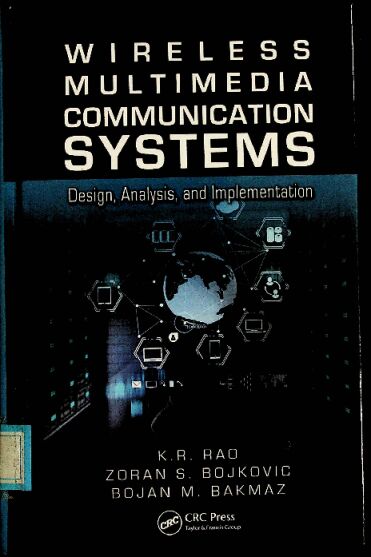
书名:Wireless multimedia communication systems
责任者:K.R. Rao | Zoran S. Bojkovic | Bojan M. Bakmaz. | Rao, K. Ramamohan
出版时间:2014
出版社:CRC Press, Taylor and Francis Group
摘要
Rapid progress in software, hardware, mobile networks, and the potential of interactive media poses many questions for researchers, manufacturers, and operators of wireless multimedia communication systems. Wireless Multimedia Communication Systems: Design, Analysis, and Implementation strives to answer those questions by not only covering the underlying concepts involved in the design, analysis, and implementation of wireless multimedia communication systems, but also by tackling advanced topics such as mobility management, security components, and smart grids.
Offering an accessible treatment of the latest research, this book:
Presents specific wireless multimedia communication schemes that have proven to be useful
Discusses important standardization processing activities regarding wireless networking
Includes wireless mesh and multimedia sensor network architectures, protocols, and design optimizations
Highlights the challenges associated with meeting complex connectivity requirements
Contains numerous figures, tables, examples, references, and a glossary of acronyms
Providing coverage of significant technological advances in their initial steps along with a survey of the fundamental principles and practices, Wireless Multimedia Communication Systems: Design, Analysis, and Implementation aids senior-level and graduate-level engineering students and practicing professionals in understanding the processes and furthering the development of today’s wireless multimedia communication systems.
查看更多
目录
Preface xv
List of Acronyms xxi
Chapter 1 Next Generation Wireless Technologies 1
1.1 Introduction 1
1.2 Wireless Networking Standardization Process 5
1.2.1 Wireless Personal Area Networks 5
1.2.2 Wireless Local Area Networks. 12
1.2.3 Wireless Metropolitan Area Networks 17
1.2.4 Wireless Wide Area Networks 23
1.2.5 Wireless Region al Area Networks 30
1.3 Interworking in Heterogeneous Wireless Environment 33
1.3.1 Interworking Architecture 33
1.3.2 Interworking Mechan isms 35
1.4 Multiple-Input, Multiple-Output Systems 37
1.4.1 Classification and Features of MIMO Techniques 38
1.4.2 MIMO-Based Protocols 39
1.4.3 MIν10 System Configuration for IEEE 802.16m and 3GPP Release 10 41
1.4.4 Multiple-Base Station MIMO Cooperation 43
1.5 Cooperation Techniques from a Networking Perspective 46
1.5.1 Benefits of Cooperation 46
1.5.2 Cooperative Routing 49
1.5.3 Wireless Relaying Protocols 50
1.6 High-Performance Congestion Control Protoco1. 54
1.6.1 TCP Enhancements for Heterogeneous Wif eless Environment 55
1.6.2 Explicitly Synchronized TCP 56
1.7 Wireless Distributed Computing 58
1.7.1 WDC Applications 59
1.7.2 WDC Design Challenges 61
1.8 Concluding Remarks 62
Chapter 2 Cognitive Radio Networks 65
2.1 Introduction 65
2.2 Cognitive Radio System Concept 68
2.2.1 Cognitive Rad10 68
2.2.2 Software-Defined Radio 69
2.2.3 Capabilities of Cognitive Radio System 70
2.2.4 Centralized and Decentralized Cogn itive Radio System 72
2.2.5 Cognitive Pilot Channe1. 72
2.2.6 Key lypes of Cognitive Radio Systems 74
2.2.7 Cognitive Cycle 74
2.2.8 Reconfigurable Radio Systems Management and Control 75
2.3 Cognitive Radio Deployment Issues 81
2.3.1 TVWS Services 82
2.3.2 Secondary Access to White Spaces Using Cognitive Radio 83
2.4 Cooperative CRN 90
2.4.1 Cooperative Communications between PUs and SUs 90
2.4.2 Spectrum Leasing 91
2.4.3 System Architecture for CCRN 93
2.5 Multihop CRNs 97
2.5.1 Routing in Multihop CRNs 99
2.5.2 Static Multihop CRNs 100
2.5.3 Dynamic Multihop CRNs 100
2.5.4 Highly Dynamic Multihop CRNs 100
2.5.5 Challenges fo outing Information through Multihop CRNs 101
2.5.6 Multicarrier Modulation in Multihop CRNs 102
2.6 Control and Coordination in Distributed CRNs 103
2.6.1 Distributed Medium Access Control Benefits 103
2.6.2 Classification of Distributed Cognitive Medium Access Control Protocols 105
2.7 Concluding Remarks 108
Chapter 3 Mobility Management in Heterogeneou s Wireless Systems 111
3.1 Introduction 111
3.2 Mobility Management Services 113
3.2.1 Location Management 114
3.2.2 Handover Management 114
3.2.3 Au x iliary Mobility Management Services 114
3.3 Mobility Management Protocols 115
3.3.1 Link Layer Mobi lity Management 115
3.3.2 Network Layer Mobility Management 116
3.3.3 Hybrid IP-Based Mobility Management Solutions 127
3.3.3.1 MIP叫+PMIPv6 128
3.3.3.2 NEMO + PMIPv6 (+MIPv6) 129
3.3.3.3 MIPv6 + N MIPv6 130
3.3.3.4 NEMO + N-PMIPv6 (+M1Pv6) 131
3.3.4 Transport Layer Mobil ity Management 133
3.3.5 Appl ication Layer Mobility Management 135
3.4 lnterdomain Mobil ity Management 137
3.4.1 Shim6 Protocol 138
3.4.2 Interdomain Session Management 138
3.5 Distributed Mobility Management 141
3.5.1 IETF Framework for DMM 142
3.5.2 3GPP Efforts toward Flexible and Dynamic Mobility Management. 145
3.6 Concluding Remarks 146
Chapter 4 Networkselection in Heterogeneou s Wireless Environment 149
4.1 Introduction 149
4.2 Handover Framework in Heterogeneous Environment 151
4.2.1 Seamless Handover 154
4.2.2 Handover Management Framework 154
4.3 Media-Independent Handover 156
4.3.1 IEEE 802.21 General Architecture 159
4.3.2 MIH Services 160
4.4 Vertical Handover Decision Criteria 167
4.5 Criteria Weights Estimation 171
4.5.1 Subjective Criteria Weights Estimation 172
4.5.2 Objective Criteria Weights Esti mation 173
4.6 Alternative Ranking Techniques 174
4.6.1 Cost Function Tech niques. 176
4.6.2 Multiattribute Decision-Marking Techniques 178
4.6.3 Fuzzy Logic Techniques 182
4.6.4 Artificial Neural Network Techniques 185
4.7 Concluding Remarks 189
Chapter 5 Wireless Mesh Networks 191
5.1 Introduction 191
5.2 WMN Architecture 193
5.2.1 Campus Mesh Network Architecture 195
5.2.2 Downtown Mesh Network Arch itecture 196
5.2.3 Long-Haul Mesh Network Architecture 197
5.3 Characteristics of WMNs 198
5.4 WMN Performance Improvement 200
5.5 Routing in WMNs 203
5.5.1 Fundamental Routing Metrics 203
5.5.2 Routing Protocols 206
5.6 Fair Scheduling in WMNs 217
5.6.1 Classification of Scheduling 217
5.6.2 Fair Scheduling with Multiple Gateways 219
5.7 Video Streaming in WMNs 224
5.7.1 Mesh-Based Peer-to-Peer Streaming Systems 225
5.7.2 Principle of Video Streaming over WMN 226
5.7.3 Multimedia-Centric Routing for Multiple-Descript ion Video Coding 227
5.8 Concluding Remarks 229
Chapter 6 Wireless Multimedia Sensor Networks 231
6.1 Introduction 231
6.2 WMSN Architecture 234
6.3 Internal Architecture of a Multimedia Sensor Device 240
6.4 Protocol Stack for WMSN 241
6.4.1 Physical Layer for the WMSN 241
6.4.2 Link Layer Quality of Service Support 242
6.4.3 Energy-Efficient Routing Techniques with QoS Assurances 246
6.4.4 Specificity of Transport Layer in WMSNs 253
6.4.5 Source Coding Techniqu es for WMSNs 254
6.5 Convergence of Mobile and Wireless Sensor Systems 256
6.5.1 Radio Access Technologies Convergence 258
6.5.2 Protocol Convergence 259
6.6 WMSN Applications 260
6.7 WSN Automated Maintenance 263
6.7.1 Task Al location and Task Fulfil l ment Problems 263
6.7.2 Topology Control and Sensor LocaUzation 264 6.8 Concluding Remarks 266
Chapter 7 Security in Wireless Multimedia Communications 269
7.1 Introduction 270
7.2 General Security Issues in Wireless Commu nications 272
7.2.1 Security Attacks 274
7.2.2 Security Requirements in Wireless Multimedia Commu nications 277
7.3 Physical Layer Security 279
7.3.1 Theoretically Secure Capacity 279
7.3.2 Channel 280
7.3.3 Coding 280
7.3.4 Power and Signal Detection 281
7.4 Security Aspects for Mobile Systems 282
7.4.1 Network Operators' Security Requirements. 283
7.4.2 Security Architecture for Mobile Systems 285
7.4.3 Security in LTE Systems 286
7.4.3.1 Cellular Security 286
7.4.3.2 Handover Security 288
7.4.3.3 IMS Security 288
7.4.3.4 HeNB Security 289
7.4.3.5 MTC Security 291
7.5 Security in CRNs 293
7.5.1 General Security Requirements in CRNs 293
7.5.2 Characteristic Attacks in CRNs 294
7.5.3 Secure Spectrum Management. 295
7.6 Security 10 WMNs 297
7.6.1 Typical Security Attacks in WMNs 298
7.6.2 Selective Jamming 300
7.6.2.1 Channel-Selective Jamming 301
7.6.2.2 Data-Selective Jamming 303
7.7 Security Aspects in WMSNs 304
7.7.1 Potential of Asy m metric Cryptography 304
7.7.2 Vulnerabilities of WMSNs 306
7.8 Concludi ng Remarks 308
Chapter 8 Wireless Communication Systems in the Smart Grid 311
8.1 Introduction 311
8.2 Key Requirements of the Smart Grid 313
8.2.1 Establishing Standards for the Smart Grid 314
8.2.2 Components of the Smart Grid 315
8.3 Communication Architecture for the Smart Grid 317
8.4 Role of Effective Demand Load Control in the Smart Grid 321
8.5 Wireless Mesh Networking for the Smart Grid 324
8.6 Heterogeneous Networks Integration to Coordinate the Smart Grid Functions 327
8.7 Smart Microgrid Network 330
8.8 Smart Grid DR 331
8.9 Concluding Remarks 335
Chapter 9 Evolution of Embedded Internet 337
9.1 Introduction 338
9.2 Mobile Crowdsensing 341
9.2.1 MCS Applications Architecture 342
9.2.2 Characteristics of MCS 344
9.3 Perspective Protocol Stack for Wireless Embedded Internet 346
9.3.1 Adaptation Layer 347
9.3.2 Routing over Low-Power and Lossy Networks 348
9.3.3 Application Protocolr 350
9.4 WSNs and loT 351
9.4.1 Mobility Management in Embedded Internet 354
9.4.2 Global Time Synchronization 355
9.4.3 Security Issues in Embedded Internet 356
9.5 M2M Communications and Embedded Internet 357
9.5.1 M2M System Architecture 358
9.5.2 M2M Standardization 359
9.5.3 IP Multimedia Subsystem and M2M Integration 361
9.6 Nanonetworks and loT 364
9.6.1 Components of loNT Architecture 365
9.6.2 Nanonetworks Communication 366
9.7 Concluding Remarks 367
Chapter 10 Flexible Future of the Internet 369
10.1 Introduction 369
10.2 Principles for Fl Architecturer 371
10.2.1 Information-Centric Networking 371
10.2.2 Network Virtualization and Adaptive Resource Management 372
10.2.3 Flexible and Evolvable Open Infrastructure 372
10.2.4 Mobility Management 372
10.2.5 Cloud Computing-Centric Architectures 373
10.2.6 Security 373
10.2.7 Energy Efficiency 373
10.2.8 Experimental Test Beds 374
10.3 Physical Layer-Aware Network Architecture 374
10.3.1 Physical Layer Awareness in Wireless Access Networks 374
10.3.2 Physical Layer-Aware Architecture Framework 375
10.3.3 Network Virtualization 377
10.4 Information-Centri c Networking 379
10.4.1 Concept and Principles of Information-Centric Networking 380
10.4.1.1 Information Naming 380
10.4.1.2 Name-Ba sed Routing and Name Resolution 381
10.4.1.3 Multisource Dissemination 383
10.4.1.4 In-Network Caching 383
10.4.2 Data-Oriented Network Architecture 385
10.4.3 Network of Information 386
10.4.4 Named Data Networking 387
10.5 Streaming of Scalable Video for FI 388
10.5.1 Wavelet-Based SVC 390
10.5.2 Event-Based Scalable Coding 391
10.6 Media Search and Retrieval in FI 393
10.7 FI Self-Management Scenarios 397
10.7.1 Adaptive Resource Management 397
10.7.2 Energy-Aware Network Management 398
10.7.3 Cache Management 400
10.8 Concluding Remarks 401
References 405
Chapter 1 Next Generation Wireless Technologies 405
Chapter 2 Cognitive R adio Networks 411
Chapter 3 Mobility Management in Heterogeneous Wireless Systems 415
Chapter 4 Networkselection in Heterogeneous Wireless Environment 418
Chapter 5 Wireless Mesh Networks 421
Chapter 6 Wireless Multimedia Sensor Networks 425
Chapter 7 Security in Wireless Multimedia Communications 430
Chapter 8 Wrreless Communications Systems in the Smart Grid 433
Chapter 9 Evolution of Embedded Internet 435
Chapter 10 Flexible Future of the Internet 438
Index 441
查看PDF
查看更多
作者简介
K. R. Rao holds a B.Sc from the College of Engineering, Guindy, Chennai, India and Ph.D from The University of New Mexico, Albuquerque, USA. Since 1966, he has been with the University of Texas at Arlington, USA, where he is currently a professor. He, along with two other researchers, introduced the Discrete Cosine Transform in 1975, which has since become popular in digital signal processing. An IEEE fellow, he has co/authored and co/edited numerous books, published extensively in refereed journals, presented at several international conferences, and served as a consultant to industry, research institutes, law firms, and academia. Zoran S. Bojkovic holds a B.Sc, M.Sc, and Ph.D from the University of Belgrade, Serbia, where he is currently a full professor. He is also a permanent visiting professor at the University of Texas at Arlington, USA. A member of the editorial board of six international journals, he has co/authored and co/edited numerous books, conference proceedings, and papers in peer-reviewed publications. A member of several academic and professional societies, he has conducted seminars and participated in over 70 scientific and industrial projects all over the world. He has also been a consultant to industry, research institutes, and academia. Bojan M. Bakmaz holds a B.Sc, M.Sc, and Ph.D from the University of Belgrade, Serbia, where he is currently an assistant professor. In his previous work, he participated in the realization of several scientific projects and studies. He is the author of a monograph, a textbook, and over 70 papers in international journals and conference proceedings. A member of IEEE, he is an active reviewer of numerous scientific publications. His research interests include multimedia wireless networks, QoS, teletraffic theory, and handover techniques.
查看更多
馆藏单位
中科院文献情报中心