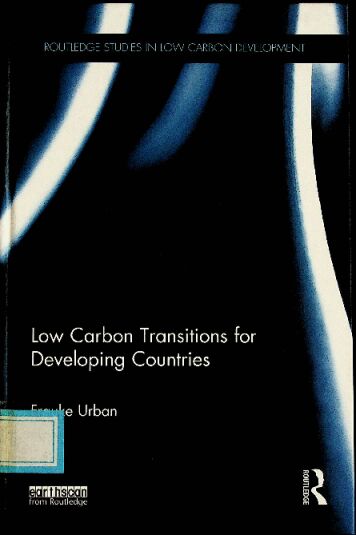
书名:Low carbon transitions for developing countries
出版时间:2014
出版社:Routledge/Earthscan
前言
Global climate change is one of the greatest challenges of our times and in order to tackle this carbon emissions need to be mitigated. China and India have recently become some of the world’s largest greenhouse gas emitters. Transitions to low carbon energy, for reducing emissions that lead to climate change, are therefore an urgent priority for China and India and at a global level.
This is the first book focusing on low carbon energy transitions for emerging economies such as China and India, assessing the opportunities and barriers for transitions to renewable and low carbon energy as climate change mitigation options. It uses energy modelling to assess the China’s power sector, the economy of Beijing and rural Indian households that do not have access to electricity. The research evaluates the environmental, technical, socio-economic and policy implications of these low carbon transitions, concluding that they are possible in China and India and they can considerably contribute to climate change mitigation.
This interdisciplinary book will be of interest to scholars, students, practitioners and policy-makers working in the fields of energy and development, energy policy, energy studies and modelling, climate policy, climate change mitigation, climate change and development, low carbon development, sustainable development, environment and development and environmental management.
查看更多
目录
List of abbreviations xi
Acknowledgements xiii
l. General introduction 1
1.1 Book overview 1
1.2 Introduction 1
1.3 Climate change and the impacts of energy use 2
1.4 Equity in the climate change debate 5
1.5 Low carbon development 9
1.6 Energy transitions and the role of renewable and low carbon energy 10
1.7 Energy modelling 15
1.8 Aim and scope of the book 16
1.9 Structure of the book 18
2. Modelling energy and development:an evaluation of models and concepts 21
Overview 21
2.1 Introduction 21
2.1.1 Metrics for the comparison of economic activity 23
2.2 Developing countries in global energy models 23
2.2.1 The Energy Ladder in the SRES models 24
2.2.2 The Environmental Kuznets Curve in the SRES models 28
2.3 Key issues of energy systems in developing countries 31
2.3.1 Development of the energy system 34
2.3.1.1 From traditional to commercial fuels 34
2.3.1.2 Electrification 37
2.3.2 From economic development to energy use 39
2.3.2.1 Economic structural change and dematerialisation 39
2.3.2.2 Income distribution 44
2.3.2.3 Informal economic systems 45
2.3.3 The context of development 47
2.3.3.1 Fossil energy resource depletion 48
2.3.3.2 Climate change 48
2.3.3.3 Urban air pollution 49
2.4 Discussion and conclusion 50
3. Modelling energy systems for developing countries 52
Overview 52
3.1 Introduction 52
3.2 Characteristics of the energy systems and economies of developing countries 54
3.2.1 Poor performance of the power sector and traditional fuels 54
3.2.2 Transitions from traditional to modern economies 57
3.2.3 Structural deficiencies in society, economy and energy systems 58
3.3 Energy model comparison 59
3.4 Results of the energy model comparison 61
3.5 Discussion 63
3.5.1 Discussion of model comparison and model groups 63
3.5.2 Discussion of methodology 66
3.6 Conclusions 68
4. Renewable and low carbon energy as mitigation options of climate change for China's power sector 71
Overview 71
4.1 Introduction 71
4.2 Method 73
4.2.1 Description of Power Plan 73
4.2.2 Modelling the Chinese power sector 75
4.2.3 Storylines and scenario-making 77
4.3 Results 79
4.3.1 Results of the business-as-usual scenarios 79
4.3.2 Results of the renewable and low carbon energy scenarios 80
4.3.3 Comparison of the scenarios 80
4.4 Discussion 87
4.4.1 Discussion of the method 87
4.4.2 Discussion of the results and implications 88
4.5 Conclusion 92
5. Scenarios for renewable energy transitions in Beijing 95
Overview 95
5.1 Introduction 95
5.2 Methodology 97
5.2.1 Modelling with LEAP 97
5.2.1.1 Final energy demand analysis 98
5.2.1.2 Activity levels, energy intensity,emissions and demand costs 98
5.2.2 Modelling framework for Beijing 100
5.2.2.1 Beijing 100
5.2.2.2 Modelling the system 101
5.2.3 Scenario-making 103
5.2.4 Data issues 106
5.3 Results 106
5.3.1 Energy demand 106
5.3.2 CO,and other greenhouse gas emissions 109
5.3.3 Costs 110
5.3.4 Technology and policy implementations 112
5.4 Discussion 117
5.4.1 Discussion of the method and data
5.4.2 Uncertainties
5.4.3 Discussion of the results 118
5.4.4 Recommendations 121
5.5 Conclusions 122
6. Energy for rural India 125
Overview 125
6.1 Introduction 125
6.2 Methodology 127
6.2.1 Modelling with the Regional Energy Model (REM) 127
6.2.2 Modelling rural India 129
6.2.3 Scenario-making 131
6.2.4 Data issues 136
6.3 Results 136
6.3.1 Primary energy use 136
6.3.2 GHG emissions 138
6.3.3 Costs 140
6.4 Discussion 142
6.4.1 Discussion of method and data 142
6.4.2 Uncertainties 142
6.4.3 Discussion of results 143
6.4.4 Policy recommendations 146
6.5 Conclusions 147
7. Conclusions 149
7.1 Introduction 149
7.2 Energy systems of developing countries:characteristics and potential changes 150
7.3 Energy transitions in emerging countries 151
7.3.1 The Chinese power sector 151
7.3.2 Beijing's economy 152
7.3.3 Rural residential India 152
7.4 Effects of low carbon energy transitions in emerging economies 152
7.4.1 Effects on the Chinese power sector 153
7.4.2 Effects on Beijing's economy 153
7.4.3 Effects on rural residential India 154
7.5 The role of energy modelling for developing countries 155
7.6 Overall conclusion and recommendations 157
8. Summary:modelling transitions to renewable and low carbon energy for emerging economies 160
8.1 Background 160
8.1.1 Energy and its impacts 160
8.1.2 Energy transitions and the role of renewable and low carbon energy 161
8.1.3 Energy modelling 161
8.2 Objective of the book and research approach 162
8.3 Findings 163
8.3.1 Energy systems of developing countries: characteristics and modelling approaches 163
8.3.2 Energy transitions in emerging economies 164
8.4 Conclusion 165
References 167
Index 183
查看PDF
查看更多
馆藏单位
中科院文献情报中心