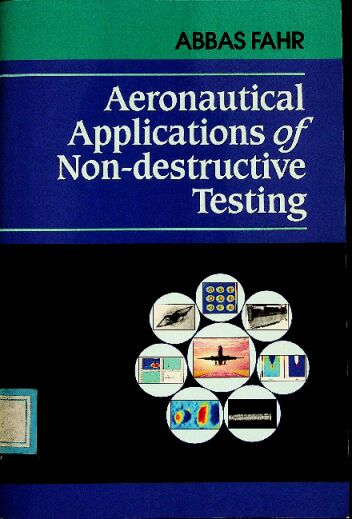
书名:Aeronautical applications of non-destructive testing
责任者:Abbas Fahr ; with ial assistance from William Wallace. | Wallace, William.
ISBN\ISSN:9781605951201,160595120X
出版时间:2014
出版社:DEStech Publications Inc.,
前言
Non-destructive testing (NDT) plays an important role in thesafety of aircraft and other critical stn川ures, yet the subject is not well-understood or recognized by many engineers. This book has been prepared with the aim of providing information on NDT technologies avai lable for aeronautical applications in a simple and concise manner, such that it will be useful to readers of various backgrounds. It is intended to serve as a general educational or reference source for students and engineers in aeronautics or related fieIds who may require NDT as a part of their education or for their project activities. The book describes NDT methods in general, their applications for the evaluation and inspection of aerospace materials or components, the types of information they provide, and how such information is used to improve aircraft safety.
This book contains 13 chapters starting with an introduction to the NDT field and a glossary of te口ns related to the subject. A review of aircraft design, anufacture and maintenance methodologies as well as their NDT requirements, is provided in chapter 2. ln chapter 3, a description of the way NDT is carried out and how the results areanalyzed is given, which explains the need for NDT standards, references, and calibrations, as well as qualified personnel to perform the tests. Chapters 4 through IO deal with the different NDT methods used in the aeronautical field describing the basic principles of the techniques, necessary instrumentation, procedures available for their use, a feW examples of applications, and a summary of their capabilities and limitations.
Technologies covered in these chapters include: optical and ernnced optical methods; liquid penetrant, replication, and magnetic particle inspections; electrornagnetic and eddy current approaches; acoustic and ultrasonic procedures; passive and active in台ared thermal imaging; and x-rays and other radiographic techniques. In addition, there are three chapters which deal with important subjects related to aircraft inspection. Chapter 11 describes NDT of composite and hybrid materials, which are extensively being used in modem air-vehicles, while chapter 12 is concerned with aging aircra位issues . In these chapters, impact damage and environmental degradation of composites, corrosion and fatigue cracking of metallic parts, and the NDT methods available to detect them are explained. Finally, chapter 13 is dedicated to NDT reliability and the ways the probabil ity of detection can be measured and employed to establish inspection intervals for the continued safe use of critical aircraft components or structures.
查看更多
目录
List of Acronyms xiii
Foreword xvii
Preface xxi
Acknowledgments xxiii
1 Introduction 1
1.1 Purpose 1
1.2 Definitions 2
1.3 Aeronautical NDT 3
1.3.1 NDT Methods 3
1.3.2 NDT Performance Measures 4
1.4 Organization of the Chapters 5
1.5 Chapter References 6
2 NDT in Aircraft Design, Manufacture, and Operation 7
2.1 Aircraft Design 7
2.1.1 Safe-Life 8
2.1.2 Fail-Safe 10
2.1.3 Damage Tolerance 1 1
2.1.4 Holistic Approach 16
2.2 NDT during Aircraft Life Cycle 17
2.2.1 Development and Manufacturing 17
2.2.2 Operation 18
2.2.3 Aging Aircraft 21
2.3 Chapter References 25
3 NDT Process 29
3.1 Background 29
3.2 NDT Personnel 30
3.3 Standard Practices 31
3.4 Reference Standards 33
3.5 Non-standard Reference Pieces 34
3.6 Calibrations 35
3.7 NDT Measurements 36
3.7.1 Example 37
3.8 NDT Signal and Image Processing 37
3.8.1 NDT Signals 38
3.8.2 Signal-to-noise Ratio 39
3.8.3 Fourier Analysis 40
3.8.4 Gated Signals 42
3.8.5 Signal Averaging 42
3.8.6 Wavelet Transfonnation 42
3.8.7 Time -frequency Analysis 43
3.8.8 Statistical Patterη Recognition 43
3.8.9 Neural Network 44
3.8.10 Data Fusion 44
3.8.11 Basic Scanning and Presentation Modes 45
3.8.12 Image Processing 47
3.9 NDT Modeling 48
3.9.1 Foiward Problem 50
3.9.2 Inverse Problems 50
3.10 Examples of Non-standard Reference Pieces 50
3.10.1 Metallic Samples with Cracks 50
3.10.2 Metallic Samples with Material Loss 54
3.10.3 Composite Reference Pieces 55
3.11 Appendices 59
3.11.1 A Partial List of ASTM General and Aerospace related NDT Standards 59
3.11.2 A Partial List of ISO NDT Standards 67
3.12 Chapter References 68
4 Visual Inspection and Optical Methods 71
4.1 Visual Inspection 71
4.1.1 Borescopes 71
4.1.2 Application Examples 74
4.1.3 Capabilities and Limitations 74
4.2 Edge of Light (EOL) 76
4.2.1 Principles 76
4.2.2 Appl ication Examples 76
4.2.3 Capabilities and Limitations 78
4.3 Double Pass Retroreflection or D-sight 79
4.3.1 Principles 79
4.3.2 Application Examples 80
4.3.3 Capabilities and Limitations 80
4.4 Laser Shearography 82
4.4.1 Principles 82
4.4.2 Application Examples 83
4.4.3 Capabilities and Limitations 85
4.5 Chapter References 85
5 Liquid Penetrant, Replication, and Magnetic Particle Methods 87
5.1 Liquid Penetrant Inspection (LPl) 87
5.1.1 Principles 87
5.1.2 2 LPI Process 88
5.1.3 LPI Methods 91
5.1.4 .4 Equipment 92
5.1.5 Application Examples 94
5.1.6 Capabilities and Limitations 94
5.2 Replication 95
5.2.1 Principles 95
5.2.2 Replication Materials 96
5.2.3 Application Examples 97
5.2.4 Capabi lities and Limitations 98
5.3 Magnetic Particle Inspection (MPI) 98
5.3.1 Principles 98
5.3.2 Magnetization Methods and Devices 100
5.3.3 Types of Magnetic Particles 103
5.3.4 MPI Process 105
5.3.5 Application Examples 106
5.3.6 Capabilities and Limitations 107
5.4 Chapter References 108
6 Electromagnetic Methods 111
6.1 Principles 111
6.2 Eddy Current Testing (ECT) 113
6.2.1 Conventional Eddy Current 115
6.2.2 Multi-frequency Eddy Current 117
6.2.3 Pulsed Eddy Current 118
6.3 Eddy Current Probes 118
6.3.1 Search Coils 118
6.3.2 Solid State Sensors 120
6.4 Eddy Current Measurement 124
6.4.1 Frequency Effects 124
6.4.2 Skin Depth of Penetration 125
6.4.3 Probe Lift-off 125
6.4.4 Lift-off Intersection (LOI) 126
6.5 Measurement Systems 126
6.5.1 Conventional Eddy Current 126
6.5.2 Pulsed Eddy Current Measurement Examples 128
6.6 Application Examples of Eddy Current Testing 142
6.6.1 Inspection of Engine Parts 142
6.6.2 Inspection of Air仓ame Structures 145
6.6.3 Inspection of Friction Stir Welds 152
6.6.4 Inspection of Them1al Barrier Coatings (TBC) 155
6.6.5 Inspection of Nickel-Aluminum-Bronz e Valves 158
6.6.6 Conductivity Mapping 162
6.6.7 Eddy Current Modeling 166
6.7 Capabilities and Limitations 170
6.8 Magneto-optical Imaging (MOI) 171
6.8.1 Principles 171
6.8.2 Applications 173
6.8.3 Capabilities and Limitations 173
6.9 Chapter References 174
7 Ultrasonic Methods 179
7.1 Principles 179
7.1.1 Wave Types 179
7.1.2 Acoustic Impedance 183
7.1.3 Reflection and Transmission at Boundaries 183
7.1.4 Attenuation 186
7.1.5 Sensitivity and Resolution 188
7.1.6 Signal-to-noise Ratio 189
7.1.7 Scanning and Presentation 190
7.1.8 Ultrasonic Coupling 196
7.2 Testi ng Procedures 199
7.2.1 Normal Beam 200
7.2.2 Oblique-angle Beam 205
7.3 Equipment 214
7.3.1 Piezoelectric Transducers 216
7.3.2 Transducer Arrays 217
7.4 Application Examples 219
7.4.1 Procedures and Parameters 219
7.4.2 Flaw Detection and Sizing 224
7.4.3 Material Characterization 229
7.5 Non-contact Ultrasonic Testing 237
7.5.1 Air-coupled U ltrnsonic Testing 237
7.5.2 Electro-Magnetic Acoustic Transducers (EMAT) 239
7.5.3 Laser Ultrasonic Testing 240
7.6 Chapter References 243
8 Acoustic τechniques 247
8.1 Tap Testing 248
8.1.1 Principles 248
8.1.2 Applications 248
8.1.3 Capabilities and Limitations 249
8.2 Mechanical Impedance Analysis (MIA) 249
8.2.1 Principles 249
8.2.2 Applications 251
8.2.3 Capabilities and Limitations 251
8.3 Acoustic Resonance 252
8.3.1 Principles 252
8.3.2 Applications 253
8.3.3 Capabilit ies and Limitations 253
8.4 Acoustic Emission Testing 254
8.4.1 Principles 254
8.4.2 Equipment 255
8.4.3 Test Procedures 256
8.4.4 Applications 261
8.4.5 Capabilities and Limitations 268
8.5 Acousto-Ultrasonic Technique 269
8.5.1 Principles 269
8.5.2 Test Procedure 271
8.5.3 Applications 271
8.5.4 Capabilities and Limitations 276
8.6 Chapter References 277
9 Infrared Thermography 279
9.1 Principles 279
9.1.1 Thennal Diffusion 280
9.1.2 Thermal Emissivity 281
9.1.3 IR Thermal Measurement 283
9.1.4 IR Tbennograpby Procedures 284
9.2 Passive Tbermography 284
9.2.1 Principles 284
9.2.2 Application Examples 285
9.2.3 Capabilities and Limitations 287
9.3 Active Thermography 288
9.3.1 Principles 288
9.3.2 Pulsed Thennography 289
9.3.3 Pulsed Phase Thermography 296
9.3.4 Lock-in Thenηography 298
9.3.5 Vibro-tbermograpby 300
9.4 The口nography Equipment 303
9.5 Chapter References 304
10 Radiography 307
10.1 Principles 307
10.2 Radiographic Image Quality 308
10.2.1 Image Density 308
10.2.2 Sensitivity 308
10.2.3 Image Contrast 309
10.2.4 Image Definition 309
10.2.5 Geometric Sharpness 309
10.3 X-ray Techniques 312
10.3.1 Principles 312
10.3.2 Equipment 312
10.3.3 Appl ication Examples 319
10.3.4 Capabi lities and Limitations of X-ray Techniques 323
10.4 Gamma Rays 324
10.4.1 Principles 324
10.4.2 Equipment 325
10.4.3 Capabilities and Limitations of Gamma Rays 325
10.5 Neutron Radiography 326
10.5.1 Principles 326
10.5.2 Equipment 326
10.5.3 Capabilities and Lim itations of Neutrnn Radiography 327
10.6 Compton Backscatteri ng 328
10.6.1 Principles 328
10.6.2 Equi pment 329
10.6.3 Capabilities and Limitations of Compton Backscattering 329
10.7 Computed Tomography 330
10.7.1 Principles 330
10.7.2 Equipment 330
10.7.3 Capabilities and Limitations 331
10.8 Chapter References 332
11 NDT of Aerospace Composite Materials and Components 335
11.1 Background 335
11.2 Carbon Fiber Solid Laminates 337
11.2.1 Defect Types 338
11.2.2 NOT Methods 340
11.2.3 Section Summa叩 348
11.3 Kevlar Laminates 349
11.3.1 Defect Types 349
11.3.2 NOT Methods 350
11.3.3 Section Summary 351
11.4 Fiber-Metal Laminates 352
11.4.1 Defect Types 352
11.4.2 NOT Methods 352
11.4.3 Section Summa γ 355
11.5 Honeycomb Sandwich Paneis 355
11.5.1 Defect Types 356
11.5.2 NOT Methods 356
11.5.3 Section Summary 362
11.6 Foam-core Sandwich Panels 363
11.6.1 Defect Types 363
11.6.2 NDT Methods 363
11.6.3 Section Summary 365
11.7 Inspection of Adhesive Bonds 365
11.7.1 Defect Types 366
11.7.2 NDT Methods 367
11.7.3 Section Summary 370
11.8 Chapter References 370
12 NDT of Corrosion in Aluminum Airframe Structures 373
12.1 Background 373
12.2 Corrosion Types 374
12.3 Aluminum Lap-joint Corrosion 376
12.4 NDT Methods for Lap-joint Corrosion 377
12.4.1 Optical Methods 378
12.4.2 Liquid Penetrant Inspection 379
12.4.3 Eddy Current 379
12.4.4 Ultrasonic Techniques 381
12.4.5 Radiography 384
12.4.6 Thermal Methods 385
12.5 Corrosion Verification Tests 386
12.6 NDT Metrics for Corrosion 388
12.6.1 Average Thickness Loss 389
12.6.2 Surface Pitting 389
12.6.3 Cracks 390
12.6.4 Surface Pillowing 390
12.6.5 Exfoliation 391
12.7 Chapter Summary 391
12.8 Chapter References 393
13 NDT Reliability 397
13.1 Background 397
13.2 Experimental Demonstration of NDT Reliability 399
13.2.1 NDT System Definition 399
13.2.2 Design of Experiments 400
13.2.3 Demonstration Tests 402
13.2.4 Statistical Analysis 403
13.2.5 Documentation of Results 411
13.3 Model-assisted POD 411
13.4 Examples of NDT Reliability Studies 413
13.4.1 POD Development using Actual Life-expi red Parts with Service-i nduced Cracks 414
13.4.2 POD Development using Actua l Parts with Artificial Damage 424
13.4.3 POD Development using Representative Specimens with Artificial Discontinuities 430
13.4.4 POD Development using Generic Test Blocks with Artificial Defects 438
13.4.5 POD Estimation from Data Generated during NDT Procedure Development 446
13.4.6 POD Estimation using Field inspection Data 452
13.4.7 POD Estimation using Modeling with Limited Experiments 457
13.5 Chapter References 464
Index 469
About the Author 479
查看PDF
查看更多
作者简介
Dr. Abbas Fahr is a Senior Research Scientist in the Aerospace Portfolio of the National Research Council Canada (NRCC). He received a B.Sc. degree in Physics from Mashad University in 1972, a Master’s degree in Non-destructive Testing (NDT) from Brunel University in 1975 and a Ph.D. degree in Materials Science from Imperial College of London University in 1979. He worked as a researcn scientist at the Materials Research Centre of the University of Missouri-Rolla, USA from 1979 to 1981 and at the Ontario Research Foundation in Mississauga, Canada from 1981 to 1984. He joined the NRCC in 1984 where he was in charge of the development of NDT technologies for aeronautical applications. Dr.Fahr is the author or co-author of over 200 technical publications and the recipient of several TTCP awards. His areas of expertise include aerospace NDT, inspection reliability assessment and materials characterization. For further information on subjects covered in this book please contact the author at: AeronauticalNDT@gmail.com.
查看更多
馆藏单位
中科院文献情报中心