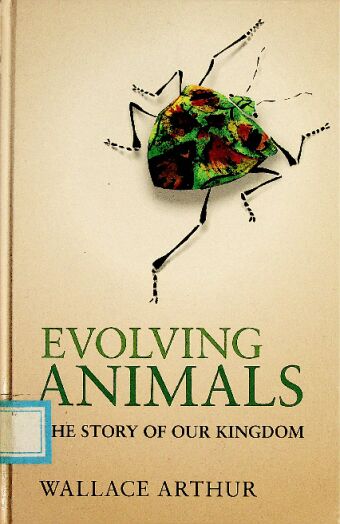
书名:Evolving animals
责任者:Wallace Arthur | Emeritus Professor of Zoology | National University of Ireland | Galway ; Stephen Arthur.
ISBN\ISSN:9781107049635,1107049636,9781107627956,1107627958
出版时间:2014
出版社:Cambridge University Press,
摘要
When our planet was only half its current age it was already teeming with life, yet not a single animal swam in its oceans, walked on its land,or flew in its skies. Now, in contrast, there are well over a million known species of animals on Earth. Sometime in between, the very first animal arose from a unicellular ancestor. Th.is animal was probably a tiny marine creature whose body consisted of just a handful of cells.One way of looking at the animal kingdom is as a vast number of lines of descent - or lineages - radiating out through time from that original animal, with each lineage either terminating in an extinction or continuing to evolve today.
Each line of descent has its own story to tell. So the story of the animal kingdom is a composite one, with ma ny subplots being played out in individual lineages. ln between a single lineage and our whole kingdom lie the stories of particular animal groups. In this book, I try to tell some of the individual stories, notably the human one, and some of the group stories, for example tho e of the three biggest groups of animals (the arthropods, the molluscs and the vertebrates). From these accounts, the composite story of the animal kingdom gradually emerges.
Often, biologists distinguish between the pattern and the process of evolution . The former concerns relationships - the issue of which types of animal are most closely re lated to which other ones. The latter concerns the mechanisms by which evolution comes about, including Darwinian natural selection. There have been major advances in both areas in the last two or three decades, with the result that our current view of evolution is considerably different from the view that prevailed in the middle of the twentieth century. In terms of patterns of animal relationships, a radical reappraisal of our perception of these began in the 1990s; and our views have been refined ever since through the use of DNA data to build more accurate evolutionary tree .In terms of process, the comparntive study of embryonic deveopment using modern techniques has yielded new insights into the way in which evolution works at the level of the individual animal. These insights complement earlier ones concerning how evolution works at the level of population and species. Ultimately, our theory of evolution must incorporate insights into the key mechanisms operating at both of these levels.
Not only can a story have many facets, but it can be told in many ways, each appropriate for different kinds of reader. This book is intended for anyone with an interest in the animal kingdom, its history, and how it came to be as we find it and not otherwise. All the chapters are short and are written in a conversational, non-technical way.This means, I hope, that the book will appeal to the general reader, as well as to students of zoology and other biological sciences. Also, the structure of the book is designed to ensure variety in the sequence of topics encountered, with chapters about evolutionary pattern interspersed with chapters about process.
The pictures are very much part of the story. All of the illustrations and diagrams herein are original and were commissioned specifically for this book. They are varied in type, including many evolutionary trees and several pictures relating to animal development. However, there are quite a lot of illustrations that are simply pictures of animals. It'simportant for readers to be able to picture in their minds animals that are not familiar to them. These include animals that are very small(for example, millimetre-long water-bears), animals that are rare(for example, fish called coelacanths), animals that are found in places we are unlikely to visit (for example, the beard-worms that are found in association with thermal vents on the seabed), and animals that are extinct and are not as well known as the dinosaurs (for example,anomalocarids and plesiosaurs). I hope that the combination of original artwork and non-technical language makes for an enjoyable read.
查看更多
目录
1 What is an animal? 1
2 Before there were animals 13
3 How to make a fossil 25
4 The Cambrian explosion 35
5 How to make a species 45
6 Jellyfish and their kin 56
7 How to make a tree 67
8 The enigmatic urbilaterian 77
9 Animal ymmetry and heads 85
10 A plethora of worms 94
11 Trends in animal complexity 104
12 Where the octopus is king 113
13 How to make an animal 123
14 Exoskeletons galore 135
15 Extinction 146
16 Mouth first, mouth second 156
17 Comparing embryos 166
18 Larvae, mouthpart and moulting 177
19 The animal toolkit 187
20 Vertebrate origins and evolution 201
21 From water to land to water 212
22 Variation and inheritance 222
23 Evolutionary novelties 232
24 Human origins and evolution 241
25 Animal plasticity 251
26 The nature of adaptation 262
27 The direction of evolution 274
28 Animal extremophiles 285
29 Extrate1Testrial animals? 295
30 The ghost in the machine 305
Appendix 319
References 324
lndex 329
查看PDF
查看更多
馆藏单位
中科院文献情报中心