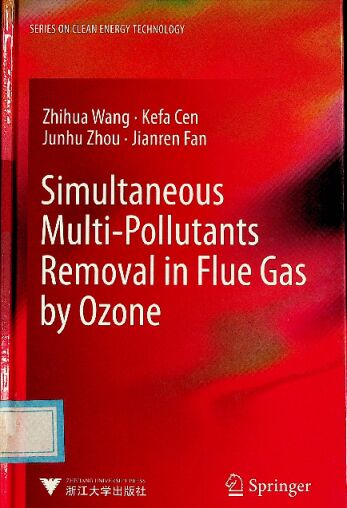
书名:Simultaneous multi-pollutants removal in flue gas by ozone
ISBN\ISSN:9787308132589,9783662435137
出版时间:2014
出版社:浙江大学出版社,Springer,
前言
Despite the rapid development in clean energy technologies, such as hydrogen fuel, wind and solar energy, the majority of the energy consumption in a foreseeable future will still rely on combustion technologies using fossil fuels, waste and biomass. It is well known that pollutant emissions including NOx, SO2, mercury, volatile organic compounds (VOCs), and dioxins from combustion and incineration processes of coal, biomass, municipal solid waste (MSW), and different kinds of waste, are extraordinary harmful to the atmosphere and human health. In China, coal has been traditionally the major primary energy source, and its role is expected to continue growing in the forecasted period. Under these circumstances, pollutant emissions derived from coal combustion have inevitably become prominent.
So far, a variety of possible options already existing to reduce these emissions individually are proposed and carried out, but unfortunately, each pollutant control method individually is turned out to be not only high investment, but also decreases the whole system reliability. Therefore, actively developing research on the coal-fired multi-pollutants removal and exploring an advanced, reliable, and cost-effective multi-pollutants removal technology are remarkably hot issues for Chinese sustainable development in light of the current use of coal as main energy source.
Ozone injection is one of the most promising multi-pollutants simultaneous removal technologies with high efficiency, energy saving, and low cost, because the strongly oxidizing radicals such as 03, 0, OH, and 02* are generated in flue gas after ozone injection. These radicals actively convert NOx into NO2 and transform elemental mercury into its oxidized form (such as HgO and HgC12), both of which are of thoroughly water-soluble. Integrated with the existing WFGD (wet flue gas desulfurization) system and special designed alkali absorption tower, pollutants including NO,, SO2, Hg, VOCs, and dioxin could be removed simultaneously.
By presenting a number of fundamental research findings, significant scientific breakthroughs, and novel advances in the research field of multi-pollutants removal by ozone during the last decades, this book will provide the readers with updated information in the field of air pollution control technology related to the coal-fired power plants. Furthermore, the fundamental research findings, comprised of the detail reaction mechanism between ozone and flue gas components, are obtained not only from chemical kinetics modeling but also from lab-scale experimental investigations. The demonstration case of the multi-pollutants removal by ozone will be attentively employed to conduct, with the help of the detailed reaction mechanism obtained. In short, this book remains at the fore front of research and development in this crucial area related with multi-pollutants removal by ozone injection.
The book is logically divided into the following five chapters.
Chapter I gives an overview of the state-of-art development of coal-fired pollution control technologies. It refers to various control technologies for sulfur dioxide, nitrogen oxides, mercury, VOCs as well as dioxin and flue gas multi-pollutants simultaneous removal technologies.
Chapter 2 presents the removal technology of multi-pollutants in flue gas by ozone oxidation. The physical and chemical properties of ozone are summarized. Ozone generation methods and overviews on the progress of ozone synthesis technologies with discharge plasma are described as well.
Chapter 3 elucidates in detail the chemical kinetics mechanism between 03 and NO„/S02/Hg, which stems from chemical kinetic modeling and lab-scale experimental invetigations. The chemical kinetics model considers 40 typical species in flue gas and refers to 121 elementary reactions in total.
Chapter 4 provides the simultaneous removal mechanism of multi-pollutants with ozone and wet scrubbing, which is obtained from lab-scale experimental work. It is attached extremely importance to the NO2 absorption in a wet scrubber for achieving an optimal NO removal. Accordingly, key operational parameters that can affect the NO2 removal are to take into account and effects of the pH value and initial NO/S02/S(IV) concentration are determined.
In Chapter 5, the work on the ozone multi-pollutants control associated with wet scrubber system has effectively led to the development of an oxidation-absorber system that is undergoing demonstration and commercialization. An economic analysis of the system is involved and highly needed for future commercialization.
This work was financed by the National Natural Science Foundation of China (Nos. 51176169 & 51390491), the key project of the Chinese National Programs for Fundamental Research and Development (No. 2012CB214906) and National Science Foundation for Distinguished Young Scholars (No.50525620).
The authors have benefited enormously from the interaction and contributions of the other members of the group. Essentially, the book covers the experience and findings gained by the other working team in the related research field.
As a final note, we wish to thank all the authors for their participation in making this book possible. And we are especially grateful to the other members of our group. We also want to thank Dr. Zhengcheng Wen, Dr. Xiang Zhang, Dr. MM Kuang, Dr. Yong He, Dr. Shudong Jiang, Dr. Lv Yu, Dr. Xin Hu, Dr. Zhuo You, Dr. Xiaoye Liang, Dr. Pei He, Dr. Yajun Zhou, Miss Daili Li, Mr. Chaoqun Xu for contributions on managing and copy-editing the context of this special issue.
查看更多
目录
1 Development of Pollution Control Technology During Coal Combustion 1
1.1 Introduction 1
1.2 Existing Air Pollution Control Technologies 2
1.2.1 Desulfurization Technology 2
1.2.2 Denitrification Technology 5
1.2.3 Hg Removal Technology 10
1.2.4 VOCs Control Technology 13
1.3 Simultaneous Multi-Pollutants Removal Technology 15
1.3.1 In-Furnace Multi-Pollutants Emission Control Technology 15
1.3.2 Flue Gas Multi-Pollutants Emission Control Technology 17
References 22
2 Principle of Multi-Pollutants Removal Technology in Flue Gas by Ozone 31
2.1 Introduction 31
2.2 Ozone Characteristics 33
2.3 Ozone Generation Methods 34
2.3.1 Electrode Type 36
2.3.2 Feed Gas 38
2.3.3 Dielectric Material 39
2.3.4 Mixed Discharges 40
2.3.5 Pulsed Discharge 41
2.4 Summary 43
References 43
3 Chemical Kinetics and Oxidation Mechanisms Between O3 and NOx/SO2/Hg 49
3.1 Introduction on Kinetics Modelling 49
3.2 Kinetic Modelling Results 54
3.2.1 Kinetic Modelling Between 03 and NO 54
3.2.2 Kinetic Modelling Between 03 and Hg 56
3.3 Oxidation Experimental Results 58
3.3.1 Experimental Setup 58
3.3.2 Oxidation Mechanism Between 03 and NO 60
3.3 3 Oxidation Mechanism Between 03 and SO2 63
3.3 4 Oxidation Mechanism Between 03 and Hg 64
3.3.5 Oxidation Mechanism Between 03 and CO 66
3.4 Competitive Reaction Mechanism Between Different Pollutants 67
3.4.1 Reaction Competition Between NO and SO2 with Ozone 67
3.4.2 Reaction Competition Between NO and Hg0 with Ozone 67
3.5 Summary 69
References 70
4 Simultaneous Multi-Pollutants Removal with Ozone and Wet Scrubber 71
4.1 Introduction 71
4.2 Experimental Section 73
4.3 Effect ofpH Value on NO2 Removal 74
4.4 Effect of Tetravalent-S Components on NO2 Removal 78
4.4.1 Effect of the Sole SO32- 79
4.4.2 Effect ofpH with the Existence of Tetravalent-S Components 80
4.4.3 Effect of the Initial NO2 Concentration 82
4.5 Simultaneous Removal of SO2 and NO2 83
4.5.1 Effect of SO2 on NO2 Removal 83
4.5.2 Effect of NO2 on SO2 Removal 85
4.6 NOr Wet Removal with Excess Ozone Oxidization 86
4.7 Simultaneous Desulfurization and Denitrification Scheme Incorporated with Ozone Oxidization and Dual-Tower Scrubbing 88
4.8 Summary 90
References 91
5 Application and Economic Analysis of the Multi-Pollutants Removal Technology Incorporated with Ozone Oxidization and Alkali Solution Adsorption 95
5.1 Application Scheme of O3 and FGD 95
5.2 Economic Analysis of the Ozone Generation Technology 98
5.3 Economic Analysis of the 03 and FGD System 100
5.4 Summary 104
References 105
Index 107
查看PDF
查看更多
馆藏单位
中科院文献情报中心