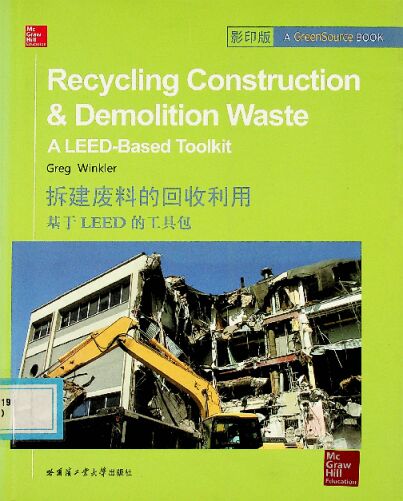
书名:Recycling construction & demolition waste
出版时间:2014
出版社:Harbin Institute of Technology Press,
分类号:环境科学、安全科学
版次:[Reprinted ed.].
前言
In the late 1980s the National Trust for Historic Preservation (U.S.) embraced a concept called embodied energy. Spawned from the oil embargo of the late 70s, this concept was based on the assertion that the accumulated labor, transport, materials manufacturing, and erection of our buildings represented captured energy, and that preserving and reusing existing buildings was among the most effective forms of energy conservation. The concept never gained ground within or outside of preserva-tion circles, principally because the best reasons for preserving buildings—their archi-tectural or historic merit—are far more compelling than that of not wasting energy by demolishing them.
In some ways, the original arguments for recycling construction and demolition waste ran along the same fault lines. Proponents argued, with good cause, that recy-cling C&D waste was the right thing to do for society and the environment. The moral argument was undeniable, but in the early days of C&D recycling few markets existed outside of scrap metal for the materials generated in the demolition of a building. Absent the economic impetus, the social arguments for recycling were simply not enough to compel change in our long-standing "throw-away" culture. Contracting is a competitive business, and until the landfills and incinerators of America became too expensive and politically unpalatable for communities to tolerate, they were the preferred and least costly way of disposing of our nation's large stream of C&D waste. In this sense, the demolition and contracting industries were a reflection of society at large. Thankfully, society and the contracting profession have changed. Recycling is now the preferred, and often required, means of handling waste from construction sites.
This happened because the public became more accepting of purchasing manufac-tured goods with recycled content. Manufacturers recognized this acceptance, as well as the public goodwill that using recycling content in their products generated, and developed more innovative ways to use waste material. It also happened because of a gradual shift in the economics of waste management. Contractors learned how to better manage, sort, and process material on their jobsites to make it more marketable. Recyclers became more sophisticated in separating single-stream materials and in pro-cessing waste to manufacturer's specifications. Manufacturers learned that recycled content yielded economic and marketing benefits, and consumers realized they could buy recycled-content products with confidence. Recycling markets for C&D waste have grown dramatically in the past decade, and continue to expand even in economic hard times.
For that reason the market sections of this book, or any book on recycling waste, are a snapshot in time of a continuously changing landscape.
查看更多
目录
Foreword xiii
Preface xv
Acknowledgments xvii
Chapter 1 Recycling Waste: The Fundamentals 1
The Reasons to Recycle 1
The Waste Management Streams 4
The Economic Case 7
All About LEED and Other Certifications 8
The Choice of Method 10
The Recycling Method 14
Buy Recycled Products 17
Summary 17
References 17
Chapter 2 Recycling Construction & Demolition Waste:The Basic Tools 19
Basic Elements of Construction Waste Management 19
Types of Recycling and Reuse: The Rs 19
The Jobsite Recycling Center 23
Team Management 27
The Importance of Training 29
Transportation of Recycled Materials 31
Hazardous Materials 32
Automated Equipment 35
Summary 36
Reference 37
Chapter 3 Recycling New Construction Waste 39
Waste Assessment 40
Waste Assessment Rules of Thumb 43
Waste Types 46
Residential Construction Waste Management 53
Summary 55
References 56
Chapter 4 Recycling Demolition Waste 57
The Site Audit 57
The Market Audit 65
Demolition Recyclables 65
Hazardous Waste 80
Summary 86
Reference 86
Chapter 5 Reuse of Existing Materials 87
ABC: Asphalt, Brick, and Concrete Recycling 88
Insulation 90
Structural Steel 91
Open-Web Joists and Miscellaneous Steel 92
Wood Framing and Heavy Timber 92
Finishes 93
Architectural Woodwork 94
Glass 94
Plastics and Composites 95 Rubber (Tires) 96
Asphalt Roofing Shingles 96
Gypsum Wallboard 98
Wood 98
Reference 98
Chapter 6 The Recycling Waste Management Plan 99
Create the Plan 99
Define the Goals 100
Define the Waste Products 100
Plan the Work 101 Educate Subcontractors and Suppliers 102
Recycling Zone Management 104
Identify the Markets 109
Calculate the Savings 110
Problem Solving 110
Tips for Effective Management 112
Waste Management Plan Checklist 113
Draft Waste Management Compliance Document 115
Summary 116
Chapter 7 Compliance Connection 119
Waste Management Credits Under LEED 121
Innovation and Design Process Credits 127
Waste Management Policy Compliance 127
References 128
Chapter 8 Other Green Certification and Code Programs 129
International Code Council Evaluation Service (ICC-ES) Sustainable Attributes Verification and Evaluation™ (SAVE™) Program 129 International Code Council (ICC) International Green Construction Code (IGCC) 131
National Association of Homebuilders (NAHB) Green Building Program 131
U.S. Environmental Protection Agency Energy Star Program 133
National Institute of Building Sciences (NIBS) Whole Building Design Guide 133
Green Building Initiative Green Globes® Program 134
Florida Green Home and Green Commercial Buildings Standards 135 GreenPoint Rated New Home Program (California) 136
U.S. State Green Building and Energy-Efficiency Programs 137 International Programs 139
References 140
Chapter 9 Documenting Compliance 141
Contractor-Generated Information 142
Outside Information Management 146
Special Items Documentation 148
Chapter 10 Waste Management in the Construction Documents 151
Specifications 153
Drawing Information 155
Site Plan Information 156
Chapter 11 Marketing Construction Site Recycling 159
Recycling Marketing and Public Relations 159
Marketing to the Public 163
Marketing to Recyclers 166
Recycling of Unusual Materials 168
References 175
Chapter 12 Resources 177
Contaminants in C&D Waste 177
Equipment 179 Salvage Materials Checklist 188
Density Conversion Factors 189
Appendix A Government and Industry Links 199
Web Resources 199
State and Municipal Government Resources 199
General Resources 210
National Recyclers 213
Appendix B Glossary 217
Index 219
查看PDF
查看更多
作者简介
Greg Winkler, AIA, LEED AP, has over 27 years of experience as a practicing archi-tect and owner's representative on commercial, industrial, and institutional projects. A graduate of the Georgia Institute of Technology, Mr. Winkler has participated in construction projects as a design professional, design-builder, and owner's agent. This perspective gives him a pragmatic view of the possibilities—and pitfalls—of construction waste management.PA\Mr. Winkler currently works as the director of a regional construction trade organization. He is the co-author of McGraw-Hill's Construction Administration for Architects, a desktop guide for design professionals during construction.
查看更多
馆藏单位
中科院文献情报中心